.png)
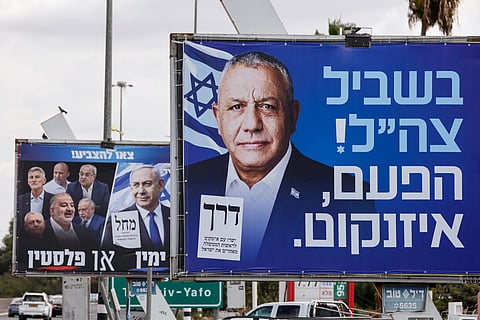
Israel votes in high-stakes election as Netanyahu faces challenge from Eisenkot
Israelis voted in a closely contested parliamentary election on Tuesday, with Prime Minister Benjamin Netanyahu facing one of the most consequential political tests of his career as voters assessed his leadership following three years of war, security crises and deepening domestic divisions. The election, the first since the Hamas-led attacks of October 7, 2023, has emerged as a referendum on Netanyahu's handling of the subsequent conflicts in Gaza, Lebanon and Iran, alongside questions over national security, military conscription, economic pressures and the future of Israel's democratic institutions.
Netanyahu, Israel's longest-serving prime minister, is seeking another term against an opposition led by former military chief Gadi Eisenkot, whose centrist Yashar party has emerged as a major challenger to the ruling Likud. Polling stations opened at 7 am local time and were scheduled to close at 10 pm, with exit polls expected immediately afterwards. Official results will be released in the coming days, although the formation of a new government could take considerably longer.
Voter turnout reaches historic high
The election witnessed unusually strong participation, with Israel's Central Elections Committee reporting that 55.7 per cent of eligible voters had cast their ballots by 4 pm local time. The figure was the highest recorded at that stage of polling and substantially exceeded the 47.5 per cent turnout registered at the same hour during the 2022 election. More than four million Israelis had voted by late afternoon, reflecting the intensity of the political contest and the significance attached to the outcome by supporters of both the government and opposition.
Approximately 7.3 million people were eligible to vote, including around 1.2 million Palestinian citizens of Israel. Polling was conducted across the country and in Israeli settlements in the occupied West Bank, while soldiers were also able to cast ballots at military facilities. Election authorities said polling stations would remain open beyond the scheduled closing time where voters were still waiting in queues.
Netanyahu faces challenge from former army chief
Netanyahu's Likud party and its right-wing and religious allies are seeking to retain control of the 120-member Knesset, where 61 seats are required to form a majority government. The prime minister has campaigned on his government's national security record, highlighting military operations against Hamas, Hezbollah and Iran while arguing that continued leadership is necessary to protect Israel against regional threats.
Eisenkot, a former Israel Defense Forces chief of staff, has positioned himself as an alternative capable of providing experienced security leadership while addressing political divisions and restoring confidence in government institutions. His campaign has focused on accountability for the failures surrounding the October 2023 attacks, military service obligations and changes to the country's political direction. Former prime minister Naftali Bennett, whose B'Yachad party is another significant opposition force, has also emerged as an important figure in the contest. Despite their shared opposition to Netanyahu, the parties challenging him have differing political priorities, making the question of post-election cooperation particularly important.
Opinion polls point to fragmented verdict
Pre-election surveys indicated that neither the ruling alliance nor the principal opposition parties were assured of securing the 61 seats required for a parliamentary majority. A Channel 12 survey published before the election projected 50 seats for Netanyahu's bloc and 56 for the opposition grouping, with Arab parties expected to secure a combined 16 seats. The figures were pre-election estimates rather than results, and different definitions of political blocs can affect such comparisons.
The same survey projected 22 seats for Eisenkot's Yashar party, 19 for Likud and 14 for Bennett's B'Yachad. An average of several Israeli television polls separately placed Netanyahu's bloc at approximately 50 seats and the opposition at 54, illustrating the uncertainty surrounding the final distribution. Israel's proportional representation system requires parties to obtain at least 3.25 per cent of the national vote to enter parliament. Smaller parties falling above or below that threshold could significantly change the balance between competing blocs.
October 7 failures dominate campaign
The political fallout from the October 7, 2023, Hamas-led attacks has remained central to the election. The attacks killed approximately 1,200 people in Israel and triggered a prolonged Israeli military campaign in Gaza, followed by wider hostilities involving Lebanon and Iran. Netanyahu's critics have demanded accountability for the security and intelligence failures that preceded the attacks, while also questioning the government's handling of the hostage crisis and the human and economic costs of subsequent military operations.
The prime minister and his supporters have defended the government's military strategy, arguing that Israel faced extraordinary security threats and that operations against armed groups and regional adversaries were necessary. Calls for an independent state commission of inquiry into the October 7 failures have also featured prominently in the campaign.
Military conscription fuels divisions
Another contentious issue has been the exemption of many ultra-Orthodox Jewish men from compulsory military service. The debate has intensified after years of military operations that placed considerable pressure on Israel's armed forces and reservists. Opposition parties have demanded a more equitable distribution of military obligations, arguing that the existing arrangements place an unfair burden on other sections of society.
Ultra-Orthodox political parties, traditionally important partners in Netanyahu's governing coalitions, have resisted measures that would substantially expand compulsory military service within their communities. The dispute could influence negotiations over the next government, particularly if religious parties hold seats needed to secure a parliamentary majority.
Fraud allegations spark fresh controversy
Election day was also marked by allegations of irregularities, competing accusations between political parties and concerns over the integrity of the voting process. Netanyahu claimed that attempts were being made to influence the election unlawfully, citing the arrest of three suspected activists associated with the Arab Ra'am party on allegations of voter bribery. Israeli police said the suspects had been detained following an investigation and that cash had been recovered during searches. Ra'am rejected the allegations against its activists and criticised the arrests.
Eisenkot's Yashar party accused Netanyahu of undermining confidence in the electoral process through unsubstantiated claims of widespread fraud. Several parties separately reported missing or damaged ballot papers and other suspected irregularities at polling stations. The Central Elections Committee said it had found no evidence of systematic tampering with ballot slips and that individual complaints were being addressed. Likud also requested an extension of voting hours, drawing objections from Eisenkot's party, which warned that the move could create grounds for challenging the outcome.
Knife incident adds to election tensions
Security concerns intensified after a man carrying a knife was arrested near opposition politician Yair Golan during an event in Tel Aviv. Golan's Democrats party alleged that the individual had attempted to attack its leader, while police confirmed that a suspect had approached Golan carrying a knife but disputed the party's description of the incident as an attempted stabbing.
Authorities had deployed approximately 20,000 police officers, Border Police personnel and volunteers across the country to maintain public order and safeguard polling operations.
Arab parties could influence government formation
The role of Arab political parties has emerged as another important factor in the election. Although Netanyahu and Eisenkot have ruled out formal coalition partnerships with Arab-led parties, their parliamentary representation could become relevant if neither major bloc secures a majority. One possibility discussed during the campaign involves Arab parties supporting a minority government from outside the coalition or abstaining during a parliamentary confidence vote.
Such an arrangement would require negotiations among parties with differing positions on national security, Palestinian rights and the future of Israeli-Palestinian relations. The question of Arab political participation has also become contentious during the campaign, particularly as Netanyahu and his allies urged supporters to vote in response to high turnout in Arab communities.
What happens after voting ends?
Israelis vote for political parties rather than directly electing a prime minister. Seats in the 120-member Knesset are distributed through proportional representation. Once the final results are established, President Isaac Herzog will consult parliamentary party leaders and assign the task of forming a government to the candidate considered capable of securing sufficient support.
That candidate can receive up to 42 days to assemble a governing coalition. If negotiations fail, other political leaders may be given an opportunity to form a government. Continued deadlock could eventually lead to another parliamentary election. Israel has experienced repeated political stalemates in recent years, including five national elections between 2019 and 2022.
Regional implications closely watched
The election is being closely followed across West Asia because of its implications for Israel's security policies, relations with neighbouring countries and diplomatic engagement with the United States. The next government will inherit unresolved questions surrounding Gaza, relations with Iran and Lebanon, settlement policies in the occupied West Bank and the future of negotiations concerning the Palestinians.
For Netanyahu, the election represents an opportunity to secure another mandate following years of conflict and political controversy. For Eisenkot and the opposition, it offers a chance to seek a change in leadership and government priorities. However, the immediate outcome will depend not only on the number of seats won by individual parties but also on their willingness to cooperate after the vote.
With polling scheduled to close at 10 pm local time on Tuesday, exit polls will provide the first indication of the parliamentary balance. No confirmed election winner had emerged at the time of this report, and the final composition of Israel's next government could remain uncertain well beyond election night.


