.png)
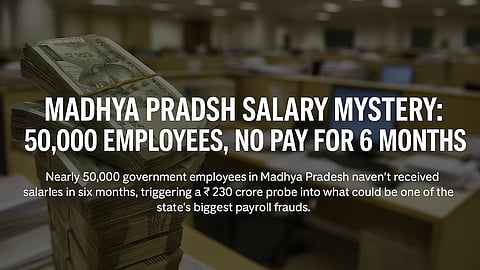
'Ghost employees' or 'massive fraud'? ₹230 crore salary gap in Madhya Pradesh sparks probe

In what may be shaping up to be one of the most significant salary-related anomalies in Madhya Pradesh's administrative history, nearly 50,000 government employees—about nine percent of the state’s workforce—have reportedly gone without salaries for over six months. This issue has now raised serious concerns of possible large-scale financial misconduct or the existence of 'ghost employees' in the system. According to documents reviewed by NDTV, these employees do appear in official records with names and employee codes. Yet, despite their presence in the system, their monthly salaries have not been processed since December 2024. The reasons behind this lapse remain unclear.
Internal Letter Flags Anomaly
The matter came to light following a letter dated May 23 from the Commissioner of Treasury and Accounts (CTA) to all Drawing and Disbursing Officers (DDOs). The letter highlights the discovery of employees registered in the Integrated Financial Management Information System (IFMIS) whose salaries have not been disbursed for months, although no formal exit procedures or verifications have been completed. The letter urges immediate clarification from DDOs and sets a 15-day deadline to explain the irregularity, which may involve funds amounting to Rs 230 crore. “We regularly carry out data analysis, and this irregularity stood out. I want to clarify that there is no indication that salaries are being misappropriated under these employee codes. However, this inquiry aims to eliminate the risk of potential misuse,” Bhaskar Lakshkar, Commissioner of Treasury and Accounts, told.
Statewide Verification Drive Initiated
In response to the findings, the Treasury Department has launched a statewide verification campaign. All DDOs have been instructed to confirm that no unauthorised individuals are currently employed under their offices. While some of the discrepancies could be attributed to genuine cases—such as transfers, long leaves, or suspensions—the fact that such a large number of employees have not received salaries and haven't been officially exited from the system has raised a red flag. A senior finance department official pointed out that while anomalies could have benign explanations, the scale of this issue makes a detailed probe necessary. "If someone hasn’t been paid for half a year and there’s no official record of them leaving, that warrants investigation," the official said.
Political Reactions: Finance Minister Sidesteps Queries
When questioned Madhya Pradesh Finance Minister Jagdish Devda about the non-payment of salaries to such a large section of the workforce, the minister appeared visibly uncomfortable. "Whatever procedure is followed, it is done as per rules," he said vaguely. Pressed further, he reiterated, “Whatever happens, will be as per rules,” before abruptly ending the interaction.
Questions That Demand Answers
Of the 50,000 affected employees, 40,000 are permanent and 10,000 are on temporary contracts. If their dues, totaling an estimated Rs 230 crore, are not accounted for, it raises troubling possibilities—ranging from clerical oversight to systemic fraud.
This situation leads to several pressing questions:
Are these sanctioned posts currently vacant?
How have departments been functioning without nearly one-tenth of their workforce?
If ghost employees are involved, who introduced them into the system?
Can salaries be manipulated retroactively?
The unfolding situation also poses a larger governance concern—how was such a massive discrepancy left undetected for so long?
A Crisis Averted or Just Uncovered?
While the discovery is deeply concerning, officials see a silver lining: the irregularity was detected during routine financial auditing. The Treasury’s alertness in flagging the anomaly may have prevented what could have become a full-blown salary scam. For now, the focus is on tracing the origins of the irregularities and ensuring that such vulnerabilities are addressed. As the 15-day deadline for DDOs ends, the state government will be under pressure to provide clarity and ensure accountability. Whether this is a case of administrative backlog or deliberate manipulation, one thing is certain—the issue has exposed major cracks in Madhya Pradesh’s employee management and payroll system.

