.png)
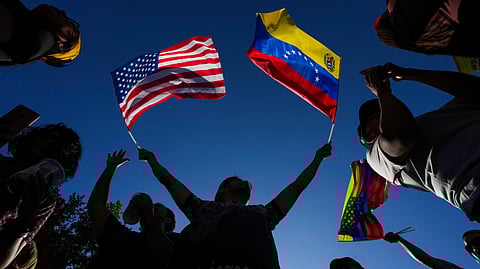
EXPLAINER | Socialism, oil, narco-terrorism: Why US attacked Venezueala?

2026 began with whispers of US hegemony in Latin America. The years of confrontation over power, oil, elections and alleged criminal activity, tensions climaxed into US military action in Venezuela on January 3, 2026, capturing President Nicolas Maduro and his wife, Cilia Flores.
The US military launched a targeted operation in Venezuela (codenamed Operation Absolute Resolve). This marks a significant escalation from years of economic sanctions to direct military intervention.
The Trump administration claimed Maduro was involved in drug trafficking and had rigged the 2024 election. The US had previously imposed sanctions on Venezuela and offered a $50 million bounty for Maduro's arrest.
Have you ever wondered what's really behind the ongoing chaos in Venezuela and why it seems to keep escalating? Is it just about politics, or is there a bigger game involving oil, sanctions, and global power plays?
The US strike on Venezuela has highlighted the country's massive oil reserves, which total over 303 billion barrels, making them the world's largest proven reserves. However, production has dwindled to 1 million barrels per day due to US sanctions and underinvestment.
Venezuela holds the world's largest proven oil reserves (estimated at over 300 billion barrels), which represent roughly 17% of the total global oil supply, OPEC data show.
Venezuela's reserves top those of second-ranked Saudi Arabia at 267 billion barrels and are more than six times the U.S.'s reserves. Most of Venezuela's untapped oil is located in the Orinoco Belt, a roughly 21,000-square-mile area that stretches across the country's northeastern region, according to CBS News.
This vast resource is the central theme of the conflict, though the stated reasons and underlying motivations differ depending on who you ask.
"President Trump does not have the constitutional authority to attack another country. When 60% of Americans are living paycheck to paycheck, he should focus on the crises at home, end his illegal military adventurism and stop trying to 'run' Venezuela for Big Oil," posted US Senator Bernie Sanders on X.
Trump announced the US would "run" Venezuela temporarily, exploiting its oil reserves, and warned other countries in the region to toe the US line.
The US government, under President Trump, justifies the intervention as a security necessity rather than a resource grab. The primary official reasons include: narco-terrorism charges, national security and migration crisis.
The US indicted Nicolas Maduro and other high-ranking officials for allegedly leading a "narco-terrorist" conspiracy to flood the US with cocaine. Washington also claims the Maduro government has become a "criminal enterprise" that destabilizes the Western Hemisphere by harbouring terrorist groups and facilitating human trafficking.
Moreover, the US administration cites the mass exodus of millions of Venezuelans as a "border security" issue for the United States.
Despite the official focus on crime and security, the US has been open about the strategic importance of Venezuela's oil.
The story begins with a long history of strained relations. Venezuela, under leaders like Hugo Chavez and now Nicolas Maduro, has adopted a socialist, nationalist stance, especially after nationalising oil assets and opposing US influence. Chavez's government (1999-2013) championed socialist policies and took control of natural resources, making Venezuela a symbol of anti-imperialist resistance.
But the real tension has escalated over the last 26 years, especially as Venezuela's political landscape has grown turbulent. Maduro's presidency, which started in 2013 after Chavez's death, has faced opposition from within Venezuela and from the US, which accuses Maduro of authoritarianism and corruption.
The opposition has also received backing from Western countries, especially the US, creating a fierce political rivalry.
Since 2005, successive U.S. presidents have imposed a range of sanctions on Venezuela, including its oil sector, for what American officials have said is the country's failure to crack down on drug trafficking and terrorism, along with alleged human rights abuses, reported CBS News.
Under former President Joe Biden, the US also froze the assets of Venezuela's state-owned oil company, Petroleos de Venezuela (PDVSA), in 2019. It barred Americans from doing business with the enterprise.
Most recently, the Trump administration imposed sanctions on four companies and associated oil tankers that it said have ties to Venezuela's oil sector.
The US strike on Venezuela is unlikely to significantly impact global oil prices due to Venezuela's limited crude production, currently around 1 million barrels per day, which is roughly 1% of global supply. Oil prices fell modestly on Saturday, with West Texas Crude dropping to $57.32 a barrel, down from nearly $80 in January.
The US has also increased its Strategic Petroleum Reserve and domestic oil production, providing a cushion against volatility in global oil markets.
The situation's outcome will depend on Venezuela's political developments and the US's next steps. If the US allows American companies to invest in Venezuela's oil industry, it could potentially increase production and impact global oil markets in the long term.
In recent public statements, Trump has explicitly mentioned that Venezuela "took away our oil rights" years ago when foreign assets were nationalised, expressing a goal to restore U.S. corporate control over these reserves.
As U.S. domestic shale production peaks, securing the Orinoco Oil Belt (the world's largest accumulation of heavy crude) provides long-term energy dominance.
The attack is also seen as a move to re-establish US hegemony in Latin America.
Under Maduro, Venezuela formed deep military and economic ties with Russia, China, and Iran. The U.S. views these alliances as a direct threat in its "backyard."
The goal of the capture was to remove Maduro and install a transitional government that is more aligned with U.S. interests and willing to reopen the economy to Western investment.
Venezuela's vast oil reserves, estimated at around 303 billion barrel, make it a treasure trove for global energy politics. Historically, Venezuela was a major oil exporter, with foreign companies like Chevron and ExxonMobil playing significant roles until the government took over assets in the late 1990s and early 2000s.
US companies like Chevron, ConocoPhillips, and Exxon Mobil may re-enter the market if Venezuela offers favourable terms.
The operation was part of Trump's National Security Strategy, aimed at reasserting US influence in the Western Hemisphere and countering the Chinese and Russian presence in the region.
Russia and China are also key players in this geopolitical chess game. Russia, for example, has warned the US about any military escalation, emphasising that Venezuela's sovereignty must be respected. Meanwhile, China's economic influence in South America continues to grow, and Venezuela's close ties with these powers complicate US efforts to isolate Maduro.
The international community reacted with mixed reactions, with some countries condemning the US action as a violation of sovereignty and international law, while others supported it. The situation in Venezuela remains uncertain, with Maduro's vice president, Delcy Rodriguez, claiming the presidency and vowing to resist US control. (ANI)

