.png)
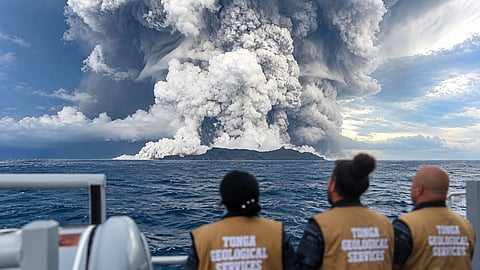
Explainer: How underwater ‘booms’ could warn of deadly volcanic tsunamis

When an earthquake beneath the ocean threatens a tsunami, networks of seismometers can detect the shaking and help authorities assess the danger. But when the trigger is a submarine volcano, the warning system faces a much harder problem.
The devastating 2022 eruption of the Hunga volcano in Tonga demonstrated why. New research into the disaster suggests that scientists may have another way to detect such events — by listening for the enormous underwater “booms” generated when a volcano collapses.
These hydro-acoustic signals can travel thousands of kilometres through the ocean. More importantly, they travel far faster than a tsunami itself. If they can be automatically identified and located, scientists believe they could provide precious warning time before destructive waves reach coastlines.
Why are volcanic tsunamis difficult to predict?
Most tsunami-warning infrastructure has been developed with earthquakes in mind. When a large undersea earthquake occurs, seismic networks can quickly establish its location, depth and magnitude. Ocean buoys and tide gauges can then help determine whether a tsunami has actually been generated. Volcanoes are more complicated. A volcanic tsunami can be produced by several processes — an explosion, a landslide, the collapse of part of a volcano or the sudden failure of its caldera.
And one eruption can produce more than one tsunami. That is precisely what happened at Hunga in January 2022. Its initial explosions generated waves that began reaching nearby Tongatapu within minutes, with run-ups of around one to four metres. More than an hour later, however, a second and far more destructive tsunami arrived. Waves reached run-ups of 18 to 40 metres on islands within 100 km of the volcano. Researchers have now concluded that this tsunami was generated when Hunga’s caldera suddenly collapsed.
Why did seismometers struggle to detect it?
The collapse was enormous. The centre of Hunga fell in on itself, ultimately leaving a caldera around four kilometres across and more than 850 metres deep. Yet conventional seismic instruments detected the event only weakly.
One reason was geography. The closest seismometer was in Fiji, roughly 750 km from Hunga. Signals from processes occurring at an isolated submarine volcano do not necessarily travel efficiently through the solid Earth to distant instruments. But while Hunga was relatively quiet to distant seismic sensors, it was extraordinarily loud underwater.
What exactly are these underwater ‘booms’?
Violent underwater events produce acoustic energy that travels through seawater. Scientists call the resulting hydro-acoustic signals tertiary waves, or T-waves. Water is exceptionally effective at carrying sound over long distances. An isolated submarine volcano can therefore behave somewhat like a giant bell: explosions, landslides and collapses send acoustic signals radiating through the surrounding ocean. Researchers examined records from 14 seismic stations around the southwest Pacific, including some as far as 2,600 km from Hunga.
They could identify underwater landslides during the eruption’s first hour. Then, at about 6.28 pm Tonga time, an exceptionally powerful acoustic signal appeared. It was the sound of the caldera collapsing. The T-wave was detected at all 14 stations, including those more than 2,000 km away. Its strongest component lasted about five minutes, providing scientists with an indication of how rapidly the main collapse occurred.
How do we know the ‘boom’ preceded the tsunami?
Scientists needed to establish whether the collapse detected acoustically actually corresponded with the arrival of the catastrophic wave. An unlikely piece of infrastructure provided the answer. A telecommunications tower at Kanokupolu on western Tongatapu stood about 180 metres inland and 13 metres above sea level. It survived the earlier waves but was destroyed by the larger tsunami.
Researchers examined telecommunications traffic through the tower and established the exact moment it stopped functioning: 6:45:24 pm. That was roughly 17 minutes after the acoustic evidence showed Hunga’s caldera beginning to collapse at about 6.28 pm. The timing was consistent with a tsunami travelling approximately 60 km from Hunga to western Tongatapu.
It provided a crucial link between the underwater sound and the destructive wave that followed.
Could the sound become an early-warning system?
Potentially — and the difference in speed is what makes the idea particularly promising. Sound travels through seawater at approximately 1.5 km per second. A tsunami travels considerably slower, with its speed depending largely on ocean depth. In the Hunga case, the researchers estimate the acoustic signal travelled more than seven times faster than the tsunami.
That creates a potentially valuable window. A monitoring network that automatically detects an unusually powerful T-wave could determine where the signal originated and assess whether it corresponds to a major submarine volcanic event. Authorities could then combine that information with other observations and issue tsunami warnings where appropriate. For communities farther from the volcano, the difference between acoustic and tsunami travel times could translate into additional minutes — or potentially much longer — to evacuate.
Can every underwater boom signal a tsunami?
No. This is the major challenge before such a system could become operational. Oceans are acoustically busy environments. Earthquakes, volcanic eruptions, submarine landslides and other processes can all generate hydro-acoustic signals. A warning network would therefore need to distinguish a potentially tsunami-generating caldera collapse from other underwater events quickly and reliably.
It would also have to locate the source, estimate its scale and determine whether enough water had been displaced to pose a tsunami threat. That means hydro-acoustic monitoring is unlikely to replace existing tsunami-warning systems. Instead, it could add another layer of detection, particularly around poorly monitored submarine volcanoes.
Why could this matter beyond Tonga?
Hundreds of submarine volcanoes lie around the Pacific “Ring of Fire”, and many are difficult to monitor continuously. Satellites can detect volcanic heat, gases and eruption plumes when conditions allow. Seismometers can identify many earthquakes and volcanic processes. Ocean gauges can detect changes in sea level.
But Hunga exposed a dangerous blind spot: an enormous underwater collapse capable of generating a devastating tsunami may leave only a weak signature on conventional seismic networks. Its sound, however, can travel across an ocean. The lesson from Hunga is therefore deceptively simple. For the next dangerous submarine eruption, scientists may need not only to watch the volcano and feel the Earth — but listen to the sea.