.png)
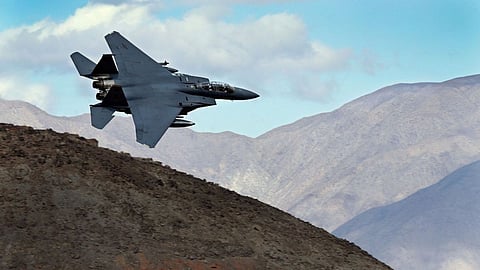
EXPLAINER | How Iran downed two US fighter jets

Iran shooting down two American military aircraft marks an exceedingly rare assault for the US that has not happened in more than 20 years and shows the Islamic Republic's continued ability to hit back despite President Donald Trump asserting it has been "completely decimated".
The attacks came five weeks after US and Israeli strikes first pounded Iran, with Trump saying earlier this week that Tehran's "ability to launch missiles and drones is dramatically curtailed". Iran shot down a US F15-E Strike Eagle fighter jet Friday, with one service member getting rescued and the search still underway for a second, US officials say. Iranian state media also said a US A-10 Warthog attack aircraft crashed in the Persian Gulf region after being hit by Iranian defense forces. After more than a month of punishing US-Israeli airstrikes, a degraded Iranian military nonetheless remains a stubborn foe.
How Iran Targeted US Jets
Footage released by Iran's Islamic Revolutionary Guard Corps (IRGC) showing US fighter jets being hit by surface to air missiles appears to have been captured by optical and infrared (IR) sensors rather than traditional radar-based tracking.
The images released by Iranian state media display high-contrast thermal images which are typical of an Electro-Optical/Infrared (EO/IR) tracking system.
With the bulk of its radar-guided surface to air missile systems likely destroyed by precision US and Israeli airstrikes, Iran appears to be relying heavily on passive sensors from surface to air missile systems which detect the heat signature from the aircraft's engines and airframe friction.
An infrared system locks onto an aircraft by detecting heat radiated from jet engines by using a cooled thermal seeker, with no radar involved. The operator aims the launcher until the seeker scans and acquires the strongest heat signature against the cooler sky background. Once locked, the system tracks the moving heat source to guide the missile accurately. Iran's indigenous Majid surface-to-air missile system may have been involved in some of the attacks.
The Majid (AD-08) is Iran's indigenous short-range, low-altitude surface-to-air missile system, developed by its Defense Industries Organisation and unveiled in April 2021. Mounted on mobile Aras-2 4×4 tactical vehicles, it provides point defense against low-flying aircraft, helicopters, cruise missiles, and drones. The system uses passive imaging infrared homing and electro-optical tracking to detect targets up to 15 km without radar emissions, ensuring stealth and survivability. Each 75 kg AD-08 missile engages threats from 700 m to 8 km in range and up to 6 km in altitude at Mach 2 speeds. The system is believed to have the ability to simultaneously track and strike four targets, strengthening Iran's layered air defense network.
Tracking fighter jets like the F-15E or A-10 with infrared/electro-optical (IR/EO) sensors is exceptionally difficult due to the aircraft's high speed, extreme maneuverability, and advanced countermeasures. IR seekers must lock onto engine heat plumes or friction around the airframe. Modern fighters, however, incorporate signature reduction-cooled nozzles, low-observability coatings, and high-altitude flight profiles-that greatly reduce the detectable thermal footprint.
Electro-optical cameras are often not reliable with range, weather, hazy conditions, and the tiny angular size of a fast-moving target. Flares and decoys launched by fighters are designed to overwhelm seeker heads of missiles, while the jet's rapid angular velocity often breaks lock before a missile can make the intercept.
Iran's recent claims of success against these platforms likely required close-range, low-altitude engagements that exploit fleeting windows when countermeasures are expended or pilots are distracted.Even then, success remains rare and highly situational.
The recent shootdown of a USAF F-15E Strike Eagle over central Iran on April 3 with one crew member rescued and the other still missing, directly challenges claims of unchallenged US-Israeli control of Iranian airspace.
Iranian air defenses were able to engage and down advanced fighters deep inside hostile territory despite weeks of coalition Search and Destroy strike missions.
Key Iranian shootdowns/claims against Israeli or USAF drones and aircraft:
Early March 2026: Multiple Israeli drones (Hermes 900, IAI Eitan) downed over Isfahan and other provinces.
13 March 2026: US MQ-9 Reaper drone shot down near Bandar Abbas
28 March 2026: US MQ-9 Reaper over Shiraz and separate Israeli IAI Heron east of Hormuz
31 March 2026: Two US MQ-9 Reapers over Isfahan
2 April 2026: US MQ-9 Reaper over Shiraz area; further Israeli Hermes 900 claims
3 April 2026: USAF F-15E Strike Eagle downed over central Iran
3 April 2026: USAF A-10 Warthog crashes in Persian Gulf after being hit
US Central Command said in a statement Wednesday that American forces have flown more than 13,000 missions in the Iran war while striking more than 12,300 targets.

