.png)
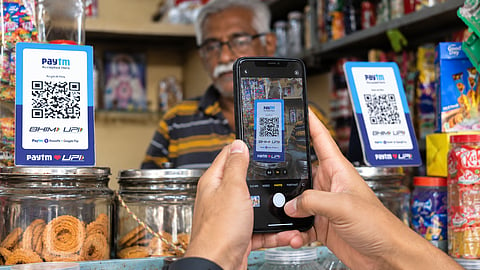
Explainer: ₹5 UPI charge introduced for select payments above ₹2,000; 'free for consumers'
For millions of Indians accustomed to scanning a QR code without thinking about transaction costs, the government’s latest change to the UPI framework has created an obvious concern: will paying more than ₹2,000 now cost extra? The short answer for consumers is no, at least not directly. The government has protected UPI transactions up to ₹2,000 from direct or indirect charges and has maintained that ordinary users will not be charged for making UPI payments. What has changed is the legal framework governing larger merchant payments, potentially allowing a Merchant Discount Rate (MDR) to return for certain transactions above ₹2,000.
The distinction between a consumer charge and a merchant charge is crucial. MDR is not normally a fee deducted from the customer’s bank account. It is the cost paid by a merchant for accepting a digital payment, with the amount distributed among participants in the payments ecosystem, including banks and payment service providers. Until now, India’s zero-MDR regime has made bank-account-based UPI unusual among major digital payment systems because merchants generally do not pay a percentage of the transaction merely for accepting UPI. The latest changes create room for that model to be modified for higher-value merchant transactions.
Will your UPI payment cost more?
If a person transfers ₹3,000 to a friend, relative or another individual through UPI, the transaction is not the kind of merchant payment at the centre of the new framework. Person-to-person transfers remain free. Similarly, the ₹2,000 figure should not be interpreted as a new free-payment ceiling after which money will automatically be deducted from a consumer.
The important category is person-to-merchant, or P2M, payments. If someone buys a product worth ₹5,000 from a business and pays through UPI, that transaction could fall within the category on which MDR may be imposed. Reports have indicated that an MDR of around 0.4 per cent is being considered for qualifying merchant transactions, although the government’s notification itself does not prescribe such a rate. At 0.4 per cent, a ₹5,000 purchase would generate a ₹20 merchant fee, while ₹10,000 would generate ₹40. A ₹5 charge would correspond to a ₹1,250 fee base at that rate, so claims that every payment above ₹2,000 automatically attracts ₹5 are misleading.
What exactly has changed?
The government has amended the framework under the Payment and Settlement Systems Act, 2007, after years during which the zero-MDR regime effectively prevented charges on specified UPI and RuPay debit-card transactions. Under the latest arrangement, transactions up to ₹2,000 remain explicitly protected from direct or indirect charges, while the framework leaves room for charges to be introduced on certain transactions above that level.
That does not mean every transaction of ₹2,001 or more has suddenly become chargeable. The precise architecture matters — including whether the payment is P2P or P2M, the category and size of the merchant and the final MDR structure prescribed by the authorities. Reports suggest the focus is on larger merchants rather than small neighbourhood sellers, but the detailed implementation will determine how widely the charge applies.
Why introduce MDR now?
The debate is fundamentally about who should pay for operating UPI. The network may appear free to users, but processing billions of transactions requires banks, payment companies and other participants to spend on servers, cybersecurity, fraud prevention, customer support, settlement infrastructure and technology upgrades. The government has supported the ecosystem through incentives, but payment companies and banks have repeatedly argued that a completely zero-MDR system becomes increasingly difficult to sustain as transaction volumes and infrastructure requirements grow.
RBI Governor Sanjay Malhotra has also highlighted this underlying reality, arguing that payment infrastructure carries a cost that ultimately has to be borne by someone. Reintroducing a limited MDR would create a direct revenue stream for the institutions operating the payment ecosystem without imposing a visible transaction fee on individual UPI users.
Could consumers still pay indirectly?
This is where the issue becomes more complicated. Even when MDR is formally charged to the merchant, businesses could attempt to recover the additional expense through product prices or other charges. A large retailer processing enormous volumes of high-value UPI transactions could face a meaningful additional annual cost even if the MDR percentage appears small.
Whether businesses are permitted to explicitly add a separate UPI surcharge would depend on the final rules and contractual arrangements. But businesses can also absorb costs into their broader pricing structures, making the ultimate economic burden harder to identify. This is why the difference between “UPI remains free for consumers” and “UPI has no cost for consumers” can become significant.
What about the old 1.1% UPI fee?
The latest debate should also not be confused with the interchange fee introduced earlier for certain UPI transactions involving Prepaid Payment Instruments (PPIs), such as wallets. Since 2023, qualifying wallet-funded merchant transactions above ₹2,000 have been subject to an interchange fee of up to 1.1 per cent depending on the merchant category. That arrangement did not mean ordinary bank-account-to-bank-account UPI transactions were charged.
The present change is broader because it reopens the question of MDR on regular merchant UPI payments after years of the zero-MDR model.
What users need to know
For an ordinary UPI user, there is no reason to stop making payments above ₹2,000 or to split a ₹5,000 purchase into smaller transactions simply to avoid an automatically imposed consumer fee. There is currently no government-announced charge that will be deducted from a customer merely because a UPI payment crosses ₹2,000.
The bigger change is taking place behind the QR code. India is beginning to reconsider how the enormous cost of running its UPI infrastructure should be distributed among the government, banks, payment platforms and merchants. The ₹2,000 threshold therefore marks less of a new charge on consumers and more of a potential turning point in the economics of India’s digital payments revolution.


