.png)
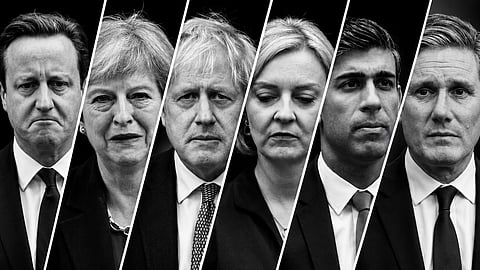
Britain’s Revolving Door | 7 Prime Ministers in the last 10 years

Britain is preparing for yet another change at the top. With Keir Starmer's resignation, the country is set to welcome its seventh prime minister in just over a decade, a level of political churn rarely seen in modern British history. The development is significant not merely because of the frequency of leadership changes, but because it reveals a deeper crisis of confidence in Britain's political and economic institutions. Successive leaders have come and gone, yet many of the issues that drove voter dissatisfaction—weak economic growth, pressure on public services, immigration concerns and the unresolved consequences of Brexit—remain largely unaddressed.
The numbers are striking. Since the Brexit referendum in 2016, Britain has seen David Cameron, Theresa May, Boris Johnson, Liz Truss, Rishi Sunak and Keir Starmer all occupy 10 Downing Street. While each leader fell for different reasons, a common pattern emerges. Cameron resigned after losing the Brexit referendum. May was brought down by her inability to secure parliamentary support for her Brexit deal. Johnson was forced out by a series of scandals and ministerial resignations. Truss lasted just 49 days after financial markets reacted negatively to her mini-budget. Sunak suffered a crushing electoral defeat, while Starmer's downfall stemmed from collapsing approval ratings and growing rebellion within Labour ranks. The result is a political system that increasingly appears incapable of producing durable leadership.
One reason for this instability lies in Britain's parliamentary structure itself. Unlike presidential systems, British prime ministers are not directly elected by voters. They serve only as long as they retain the confidence of their party and Parliament. Once MPs conclude that a leader has become an electoral liability, removal can happen swiftly without a general election. While this mechanism allows parties to replace ineffective leaders quickly, it also creates incentives for constant internal manoeuvring. Leadership speculation often begins the moment opinion polls deteriorate. In an era of 24-hour media scrutiny and instant public feedback, political patience has become increasingly scarce.
Yet the deeper problem is not political procedure but economic performance. Britain's economy has struggled to generate sustained growth since the global financial crisis and particularly since Brexit. Although inflation has fallen from the peaks recorded during the cost-of-living crisis, households continue to feel squeezed because prices remain significantly higher than they were a few years ago. Economic growth has remained modest compared with several major economies. During the January-March 2026 quarter, Britain's economy expanded by only 0.6 per cent, lagging behind countries such as India, China, Japan and the United States. Productivity growth remains weak, business investment has underperformed historical trends and public debt remains elevated. The consequence is that governments have increasingly found themselves managing scarcity rather than prosperity.
The National Health Service has become a visible symbol of this challenge. Long waiting lists, staff shortages and funding pressures have eroded public confidence. Similar strains are visible across local government, policing and transportation. Voters may not always agree on solutions, but they increasingly share the perception that public services are delivering less despite higher levels of taxation and public spending. Governments that promise transformation often discover that fiscal constraints leave little room for dramatic change, creating a cycle of rising expectations followed by inevitable disappointment.
Brexit continues to cast a long shadow over British politics. While the United Kingdom formally left the European Union years ago, the political and economic consequences remain unresolved. Supporters of Brexit promised stronger border controls, faster growth and greater national sovereignty. Critics warned of trade barriers, labour shortages and reduced investment. The reality has been mixed, but Brexit has unquestionably reshaped the country's political landscape. It deepened divisions within both major parties, intensified debates over national identity and immigration, and transformed electoral competition across the country. Successive governments have struggled to reconcile the promises of Brexit with the realities of governing a modern economy closely linked to European markets.
Immigration remains particularly contentious. For many voters who supported Brexit, controlling migration was a central objective. Yet net migration reached record levels in several years following departure from the European Union. Economic realities partly explain the trend. Universities rely heavily on international students. Businesses facing labour shortages have demanded foreign workers. Healthcare and social care sectors depend on overseas recruitment. The result is a gap between political promises and economic necessity. That disconnect has created fertile ground for challenger parties such as Reform UK, which have successfully tapped into public frustration with the political establishment.
Keir Starmer's rise and fall illustrates many of these broader dynamics. Labour's victory in 2024 appeared decisive, ending fourteen years of Conservative rule. The party secured 411 seats in the House of Commons and gained a commanding parliamentary majority. Yet beneath the headline numbers lay a more complicated reality. Labour won just 33.7 per cent of the national vote, meaning roughly two-thirds of voters supported other parties. Britain's First-Past-the-Post electoral system converted that vote share into an overwhelming majority of seats, creating an impression of political dominance that was not necessarily matched by public enthusiasm.
That distinction matters because large parliamentary majorities can sometimes conceal fragile political foundations. Once economic conditions fail to improve or campaign promises remain unmet, support can erode rapidly. Starmer's government encountered precisely this problem. Expectations were high after years of Conservative turmoil, but the pace of improvement in living standards proved slower than many voters anticipated. Policy reversals, internal disagreements and declining approval ratings gradually weakened his authority. Reports that more than one hundred Labour MPs wanted a timetable for his departure reflected growing anxiety about the party's electoral prospects.
The challenge facing Starmer's successor will therefore be formidable. The next prime minister will inherit a country experiencing low growth, persistent pressure on public services, unresolved debates over immigration and lingering divisions created by Brexit. More importantly, they will inherit an electorate that has become increasingly impatient with promises and increasingly sceptical of political leadership. Britain does not suffer from a shortage of politicians. It suffers from a shortage of convincing solutions to long-term structural problems.
The revolving door at Downing Street is ultimately a symptom rather than the disease itself. Frequent changes of leadership reflect deeper frustrations within British society about economic stagnation, institutional performance and political representation. Until governments can deliver measurable improvements in growth, public services and living standards, prime ministers may continue to come and go with remarkable speed. The real test for Britain's next leader will not be winning office. It will be proving that the country's political system can still produce lasting results.

