.png)
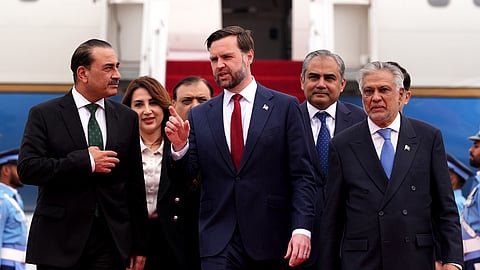
Behind Islamabad Talks | Why is JD Vance chosen to negotiate with Iran

A US delegation led by Vice President JD Vance has arrived in Pakistan to hold talks with Iran and try to end the war that started six weeks ago. The decision to send JD Vance to Pakistan for weekend talks with Iran amid a fragile ceasefire, along with senior US envoys, marks a turning point in Trump’s attempt to resolve his confrontation with Iran. The move reflects a recognition in Washington that technical diplomacy alone is no longer enough. It is now about who can be trusted to carry the weight of ending the war. And Vance is the only man among Trump's close aides whom Iran trusts.
The US delegation to Pakistan now combines three distinct profiles: Vance, the vice president; special envoy Steve Witkoff, a real estate billionaire and old buddy of Trump; Trump's son-in-law and presidential adviser Jared Kushner. This structure is not accidental. It is designed to project both executive authority and negotiating flexibility at a moment when the ceasefire framework remains unstable and contested across multiple fronts. Unlike Witkoff and Kushner, Vance carries constitutional authority and political weight that indicates continuity at the highest level of the US system. But more importantly, he carries a different kind of perception in Iran.
Why Iran views JD Vance differently
As per a recent report from CNN, Iranian officials have shown a preference for dealing with Vance rather than Witkoff or Kushner due to what they describe as a deficit of trust in previous negotiation channels. "Iranian representatives have let the Trump administration know it does not want to re-enter negotiations with Witkoff and Kushner and would prefer to engage with Vance, two regional sources said," CNN reported.
This distrust is rooted in Iran’s interpretation of earlier diplomatic breakdowns. Iranian officials believe that negotiations involving Witkoff and Kushner were overtaken by military escalation, including strikes that coincided with diplomatic engagement. From their perspective, this created the impression that talks were used tactically rather than as genuine attempts at resolution.
Probably, Iranian interlocutors view Vance as comparatively more inclined toward ending the conflict and less embedded in the pre-war negotiation structure that later collapsed. That separation matters in a system where perceived continuity of personnel is often interpreted as continuity of intent. Vance’s earlier skepticism of military escalation, even if later aligned with Trump's policy, has created a symbolic distinction. He is seen less as an architect of the war and more as a potential broker for its conclusion, even while operating within the same administration.
As per a recent NYT report, Vance emerged as the most consistent internal critic. His warnings extended from battlefield risks to political fallout and long-term strategic consequences. “Mr. Vance warned Mr. Trump that a war against Iran could cause regional chaos and untold numbers of casualties… It could also break apart Mr. Trump’s political coalition and would be seen as a betrayal by many voters,” NYT reported. Vance also stressed the unpredictability of escalation: “The vice president told associates that no amount of military insight could truly gauge what Iran would do in retaliation when survival of the regime was at stake. A war could easily go in unpredictable directions.”
However, despite the range of concerns, Vacne's resistance never turned into opposition. In the decisive moment, he yielded: “You know I think this is a bad idea… but if you want to do it, I’ll support you,” he told Trump as per the NYT report.
Why Iran doesn't trust Witkoff and Kushner
The distrust toward Witkoff and Kushner is tied to how Iran interprets the collapse of prior diplomatic efforts. As per many reports, Iranian officials feel that earlier negotiations involving Witkoff and Kushner gave the impression of progress while military preparations were simultaneously underway. This created a belief in Iran that diplomacy may have been used to manage time and expectations rather than prevent escalation. As per an Al Jazeera report, there is a deeper strategic concern in Iran. Engagement with these figures has repeatedly coincided with breakdowns in trust. Iranian officials reportedly believe that the eventual outcome, the attack on Iran, undermined confidence in the entire negotiation channel.
Javad Heiran-Nia, director of the Persian Gulf Studies Group in Tehran, told Al Jazeera that Iran had initially viewed Witkoff as a moderate within Trump’s inner circle and accepted his role on that basis. When Kushner joined the talks before the February round, Tehran saw it as a signal of seriousness, given his proximity to Trump. “Iran’s assessment was that the US was serious about the negotiations,” Heiran-Nia said. But the US decision to join Israel in launching the war even while talks were on flipped that assessment. “There is a feeling among Iranian officials that the pre-war negotiations were essentially aimed at buying time to complete military positioning,” he said. From Iran’s point of view, this produces a deficit of trust where the issue is not simply disagreement over terms but skepticism about whether negotiations conducted through these figures can remain insulated from military decision-making. That is why, as CNN reported, Iran conveyed a preference to shift primary engagement away from Witkoff and Kushner and toward Vance, even while still accepting a multi-party format that did not exclude Witkoff or Kushner.
Why Vance’s role carries disproportionate weight
The inclusion of Vance changes the structure of the negotiations in several important ways. It introduces a figure seen in Iran as less directly implicated in the origins of the war, which improves minimum trust thresholds required for engagement. It also indicates that the talks are not confined to technocratic diplomacy but have direct backing from the US executive leadership. It allows the US to manage internal contradictions, balancing experienced negotiators like Witkoff and Kushner with a political actor who can absorb both diplomatic risk and domestic accountability. But this also places disproportionate weight on Vance. If Iran’s tentative trust in him weakens, or if his role is overshadowed by perceived continuity with earlier policy failures, the fragile opening could close quickly.
Even before the talks begin, Vance has had an uneasy exchange with Iranian Foreign Minister Abbas Araghchi which shows that his job on the talks table will be tough. Vance warned that Iran would be “dumb” to risk the ceasefire framework over disputes involving Lebanon, framing the issue of Israeli strikes on Lebanon as unrelated to the core agreement and cautioning against derailment of negotiations.
Araghchi responded in kind, accusing the US of enabling conditions that could collapse diplomacy if Israeli strikes continued. He argued that it would be “dumb” for the US to allow regional escalation to undermine negotiations, directly mirroring Vance’s language and escalating the rhetorical confrontation.
What makes Vance's job even more difficult before it even begins is Iran's hardening of stance on Lebanon. Iran’s state broadcaster Press TV, citing Tasnim News Agency, dismissed claims and a Wall Street Journal report alleging that senior Iranian officials had travelled to Islamabad for talks with Washington. According to Tasnim, citing a senior official, any dialogue will remain on hold until Israeli attacks in Lebanon stop and the US fulfills its commitment to a ceasefire in the country. The source told Tasnim: “The news from some media outlets that an Iranian negotiating team has arrived in Islamabad, Pakistan, to negotiate with the Americans is completely false.” Press TV also reported that Iran’s Fars News Agency categorically stated that Iran has “no plans to attend peace talks with the American side until a ceasefire is established in Lebanon.”

