.png)
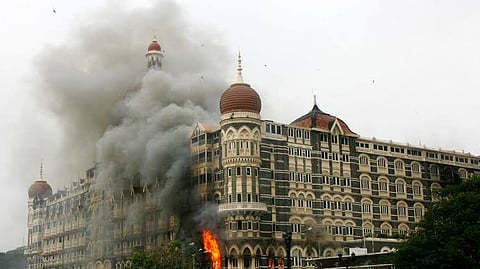
18 years after 26/11, key conspirators remain beyond India's reach in Pakistan
Eighteen years after the Mumbai terror attacks, several alleged masterminds and facilitators of the November 26, 2008, assault continue to evade accountability, with Indian intelligence agencies maintaining that key Lashkar-e-Taiba (LeT) operatives and their associates remain active in Pakistan under the protection of the state.
Among those accused are LeT chief Hafiz Saeed, the outfit's operations chief Zaki-ur-Rehman Lakhvi and four other prominent figures allegedly involved in planning and overseeing the attacks. Indian agencies say the six have escaped meaningful punishment for their roles in the conspiracy and continue to operate their terror networks.
The attacks, carried out by 10 heavily armed Pakistani terrorists who entered Mumbai through the Arabian Sea, killed 166 people, including six Americans and other foreign nationals, and left the city under siege for more than 60 hours.
India's pursuit of the absconding accused
The wider conspiracy involved 10 accused, seven of whom were based in Pakistan during the planning and execution of the attacks. Indian investigators have repeatedly sought evidence and cooperation from Islamabad to bring those allegedly involved to justice.
An Indian intelligence officer said letters rogatory, or formal judicial requests for information and evidence, had been sent to the Pakistani government. However, there had been no cooperation so far.
India has also submitted an extradition request for Saeed, which remains pending.
In a fresh development, a special court in Mumbai issued proclamation orders in July 2026 against six absconding accused, including Saeed and Lakhvi, to facilitate proceedings against them in absentia.
The other four named in the orders are Sajid Mir, Abu Alqama, Asim alias Abu Qahafa and Major Abdur Rehman Pasha. The prosecution has approached the Ministry of Home Affairs to serve the orders through Interpol, but the process has yet to make significant progress.
Special Public Prosecutor Ujjwal Nikam has said the prosecution would continue to pursue those accused of facilitating the attacks and ensure they are brought to justice in India.
Saeed, Lakhvi and the alleged Pakistani network
According to Indian intelligence agencies, Saeed, Lakhvi and four other key figures on Pakistani soil played crucial roles in the conspiracy.
Sajid Majeed, also known as Sajid Mir, was identified as a senior LeT commander who allegedly oversaw the attack. Abdur Rehman Hashim Syed, alias Pasha, was a retired major in the Pakistani military.
Major Iqbal and Major Sameer Ali, both officers of Pakistan's Inter-Services Intelligence (ISI), were also named among the alleged conspirators.
Indian officials maintain that these individuals have not faced significant legal consequences for the attacks and that the Pakistani state has shielded them.
Saeed was sentenced to a cumulative 78 years in prison in Pakistan in 2020, reportedly following pressure from the United States. Indian officials, however, have alleged that he remains under ISI protection and continues to carry out activities linked to his organisation.
Mir was reportedly arrested and sentenced to eight years in prison, although his current whereabouts remain unclear.
Lakhvi was sentenced in 2021 to three consecutive five-year terms in terror-financing cases. Indian agencies have maintained that he continues to operate freely.
No action has reportedly been taken against the two serving ISI officers, Major Iqbal and Major Sameer Ali, or the retired military officer, Pasha, in connection with the 26/11 conspiracy.
The wider group involved in training and preparing the attackers
Apart from the six prominent figures, several other LeT operatives are believed to have played roles in preparing the 10 terrorists, from weapons training and operational briefings to religious instruction.
Abu Qahafa, identified as a senior LeT trainer, was reportedly responsible for the physical and technical training of the attackers. He was described as an expert in handling arms and explosives.
Abu Alqama was identified as a senior LeT commander who oversaw the outfit's Kashmir operations until 2008. He allegedly participated in the training and briefing of the 10 terrorists.
Muzammil was described as a close associate of Lakhvi, while Abu Anas allegedly managed an LeT safehouse in Rawalpindi.
Abu Hamza was also named among the operatives who played a role at different stages of the preparation and execution of the attacks.
Two accused accessed by Indian investigators
Indian agencies have gained access to only two of the 10 conspirators identified in the wider case: US national David Coleman Headley and Pakistani-Canadian physician Tahawwur Hussain Rana.
The National Investigation Agency (NIA) questioned Headley in 2011. However, the United States declined to hand him over to India.
Rana, Headley's childhood friend, was extradited from the US to India in April 2025 and is currently lodged in Delhi's Tihar jail.
The NIA filed a fresh charge sheet in the 26/11 case in July 2025, following Rana's interrogation.
According to the agency's court documents, Rana was part of the conspiracy from 2006 onwards and visited India between November 13 and 21, 2008.
Investigators said he was in Dubai shortly before the attacks, where he met Pasha, before travelling to China. From China, Rana returned to the US on November 26, 2008, the first day of the attacks.
Two other alleged plotters have died
Two other individuals linked to the wider conspiracy are no longer alive.
Abdul Rehman Makki, LeT's former deputy chief and Saeed's brother-in-law, died in Lahore in December 2024.
Ilyas Kashmiri, an al-Qaeda leader and head of the Pakistan-based Harkat-ul Jihad Islami, reportedly died in a US drone strike in June 2011.
Despite the deaths of some alleged plotters and the extradition of Rana, the prosecution of several Pakistan-based accused remains a major challenge for Indian investigators.
The continued delay in serving legal orders and the absence of cooperation from Pakistan have left many of the alleged masterminds and facilitators of the 26/11 attacks beyond India's immediate reach, nearly two decades after the deadly assault.


