.png)
Ethanol at the pump | India’s E20 leap and the missing consumer choice
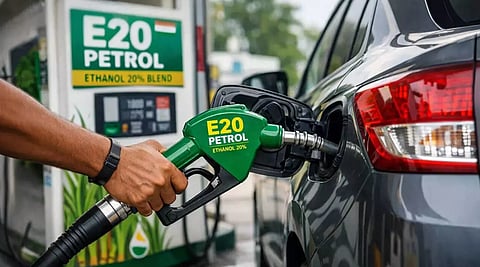
A motorist pulls into a fuel station, expecting to choose between regular and premium petrol. Instead, he discovers that the choice has already been made for him. The question is no longer what octane he prefers, but whether he prefers ethanol at all. Across India today, that decision belongs less to the customer and more to policy. That is what is making India’s E20 debate bigger than a dispute over fuel chemistry. It is a test of how a nation balances energy security with consumer confidence, national priorities with individual choice and technological transition with public trust.
India deserves credit for the ambition and speed of its ethanol programme. The target of achieving 20-per cent blending by 2030 was pre-achieved in 2025 itself, ahead of schedule. The Government says this has reduced dependence on imported crude, saved foreign exchange and created a market for agricultural feedstock like sugarcane and grain-based ethanol. In a country that imports nearly 90 per cent of its crude needs, these are not trivial achievements. But public policy succeeds not merely when targets are met. It succeeds when citizens feel confident that the transition is fair, transparent and suited to their realities.
Fuel Revolution
The scale of India’s ethanol push is extraordinary, with blending rising from 1.5 per cent in 2015 to 20 per cent today. The programme has saved billions of dollars in imports while providing income streams to farmers and distilleries. Few economies have moved so quickly on biofuel blending. Supporters of the policy point to Brazil, where ethanol has long been part of the fuel ecosystem, and to the United States, where ethanol blends are widely used. The comparison is valid. Diversifying transport fuel sources is seen as a strategic necessity in a world shaped by volatile oil prices, geopolitical disruptions and climate concerns.
Yet, there is a difference. Brazil’s ethanol drive evolved over decades and gave consumers clear choices at the pump. Flex-fuel vehicles became common and motorists could decide whether to fill up with gasoline, ethanol or any blend. The transition succeeded because policy and consumer behaviour matured together. India, by contrast, has moved with remarkable speed. That speed may prove visionary. But it has also left behind unanswered questions – for owners of vehicles manufactured before the E20 era became the norm.
Trust Deficit
This is where the debate gets uncomfortable. Social media is flooded with videos of motorists claiming that fuel pumps, injectors, rubber hoses and fuel tanks have deteriorated due to E20. Anecdotes are not proof and many such claims draw scepticism. But calling all concerns ‘misinformation’ would be unwise. Critics point to an unpublished study by the Automotive Research Association of India that reportedly found damage in certain rubber components in vehicles designed only for E10 fuel. According to them, the only option is replacement of affected parts as and when necessary. Whether the findings are published or refined, such concerns explain why owners of older vehicles remain uneasy.
The Government has been consistent, sating E20 does not damage vehicles and that it was introduced only after extensive testing by ARAI and vehicle manufacturers. It adds that ethanol contains less energy than petrol and may lead to some reduction in mileage, but that claims of vehicle damage were “exaggerated”. Two-wheelers and cars sold before 2023 were designed for E10 compatibility. Today, their owners are not resisting national policy; they are seeking clarity about the machines they purchased in good faith.
Missing Choice
There is another dimension, in that the current debate is being framed as a contest between supporters and opponents of ethanol. That is the wrong frame. The real issue is whether citizens should have the option to choose the fuel most appropriate for their vehicle. If a motorist owns an E20-ready car, he would be happy to use E20, especially if it is priced lower. Another motorist may own a decade-old scooter and feel more comfortable using conventional petrol. Why should the second find that option difficult?
Choice is not an obstacle to policy. In fact, it is often the strongest proof of confidence in it. If E20 offers economic, strategic and environmental advantages, most consumers will adopt it voluntarily when pricing and information are transparent.
A sensible middle path is possible. E20 can remain the mainstream fuel. But selected outlets, especially in urban India and highway corridors, could offer pure petrol with clearly-stated ethanol content, or the lack thereof. QR codes at pumps could tell consumers whether their vehicle is E20-compatible. Manufacturers could publish compatibility lists rather than technical footnotes. And long-term data from ARAI, oil firms and automakers could be placed in the public domain instead of circulating through leaks. Such measures would not weaken the ethanol programme. They would strengthen its credibility.
Beyond Blending
There is another inferno simmering, one concerning the sustainability of ethanol itself. India’s ethanol plan relies on a diversified feedstock basket, including sugarcane juice, molasses, damaged foodgrain and surplus rice allocated under approved policy, rather than any single source. That diversification is important as it seeks to balance energy security with agricultural economics. Yet, questions are being raised about the long-term implications of scaling up ethanol production when water is becoming a scarce resource. Sugarcane, the backbone of India’s ethanol industry, is water-intensive and studies estimate that producing a single litre of ethanol can involve a substantial water footprint. In a nation where many regions grapple with drought and groundwater depletion, the question deserves discussion, not ideological dismissal.
This is not an argument against ethanol. It is an argument for examining the entire lifecycle of the fuel. If the objective is to reduce dependence on imported crude oil, another must be conserving India’s precious groundwater. Public policy should not be forced into choosing one strategic resource over another.
The same approach should guide discussions around higher ethanol blends. As E20 becomes the standard, variants like E25 and beyond are being spoken on. The Government says higher blends are only under evaluation and that no rollout decision has been taken. This presents an opportunity to absorb the lessons of E20 before racing towards the next milestone. For transitions of this magnitude are strongest when they are evolutionary, rather than merely ambitious or blatantly revolutionary.
Trust Matters
An unfortunate fallout of this debate is that it has become polarised. On one side are those who portray ethanol as an unqualified environmental and economic triumph. On the other are those who insist it is slowly damaging their engines. Neither extreme really serves the public interest. For science rarely speaks in absolutes. And engineering certainly does not.
Transport Minister Nitin Gadkari’s statement that E20 may marginally reduce fuel efficiency reflects a key principle – that acknowledging a limitation does not weaken a policy, it only strengthens its credibility. His assertion that claims of vehicular damage are exaggerated should encourage authorities to release more data in the public domain. Transparency has an extraordinary ability to silence rumour. This is where India’s ethanol story now stands. The country has achieved an ambitious blending target. The next challenge is not logistical. It is psychological. Winning trust is harder than achieving targets.
India’s ethanol programme is too important to become trapped in a shouting match between cheerleaders and sceptics. It deserves a mature conversation, one that recognises its strategic value while remaining sensitive to the concerns of motorists who simply want to protect their second-most expensive asset. The debate is no longer about whether ethanol has a place in India’s future. It clearly does. The question is whether that future will be built on compulsion or conviction.
Views expressed are personal


