.png)
‘World witnessed IAF’s speed’: AP Singh highlights air power lessons from Operation Sindoor
Air Chief Marshal AP Singh on Thursday said Operation Sindoor demonstrated to the world how quickly the Indian Air Force can transition into combat, highlighting the force’s operational preparedness and the growing importance of air power in protecting India’s national interests.
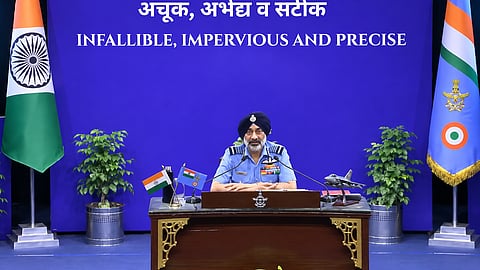
Addressing personnel at the Hindan air force station on Air Force Day, the Chief of Air Staff said the four-day military confrontation with Pakistan last year had provided a real-world demonstration of the IAF’s offensive and air defence capabilities.
“Last year, the whole world witnessed the speed with which the IAF moved into combat operations. We saw first-hand the destructive power as well as the effective air defence operations of the IAF during Operation Sindoor,” Singh said.
His remarks came as the IAF showcased its combat capabilities and operational assets on its 94th anniversary. Recent reporting has also highlighted the force’s shift towards a capability-centric approach, with greater emphasis on integrating platforms, weapons and other elements rather than focusing on individual aircraft alone.
Operation Sindoor demonstrated rapid combat response
Operation Sindoor began in the early hours of May 7, 2025, when the IAF struck terror targets at Markaz Subhanallah in Bahawalpur and Markaz Taiba near Muridke, both in Pakistan’s Punjab province.
The Indian Army simultaneously targeted seven locations, including Mehmoona Joya in Sialkot, Sawai Nala and Syed Na Bilal in Muzaffarabad, Gulpur and Abbas in Kotli, Barnala in Bhimber and Sarjal.
The IAF subsequently struck Pakistani military targets on May 9 and 10, including locations at Rafiqui, Murid, Chaklala, Rahim Yar Khan, Sukkur, Chunian, Pasrur, Sialkot, Skardu, Sargodha, Jacobabad, Bholari and Malir Cantt in Karachi.
Singh said the experience demonstrated why operational readiness, rather than simply possessing advanced platforms, remains central to air power.
“We believe that any air force can have the most advanced aircraft or systems in the world, but its true strength is measured by its operational preparedness...how quickly and confidently it can act whenever the call comes,” he said.
The IAF chief also referred to the force’s tagline, “Infallible, Impervious, and Precise”, while emphasising the importance of the personnel operating and maintaining its systems.
Training remains central to combat capability
Singh said the people behind the aircraft and weapons systems were ultimately the most important component of the force.
He said IAF aircrew and ground crew undergo intensive professional training so that their skills become second nature. The training, he added, prepares personnel for a range of missions, from defending Indian airspace and conducting punitive strikes to providing assistance during disasters.
“Our aircrew and ground crew are trained to such a high degree that their skill becomes their second nature,” Singh said.
He added that the IAF had continued strengthening this foundation through initiatives such as Vayu Shakti, Dronathon and the ongoing multinational air exercise Tarang Shakti.
According to Singh, these exercises and initiatives are intended to validate combat readiness while allowing the force to incorporate niche technologies into its operational framework more rapidly.
Tarang Shakti brings together international air forces
More than 80 Indian and foreign aircraft are participating in Tarang Shakti, including aircraft ranging from the US-made F-35 to India’s indigenous Tejas light combat aircraft.
Eight foreign air forces are participating with air assets, including those of the United States, France, Germany, the United Arab Emirates, Australia, Bangladesh and Sri Lanka. Another 32 countries are participating as observers, including Brazil, Egypt, Italy, Japan, Malaysia, Oman, Singapore, South Africa, Thailand and Vietnam.
The second edition of Tarang Shakti is being conducted at Air Force Station Jodhpur from September 26 to October 12, 2026. The Ministry of Defence has described the exercise as an opportunity to conduct realistic multinational operations, joint aerial missions and tactical training while improving interoperability and sharing operational experience.
The participation of the US F-35 is particularly significant, with the fifth-generation fighter making its debut in the multinational exercise in India.
AI and autonomous systems to shape future operations
Singh said the IAF was preparing for a new era of warfare shaped by artificial intelligence, autonomy and digital technologies.
He said AI was already being used to assist commanders in making informed decisions by analysing large volumes of data.
At the same time, autonomous systems are being developed with a “man-in-the-loop” approach, ensuring that human authority remains central to decision-making.
The objective, he said, was to build an AI-augmented force in which technology enhances operational capability without removing human control.
The IAF has also been expanding its use of unmanned systems. Singh said earlier this month that drones should evolve alongside conventional weapons and platforms rather than being treated as a separate capability requiring an independent force.
Indigenous systems at the heart of self-reliance
Singh also placed renewed emphasis on atmanirbharta, or self-reliance, as the IAF expands its capabilities.
He pointed to the Tejas light combat aircraft, Advanced Medium Combat Aircraft, HTT-40 trainer, Dhruv and Prachand helicopters, Astra missiles, Akash air defence systems and BrahMos missiles as examples of indigenous defence development.
“While enhancing the capability of the IAF, atmanirbharta is our guiding principle,” Singh said, adding that rapid adoption of emerging technologies had become a top priority on the foundation of self-reliance.
His comments come as the IAF continues to face challenges over the availability of fighter aircraft. Singh said earlier this month that delays in fighter production were hurting the force and that its combat aircraft numbers were declining. He has called for the IAF to receive 36 to 40 new fighters a year to arrest the decline.
Singh’s final Air Force Day as chief
The address was among Singh’s last major Air Force Day engagements as Chief of the Air Staff. He is due to retire on October 31.
The government has already appointed Air Marshal Ashutosh Dixit as the next Chief of the Air Staff. Dixit, currently serving as Vice Chief of the Air Staff, will become the 29th IAF chief.
Singh said the rapidly changing global security environment required the IAF to remain prepared for increasingly complex contingencies.
“The world is going through rapid changes, leading to uncertainty and intricate geopolitical challenges,” he said, pointing to conflicts emerging in different parts of the world.
“These events have clearly demonstrated that air power is the primary means of protecting the national interest. The IAF, being the custodian of the air power, understands its role and responsibilities and is always alert, committed, and ready to meet any contingency,” Singh said.


