.png)
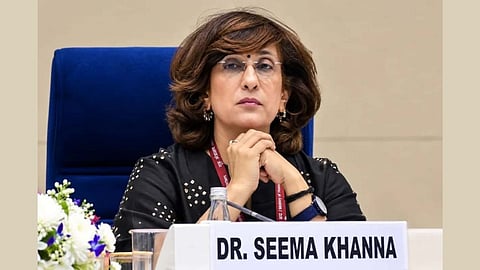
Who is Seema Khanna, the ECI official in spotlight after Rahul Gandhi's 'lady hiding' remark?
Election Commission of India (ECI) official Seema Khanna has emerged at the centre of a political controversy following Congress leader Rahul Gandhi's reference to a woman allegedly "hiding in Dehradun" during an INDIA bloc press conference, amid intensifying Opposition allegations of irregularities in the revision of electoral rolls.
Although Gandhi did not identify the woman, speculation on social media and statements by Opposition leaders have brought attention to Khanna, the Election Commission's Director General of Information Technology, whose department oversees the digital systems used for managing electoral rolls.
The controversy has gained significance following an investigation by The Indian Express that reported repeated objections by Election Commissioners Sukhbir Singh Sandhu and Vivek Joshi over the centralisation of electoral-roll software and restrictions faced by statutory election officers.
The disclosures have raised questions about the extent of authority exercised by the Commission's IT department over systems used by Electoral Registration Officers (EROs), who are legally responsible for preparing and maintaining voter lists.
𝗥𝗮𝗵𝘂𝗹'𝘀 '𝗹𝗮𝗱𝘆 𝗵𝗶𝗱𝗶𝗻𝗴' 𝗿𝗲𝗺𝗮𝗿𝗸 𝘀𝗽𝗮𝗿𝗸𝘀 𝗿𝗼𝘄
Addressing a joint press conference of INDIA bloc leaders on Tuesday, Gandhi accused Prime Minister Narendra Modi, Union Home Minister Amit Shah and Chief Election Commissioner Gyanesh Kumar of responsibility for alleged irregularities in the Special Intensive Revision (SIR) of electoral rolls.
"It is our commitment to you that the people who have done this, Mr. Modi, Mr. Shah, Mr. Gyanesh Kumar, the lady who's hiding right now in Dehradun, and others are going to be brought to justice," Gandhi said.
The statement triggered speculation about the identity of the woman.
Several social media users and Congress functionaries subsequently suggested that Gandhi could have been referring to Khanna. However, there has been no confirmation from Gandhi that she was the person mentioned in his remarks.
According to reports citing Election Commission sources, Khanna has been in Dehradun overseeing election preparations in Uttarakhand, which is scheduled to hold Assembly elections next year.
There is no independently established evidence that she is hiding or evading any investigation.
𝗪𝗵𝗼 𝗶𝘀 𝗦𝗲𝗲𝗺𝗮 𝗞𝗵𝗮𝗻𝗻𝗮?
Khanna is the Director General of the Election Commission's Information Technology Department and oversees digital infrastructure supporting electoral administration.
She joined the Commission in 2025 on deputation from the National Informatics Centre (NIC), an organisation under the Ministry of Electronics and Information Technology.
Her department is responsible for technology systems associated with electoral-roll management, including ERONet and ECINet.
ECINet, launched in January 2026, brought more than 40 election-related applications and portals onto a unified digital platform.
Khanna's position has attracted attention because of concerns about whether software permissions controlled by the IT department could restrict the ability of statutory election officers to perform their legally assigned functions.
𝗧𝘄𝗼 𝗘𝗹𝗲𝗰𝘁𝗶𝗼𝗻 𝗖𝗼𝗺𝗺𝗶𝘀𝘀𝗶𝗼𝗻𝗲𝗿𝘀 𝗿𝗮𝗶𝘀𝗲𝗱 𝗼𝗯𝗷𝗲𝗰𝘁𝗶𝗼𝗻𝘀
An investigation by The Indian Express reported that Election Commissioners Sandhu and Joshi had raised objections on at least 14 occasions over approximately 10 months concerning decisions taken within the poll panel.
Among the issues flagged was the centralised management of software used to prepare and revise electoral rolls.
According to the investigation, EROs complained that they did not have adequate access to the systems necessary to discharge their statutory responsibilities.
Sandhu reportedly recorded that state-level officials lacked proper and complete access to ERONet.
He also questioned the authority of the Commission's IT department to restrict access available to statutory officers under electoral law.
In an internal observation cited in the investigation, Sandhu reportedly stated that Khanna did not possess the legal authority to restrict the access and operational freedom granted to EROs by law.
The reported objections have raised a wider question about whether administrative control of election software can effectively limit powers vested in electoral officers.
𝗪𝗵𝘆 𝗱𝗼𝗲𝘀 𝗮𝗰𝗰𝗲𝘀𝘀 𝘁𝗼 𝘃𝗼𝘁𝗲𝗿 𝗱𝗮𝘁𝗮𝗯𝗮𝘀𝗲𝘀 𝗺𝗮𝘁𝘁𝗲𝗿?
Electoral Registration Officers derive their responsibilities from the Representation of the People Act, 1950, and associated electoral rules.
They are entrusted with preparing, correcting and updating electoral rolls in their respective jurisdictions.
However, the growing dependence on centralised digital platforms means that their ability to carry out these responsibilities also depends on the permissions and functions available through Election Commission software.
If an officer is legally empowered to include or restore a voter's name but cannot access the relevant software function, the resulting administrative restriction could delay or prevent implementation of the decision.
The controversy has therefore brought the distinction between statutory authority and technological control into focus.
The reported internal objections do not, by themselves, establish that Khanna deliberately manipulated electoral rolls or acted under political instructions.
𝗢𝗽𝗽𝗼𝘀𝗶𝘁𝗶𝗼𝗻 𝗹𝗲𝗮𝗱𝗲𝗿𝘀 𝘁𝗮𝗿𝗴𝗲𝘁 𝗘𝗖𝗜 𝗼𝗳𝗳𝗶𝗰𝗶𝗮𝗹
The issue has also drawn political reactions from Congress, the Trinamool Congress and Shiv Sena (UBT).
Congress leader Pawan Khera referred to Khanna's professional background, her association with technology-related projects and her deputation to the Election Commission in a social media post.
Shiv Sena (UBT) leader Sanjay Raut had earlier accused her of involvement in alleged electoral manipulation, while Trinamool Congress MP Mahua Moitra publicly questioned her role in the Commission's digital systems.
These accusations form part of the Opposition's broader campaign against alleged irregularities in electoral-roll revisions.
However, the claims of deliberate manipulation and political involvement remain allegations and have not been established through an independent judicial finding.
𝗙𝗼𝗿𝗺 𝟲 𝗰𝗼𝗻𝘁𝗿𝗼𝘃𝗲𝗿𝘀𝘆 𝗮𝗱𝗱𝘀 𝘁𝗼 𝗱𝗲𝗯𝗮𝘁𝗲
Another issue associated with the controversy concerns Form 6, which is used by eligible citizens seeking inclusion in electoral rolls.
According to reports, questions were raised about the introduction of an additional declaration and its implementation through the Election Commission's online systems.
Election Commission officials reportedly maintained that Form 6 itself had not been amended and that a declaration had been added alongside it.
They also attributed certain difficulties in online submissions to changes made by the IT department.
Officials said the Supreme Court had upheld the authority to add the declaration on May 27, 2026.
The issue has added to the debate over how electoral rules are implemented through digital systems and whether technical changes are subject to adequate institutional scrutiny.
𝗘𝗖𝗜'𝘀 𝗱𝗶𝗴𝗶𝘁𝗮𝗹 𝗰𝗼𝗻𝘁𝗿𝗼𝗹 𝗳𝗮𝗰𝗲𝘀 𝗾𝘂𝗲𝘀𝘁𝗶𝗼𝗻𝘀
The controversy surrounding Khanna comes against the backdrop of continuing protests by the INDIA bloc and the Cockroach Janta Party (CJP) against Chief Election Commissioner Gyanesh Kumar over the Special Intensive Revision exercise.
Opposition leaders have demanded greater transparency in the deletion and inclusion of voters, while questioning the functioning of the Election Commission's technological infrastructure.
The reported concerns of two sitting Election Commissioners have given the issue an additional institutional dimension.
Questions now centre on who determines access permissions for statutory electoral officers, what safeguards exist against unauthorised restrictions and how disputes between field-level officers and the Commission's IT department are resolved.
The distinction between concerns documented in internal correspondence and allegations of intentional wrongdoing remains important.
While the reported objections establish that senior election officials questioned aspects of the digital system's functioning, they do not establish the broader accusations of electoral fraud levelled against Khanna.
The controversy nevertheless highlights the need for clear accountability in the management of electoral technology, particularly when access to digital systems can directly affect the exercise of statutory powers and the inclusion of eligible voters.


