.png)
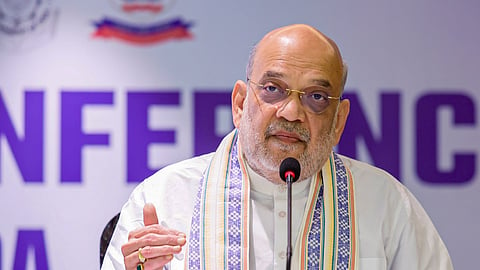
'UCC in all 21 NDA-ruled states before 2029', Amit Shah sets deadline for rollout
Union Home Minister Amit Shah on Sunday said the Uniform Civil Code (UCC) would be implemented in all 21 states governed by the BJP and its NDA partners before 2029, setting a clear political timeline for one of the ruling alliance's longest-standing ideological commitments. Shah said NDA governments would move towards introducing uniform civil laws in every state under their control, with the process expected to be completed before the next Lok Sabha election.
The announcement represents a significant expansion of the BJP's state-by-state strategy on the UCC, which seeks to replace religion-specific personal laws governing matters such as marriage, divorce, inheritance and succession with a common legal framework. Uttarakhand became the first state after Independence to enact a UCC law in 2024 and remains the first to have fully implemented the legislation. Other BJP and NDA-governed states have since explored their own frameworks, setting up committees or beginning legislative exercises.
Shah sets 2029 target
Speaking at an event in Mumbai, Shah said the NDA was committed to implementing the UCC in all 21 states where the alliance is in power before 2029. The Home Minister presented the measure as part of the government's broader effort to establish equality before the law and remove differences in civil rights based on religion.
The BJP has long maintained that different personal laws governing citizens belonging to different religious communities are inconsistent with the principle of equality and that a common civil code would provide uniform rights, particularly to women. Article 44 of the Constitution, one of the Directive Principles of State Policy, says the State shall endeavour to secure a Uniform Civil Code for citizens throughout India. The provision, however, has remained politically contentious for decades because personal laws are closely connected with religious and community practices.
Uttarakhand provides template
The UCC debate gained fresh momentum after Uttarakhand became the first state to pass dedicated legislation in February 2024 and subsequently brought the law into force. The Uttarakhand framework introduced common provisions governing areas including marriage, divorce, inheritance and succession, although Scheduled Tribes were exempted from its ambit.
Since then, the BJP has increasingly pursued the issue through individual state governments rather than waiting for a single nationwide law. Shah's latest statement indicates that this approach could now be accelerated across the NDA's political map, with individual state governments potentially drafting legislation suited to their jurisdictions while adhering to the broader objective of uniformity in personal laws. The precise timelines and legislative models for each of the remaining states, however, are yet to be announced.
UCC returns to political centre stage
The Uniform Civil Code has been among the BJP's core ideological commitments for decades, alongside the construction of the Ram temple in Ayodhya and the abrogation of Article 370 provisions relating to Jammu and Kashmir. While the latter two objectives have already been implemented, the UCC has increasingly emerged as the major unfinished item on that longstanding agenda.
Supporters argue that a common code would strengthen constitutional equality, eliminate discriminatory provisions in personal laws and ensure equal rights irrespective of religion.
Opposition parties and several minority organisations have raised concerns that a uniform law could interfere with religious freedoms and India's pluralistic traditions. They have argued that reform of discriminatory practices can be pursued without imposing a single framework across communities. The debate also involves questions about how a UCC would accommodate India's considerable diversity in customary laws, including tribal practices and region-specific traditions.
State route gathers momentum
Shah's announcement is politically significant because it points towards the UCC being advanced through state legislatures on a much wider scale over the next three years. The Constitution places marriage and divorce, infants and minors, adoption, wills, intestacy and succession, joint family and partition among subjects in the Concurrent List, allowing both Parliament and state legislatures to enact laws in these areas, subject to constitutional provisions governing conflicts between central and state legislation.
The Uttarakhand experiment has consequently been closely watched as a possible template for other BJP-governed states. A rollout across 21 NDA-ruled states would dramatically widen the geographical reach of UCC legislation even in the absence of a single nationwide code passed by Parliament.
Shah's 2029 deadline also ensures that the issue is likely to remain at the centre of political and legal debate in the run-up to the next general election, as individual NDA governments begin converting the broader commitment into legislation. If the target announced by the Home Minister is met, uniform civil laws would move from being a decades-old constitutional and political debate to an operative legal framework across a substantial part of the country before India votes in 2029.


