.png)
Tamil Nadu urges Centre to withhold all clearances for Karnataka's Mekedatu dam project
The Tamil Nadu government has urged the Centre not to grant any approval for Karnataka's proposed Mekedatu dam project across the Cauvery river, reiterating that the reservoir cannot be implemented without the consent of lower riparian states.
The demand comes amid renewed tensions between the two neighbouring states over the long-pending project, with Karnataka pressing for statutory clearances and Tamil Nadu expressing concern about its potential impact on water availability.
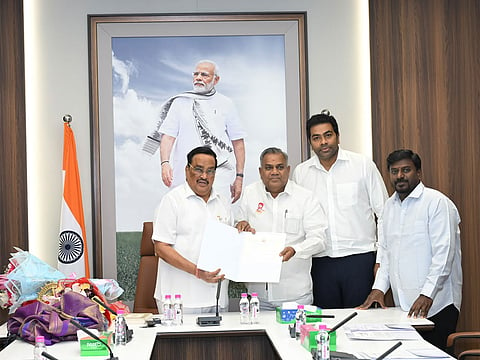
Tamil Nadu Water Resources Minister N Anand and Public Works Department Minister Aadhav Arjuna were expected to take up the issue with Union Jal Shakti Minister C R Patil in New Delhi on Wednesday.
The state has maintained that the proposed reservoir could interfere with the regulated release of Cauvery water to Tamil Nadu, particularly during periods of inadequate rainfall.
𝐓𝐚𝐦𝐢𝐥 𝐍𝐚𝐝𝐮 𝐨𝐩𝐩𝐨𝐬𝐞𝐬 𝐮𝐧𝐢𝐥𝐚𝐭𝐞𝐫𝐚𝐥 𝐚𝐩𝐩𝐫𝐨𝐯𝐚𝐥
Tamil Nadu has consistently argued that Karnataka cannot proceed with a major project on the interstate river without addressing the concerns of downstream states.
Chief Minister C Joseph Vijay had earlier written to Prime Minister Narendra Modi, requesting his intervention to prevent the proposed dam from receiving statutory or administrative approval without the consent of the states sharing the Cauvery basin.
In his November 6 letter, Vijay expressed concern that the proposed reservoir, with a storage capacity of approximately 67.16 thousand million cubic feet (TMC), could affect the monthly water releases stipulated under the Supreme Court's judgment.
He also objected to reports of central officials inspecting the proposed project site, arguing that such developments had raised apprehensions among farmers in Tamil Nadu.
The Chief Minister urged the Centre to defer further administrative and technical action concerning the project until the concerns of the lower riparian states were addressed.
𝐊𝐚𝐫𝐧𝐚𝐭𝐚𝐤𝐚 𝐩𝐮𝐬𝐡𝐞𝐬 𝐟𝐨𝐫 𝐜𝐥𝐞𝐚𝐫𝐚𝐧𝐜𝐞𝐬
The latest disagreement follows Karnataka Chief Minister D K Shivakumar's appeal to the Centre to expedite the remaining approvals for the Mekedatu project.
Speaking at an event in Mysuru in the presence of Prime Minister Modi last week, Shivakumar asserted that the reservoir would be constructed and sought central assistance in securing the necessary clearances.
Karnataka maintains that the proposed balancing reservoir is important for meeting Bengaluru's drinking water requirements and generating hydroelectric power.
The state has also argued that the project would help regulate water availability and improve resource management.
Tamil Nadu, however, fears that a large upstream reservoir could give Karnataka greater control over the timing and quantity of water flowing into its territory.
𝐂𝐚𝐮𝐯𝐞𝐫𝐲 𝐰𝐚𝐭𝐞𝐫 𝐬𝐡𝐚𝐫𝐢𝐧𝐠 𝐚𝐭 𝐜𝐞𝐧𝐭𝐫𝐞 𝐨𝐟 𝐫𝐨𝐰
The Mekedatu project has remained a contentious issue because of the longstanding dispute over sharing Cauvery waters between Karnataka and Tamil Nadu.
Under the Supreme Court's 2018 judgment modifying the Cauvery Water Disputes Tribunal's award, Karnataka is required to ensure the release of 177.25 TMC of water annually to Tamil Nadu at the interstate measuring point in a normal water year, subject to the prescribed monthly schedule and distress-sharing considerations.
Tamil Nadu maintains that any new upstream storage facility must comply with the tribunal's award and the Supreme Court's directions.
The state has also raised concerns about water shortages during the 2026-27 water year, alleging that Karnataka failed to release its due share even on a proportionate basis.
Tamil Nadu Congress Committee president Manickam Tagore recently urged the Prime Minister to clarify the Centre's position on the project.
In a letter, Tagore alleged that Karnataka had repeatedly failed to comply with water-release directions and claimed that Tamil Nadu faced a shortfall of 16.895 TMC as of November 4.
He warned that further restrictions on Cauvery flows could affect agricultural activities across the delta region.
𝐋𝐞𝐠𝐚𝐥 𝐝𝐢𝐬𝐩𝐮𝐭𝐞 𝐜𝐨𝐧𝐭𝐢𝐧𝐮𝐞𝐬
Tamil Nadu has also pursued legal and legislative measures against the proposed project.
The state Assembly passed a resolution in June opposing clearances for Mekedatu, while the government has approached judicial forums over matters connected with the proposal.
The state has maintained that the project should not receive approval unless its consistency with the Cauvery tribunal's award and the Supreme Court's judgment is established.
Karnataka, meanwhile, continues to seek the remaining clearances for the multipurpose reservoir.
With both states maintaining their respective positions, the Centre's handling of the proposed project remains central to the dispute, particularly over the protection of downstream water rights and the future management of Cauvery resources.


