.png)
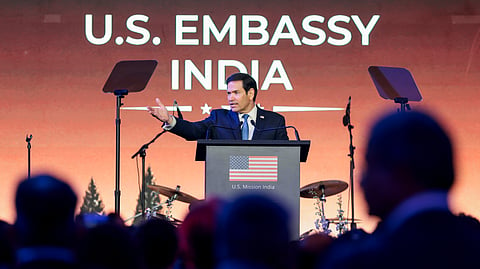
Rubio says US immigration crackdown is not aimed at India, insists Washington is ‘fixing’ system
US Secretary of State Marco Rubio has sought to reassure India that the Trump administration’s increasingly restrictive immigration policies are not directed at Indian nationals, arguing that Washington is undertaking a global overhaul of its immigration system to address alleged abuses and longstanding shortcomings.
In an interview with The Indian Express, Rubio acknowledged that the impact of the changes could appear particularly significant in India, given the close economic and people-to-people ties between the two countries and the large number of Indians applying for certain American visas. However, he maintained that the measures were part of a broader effort and were not specifically aimed at India.
“From your perspective here in India, it may seem targeted at India, (but) it’s not,” Rubio said, seeking to address concerns over the implications of tighter immigration rules for Indian students, skilled professionals and others seeking opportunities in the United States.
The Trump administration’s approach has drawn attention in India because of restrictions affecting work visas and increased scrutiny of foreign students and skilled professionals entering the US. The changes have also raised questions about the future of opportunities for Indians, who account for a significant share of applicants in several American visa categories.
Rubio defends tougher immigration rules
Explaining the rationale behind Washington’s approach, Rubio argued that illegal immigration and what he described as mass migration posed a threat to legal immigration. He said the administration was seeking to restore the credibility of a system that it believed had been neglected for years and that several visa programmes had been misused.
“The biggest threat to legal immigration is illegal immigration. The biggest threat to legal immigration is mass migration,” Rubio said, adding that mass migration was “not an Indian phenomenon” and was more closely associated with other parts of the world.
He alleged that 20 million people had entered the US unlawfully during Joe Biden’s four-year presidency. Rubio also cited birth tourism as another example of practices that the administration wanted to address, maintaining that the concerns extended beyond India.
“There is virtually no country on Earth that I visit where I don’t get a complaint about some visa or process, because we are fixing it globally,” he said.
Rubio insisted that the US continued to welcome visitors, international students, temporary workers and investors, provided they followed the country’s immigration laws.
“We want people to visit the United States. We want people to study in the United States. There are certain people that we want, that want to come work for a time in the United States. We want people to invest in the United States,” he said.
“But we want it done through a system of laws that are complied with,” he added.
According to Rubio, the objective is to establish an immigration framework that can be sustained over the long term. He argued that addressing the system’s shortcomings could eventually benefit those who use the programmes legitimately while also protecting American interests.
Strong India-US ties put Indian applicants in focus
Rubio acknowledged that the consequences of the policy changes could be more visible in India because of the scale of bilateral engagement and the number of Indian applicants in particular visa categories.
“Because of the developments, because of the ties between our countries, because of how developed your economy is, there are certain categories of visas that see a large number of Indians applying for,” he told The Indian Express.
His remarks come amid uncertainty over the impact of the Trump administration’s immigration measures on Indian students and professionals who view the US as a destination for higher education, employment and investment. While Rubio maintained that the changes were not India-specific, the concentration of Indian applicants in certain categories means that alterations to visa rules and procedures can have a substantial effect on them.
The administration has framed its approach as an effort to enforce immigration laws and address what it considers systemic weaknesses, rather than as a policy directed against any one country.
Trade deal and Pakistan ties also figure in bilateral relationship
Rubio’s comments on immigration come as New Delhi and Washington seek to sustain positive momentum in their relationship despite differences over trade, tariffs and energy ties, particularly India’s purchases of Russian oil.
Describing the bilateral relationship positively, the US secretary of state said ties with India had become an established feature of American foreign policy. He also indicated that the two countries were close to concluding a trade agreement, with 99% of the work completed and only weeks, rather than months, remaining before it could be finalised.
Trade disputes have nevertheless remained a source of friction. The Trump administration’s tariff measures and its approach to India’s Russian oil purchases have added uncertainty to economic relations between the two countries.
Rubio sought to play down concerns over the tariffs, arguing that they were not intended to punish or harm India. He said Washington was attempting to balance its foreign policy objectives with the need to preserve important partnerships.
He also sought to reassure New Delhi about US engagement with Pakistan, maintaining that Washington’s relationship with no other country would come at the expense of its ties with India.
The remarks reflect Washington’s effort to address Indian concerns over immigration restrictions while maintaining cooperation on trade and broader strategic interests. Although Rubio has insisted that the immigration changes are global in scope, their implications for Indian students and skilled professionals remain a significant concern as the two countries work to advance their wider partnership.


