.png)
‘RSS an anti-Tamil force’: Rahul Gandhi claims 850-seat delimitation plan threatens Tamil culture
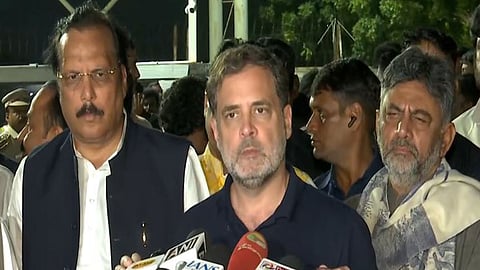
Leader of Opposition in the Lok Sabha Rahul Gandhi on Sunday launched a sharp attack on the Rashtriya Swayamsevak Sangh (RSS), describing it as an anti-Tamil force and alleging that the Centre's proposed delimitation exercise would pave the way for an attack on Tamil culture and language.
Speaking to reporters after meeting DMK president MK Stalin in Chennai, Gandhi claimed that expanding the Lok Sabha to 850 seats and redrawing parliamentary constituencies would allow the BJP to reshape the country's electoral landscape to its political advantage.
The Congress leader described the meeting with Stalin as cordial and said the Opposition delegation had conveyed its concerns regarding the implications of the proposed legislation for the country, southern states and Tamil Nadu in particular.
𝗥𝗮𝗵𝘂𝗹 𝗮𝘁𝘁𝗮𝗰𝗸𝘀 𝗕𝗝𝗣-𝗥𝗦𝗦
Gandhi alleged that the proposed delimitation exercise would undermine democratic representation and accused the RSS of opposing the idea of Tamil civilisation.
He warned that once parliamentary constituencies were redrawn under the proposed framework, Tamil culture and language could come under attack.
The Congress leader appealed to Stalin, whom he described as a longstanding defender of Tamil Nadu's interests, to oppose what he called the BJP's "dirty design".
Earlier in the day, Gandhi had appealed to the DMK leadership to join the INDIA bloc in opposing the constitutional amendment bills in the interest of Tamil Nadu, the country and the Constitution.
𝗗𝗠𝗞 𝗿𝗲𝗺𝗮𝗶𝗻𝘀 𝗳𝗶𝗿𝗺 𝗼𝗻 𝗱𝗲𝗹𝗶𝗺𝗶𝘁𝗮𝘁𝗶𝗼𝗻
The Opposition delegation, comprising Congress president Mallikarjun Kharge, Sonia Gandhi, Rahul Gandhi, MAITC chief Mamata Banerjee and other senior leaders, held discussions with Stalin at his residence in Chennai.
However, the meeting failed to secure any assurance from the DMK leadership regarding a reversal of its decision to support the revised delimitation legislation.
The DMK on Saturday announced its support for the Centre's proposal, maintaining that its two principal demands had been accommodated in the revised legislation.
These include protecting Tamil Nadu's existing 7.18 per cent share of Lok Sabha seats and retaining the existing proportion of parliamentary representation among states, based on the 1971 Census, for another 25 years.
Under the proposed uniform 50 per cent expansion, Tamil Nadu's representation in the Lok Sabha is expected to increase from 39 to 59 seats.
Responding to Gandhi's earlier appeal, Stalin reiterated that the welfare of Tamil Nadu and its people would remain the foremost consideration in every decision taken by the DMK.
𝗖𝗿𝘂𝗰𝗶𝗮𝗹 𝘃𝗼𝘁𝗲 𝗮𝗵𝗲𝗮𝗱 𝗶𝗻 𝗣𝗮𝗿𝗹𝗶𝗮𝗺𝗲𝗻𝘁
The exchange between Gandhi and Stalin comes ahead of Parliament's special sitting beginning November 30, during which the Centre is expected to introduce the Constitution (132nd Amendment) Bill, 2026.
The legislation proposes increasing the maximum strength of the Lok Sabha to 850, alongside a uniform 50 per cent increase in parliamentary representation across states and Union Territories.
The proposal is also linked to the implementation of 33 per cent reservation for women in Parliament and state legislative assemblies.
With the DMK holding 22 seats in the Lok Sabha and eight in the Rajya Sabha, its support assumes significance as the constitutional amendment requires a special majority in both Houses of Parliament.
The BJP and RSS's immediate response to Gandhi's latest allegations was not available in the reports reviewed.


