.png)
Rajnath Singh urges IAF to sharpen 'element of surprise', prepare for drone and cyber threats
Defence Minister Rajnath Singh on Thursday called on the armed forces to strengthen their offensive and defensive capabilities to maintain the element of surprise in modern warfare, stressing that military preparedness must keep pace with rapidly evolving conventional and emerging threats.
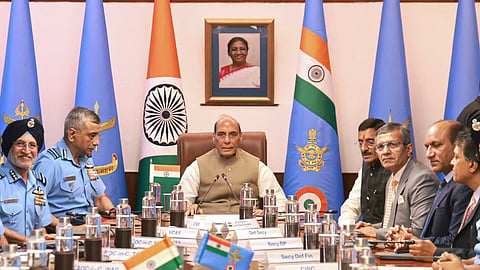
Addressing the Air Force Commanders' Conference, Singh said the changing security environment required continuous adaptation, stronger intelligence and surveillance systems, and a forward-looking approach to identifying potential threats before they materialise.
"Our defence forces must develop capabilities and methods that leave the adversary with no time to react or recover, while simultaneously ensuring that we are never caught off guard by an unexpected move from the enemy," he said.
The minister underlined that the nature of contemporary conflicts was expanding beyond conventional battlefields into non-contact domains, making it essential for the military to remain alert and prepared for unexpected developments.
"Surprise can manifest in various forms, both conventional and electronic. Our intelligence and surveillance mechanisms must be further strengthened and operational preparedness enhanced to ensure that our personnel remain alert, agile and equipped to respond effectively to any emerging challenge," he added.
Drones, air defence and emerging warfare technologies
Referring to the ongoing Russia-Ukraine and Israel-Hamas conflicts, Singh said drones and air defence systems had become critical elements of modern warfare. He urged Air Force commanders to prepare for emerging challenges involving kamikaze drones, surveillance operations and counter-drone capabilities.
He also called on the Indian Air Force (IAF) to develop dedicated doctrines and operational architectures for new domains of warfare, including electronic, cyber and space.
Singh said future military victories would depend not simply on the number of aircraft or weapons available, but increasingly on technological sophistication, response speed and precision in planning and execution.
"Victory in future conflicts would depend not merely on the number of aircraft, but also on technological sophistication, speed of response and precision of preparations," he said.
He asked commanders to make these emerging areas a core priority by incorporating them into the IAF's institutional thinking, planning and operational processes.
Operation Sindoor lessons shaping military reforms
The Defence Minister said India's armed forces were undergoing a significant transformation, with reforms spanning organisational structures, jointness and integration among the three services.
He praised the IAF for implementing its doctrines and operational methods effectively during and after Operation Sindoor. He also commended the professionalism, restraint and judgement displayed by air warriors while carrying out their assigned responsibilities.
According to Singh, the lessons learnt during the operation were reflected in the IAF's evolving operational procedures, particularly its growing emphasis on drones and air defence systems, which he described as vital to national security.
He said these operational lessons were influencing the pace and direction of the wider transformation taking place within the defence forces.
Highlighting the coordinated and complementary contributions of the Army, Navy and Air Force during Operation Sindoor, Singh congratulated the three services for demonstrating synergy and integration. He stressed that jointness and coordinated efforts must remain central to military planning and operational execution.
Focus on training and Agniveers' second tour of duty
Singh also appreciated the IAF's efforts to upgrade the skills and capabilities of its personnel in response to rapid technological advancements. He urged commanders to continue training air warriors in emerging technologies and make greater use of the technical knowledge and expertise of younger recruits.
He said the capabilities of young personnel could make a significant contribution to improved decision-making and organisational development.
Referring to the two-year extension approved for Agniveers, the Defence Minister said the decision had been taken after considering feedback from the armed forces. He reiterated the government's commitment to incorporating suggestions from the services into policy decisions and expressed confidence that the initiative, described as the 'Second Tour of Duty', would further strengthen the three services.
Under the revised arrangement, Agniveers completing their initial four-year engagement will have the opportunity to continue serving for an additional two years, subject to the prescribed framework. The extended period is also intended to provide another opportunity for eligible personnel to seek regular enrolment, subject to willingness and selection criteria.
IAF launches artificial intelligence applications
During the commanders' conference, Singh launched a suite of artificial intelligence applications developed in-house by the IAF's AI Centre of Excellence.
The applications are designed to automate and speed up work across operations, administration and aerospace safety. They have been deployed on the IAF's secure network.
The Defence Ministry described the initiative as an important milestone in the Air Force's efforts to drive technology-led transformation and strengthen its operational capabilities.


