.png)
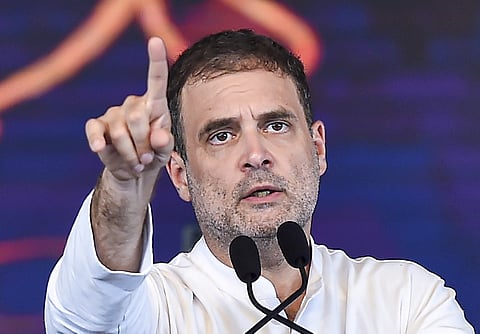
Rahul Gandhi attacks Modi government over UPI fee framework, alleges US pressure
Congress leader Rahul Gandhi has criticised the Narendra Modi-led government's latest move on Unified Payments Interface (UPI), alleging that it has opened the door to Merchant Discount Rate (MDR) charges on high-value merchant transactions and accusing the Prime Minister of being "compromised".
"The Modi government has quietly opened the door to imposing fees on UPI. Now, MDR (Merchant Discount Rate) can be levied on merchant UPI transactions above Rs 2,000. Even if these transactions account for just 5% of the volume, they make up nearly 65% of UPI's total transaction value," Gandhi, the Leader of the Opposition in the Lok Sabha, posted on X.
His remarks came after the government notified that banks and payment system providers cannot levy charges on UPI transactions of up to Rs 2,000 or on payments made through RuPay debit cards.
The September 14 notification, issued under Section 10A of the Payment and Settlement Systems Act, 2007, specifies RuPay-powered debit cards and UPI transactions up to Rs 2,000 as electronic modes of payment on which no direct or indirect charge can be imposed on the person making or receiving the payment.
However, the government has not specified an MDR rate for UPI transactions above Rs 2,000, nor has it formally imposed such a charge. So far, UPI transactions have remained free irrespective of the amount.
Opposition warns of higher costs for consumers
"The government says no fees will be charged to customers. But where will the fees imposed on shopkeepers ultimately come from? Added to prices, straight out of the customer's pocket," Gandhi said.
He alleged that American payment companies have long opposed India's zero-MDR policy and claimed that the Modi government had now created a route towards changing that policy.
"American payment companies have long opposed India's zero-MDR policy. Now, the Modi government has opened the path to changing the policy in exactly that direction. Just like with the US Trade Deal, Compromised PM Modi is once again surrendering to American pressure," Gandhi claimed.
Congress president Mallikarjun Kharge also attacked the government, alleging that instead of providing relief to an inflation-weary public, it was finding new ways to take money from their pockets.
"The Modi government's loot has now reached UPI. "No fees on UPI" has been changed to "no fees on UPI transactions up to Rs 2,000. Sky-high inflation has already emptied the common man's pocket. Wholesale inflation is near 10%, and the BJP government has planned to impose a 'Digital Payments Tax' on the public, aiming to destroy whatever little savings they have left," Kharge said in a post on X.
"Speaking of MDR, doesn't the government know that this additional burden on merchants will ultimately be recovered from the common consumer's pocket through price hikes?" Kharge said.
The Congress' criticism has centred on the fact that only a small share of person-to-merchant UPI transactions are above Rs 2,000, but these account for a disproportionately large share of transaction value. According to data reported after the notification, around 4% of P2M UPI transactions in 2025-26 exceeded Rs 2,000, while they accounted for about two-thirds of the value.
The BJP has rejected the Congress' interpretation, accusing the opposition of spreading "fake news" and pointing out that the government has not announced any charge on transactions above Rs 2,000.
Government cites sustainability of UPI ecosystem
The amendment to Section 10A of the Payment and Settlement Systems Act, 2007, was passed by Parliament during the Monsoon Session, which concluded on August 13.
Following the passage of the Bill, the government had said the UPI and Services Steering Committee, headed by the National Payments Corporation of India (NPCI), would decide on MDR rates.
In August, the Finance Ministry had clarified that consumers would not face transaction charges, all person-to-person UPI transactions would remain free, and any future MDR would apply only to a limited set of merchant transactions above a specified threshold. It also said any such MDR would be nominal and significantly lower than rates applicable to debit or credit cards.
Explaining the rationale for the legal amendment, the government said exponential growth in transaction volumes had created a need for significant and continuous investment in cybersecurity, fraud prevention and infrastructure.
Charges, it said, were required for market expansion and self-sustainability. The government also argued that a revenue model capable of sustaining the ecosystem was necessary to encourage more companies to expand their operations and increase competition.
Reliance on subsidies alone, it said, was not viable for the next phase of UPI's growth. A balanced framework was required to ensure that UPI remained robust, inclusive and future-ready.
The government had previously said that any future MDR would be restricted to select merchant transactions and that the vast majority of UPI transactions would continue to remain free for merchants as well.
UPI is operated by the National Payments Corporation of India (NPCI), an initiative of the Reserve Bank of India (RBI) and the Indian Banks' Association.
The latest notification therefore guarantees zero charges for UPI payments up to Rs 2,000 and RuPay debit card payments, while leaving the framework open for a future decision on charges for certain higher-value merchant transactions. No final MDR rate for such transactions has been announced so far.


