.png)
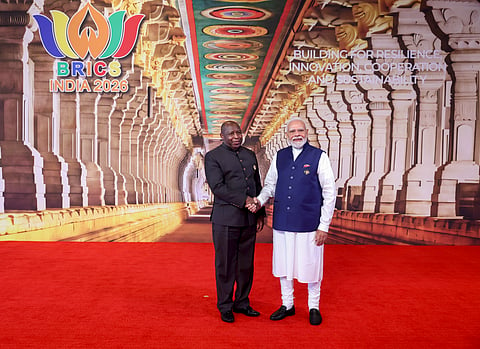
PM Narendra Modi highlights four pillars of India’s BRICS presidency as leaders gather in Delhi
Prime Minister Narendra Modi on Sunday said India’s BRICS presidency had been guided by four key pillars, resilience, innovation, cooperation and sustainability, as leaders of the expanded grouping gathered at Bharat Mandapam in New Delhi for the second day of the 18th BRICS Summit.
Modi said India, with the support of fellow BRICS members, had translated the grouping’s shared vision into “win-win collaboration”. Leaders took part in an official family photograph before the main session on “Resilience, Innovation, Cooperation and Sustainability”.
The summit, being held in New Delhi on September 12 and 13, has brought together leaders including Modi, Chinese President Xi Jinping, Russian President Vladimir Putin and Iranian President Masoud Pezeshkian.
New Delhi Declaration sets out broad cooperation agenda
BRICS leaders unanimously adopted the New Delhi Declaration 2026 at the summit on Saturday. Titled “New Delhi Declaration — Building for Resilience, Innovation, Cooperation and Sustainability”, the 140-point document covers a wide range of issues, including global governance, conflicts, terrorism, trade, climate change, healthcare, technology and development.
The declaration also strongly condemned the April 22, 2025 Pahalgam terror attack, which killed 26 people, and called for stronger international cooperation against terrorism, terrorist financing, networks and safe havens.
The grouping also called for dialogue, diplomacy and restraint in addressing conflicts in West Asia. It raised concerns over unilateral tariff and non-tariff measures and reiterated the importance of a more representative global governance system.
11-member bloc represents nearly half the world's population
BRICS currently has 11 full members: Brazil, Russia, India, China, South Africa, Egypt, Ethiopia, Indonesia, Iran, Saudi Arabia and the UAE.
According to India, the expanded grouping represents about 49.5% of the world's population and 40% of global GDP.
Among those attending the summit are Brazilian President Luiz Inácio Lula da Silva, South African President Cyril Ramaphosa, Egyptian President Abdel Fattah El-Sisi, Indonesian President Prabowo Subianto, Ethiopian Prime Minister Abiy Ahmed Ali and Abu Dhabi Crown Prince Sheikh Khaled bin Mohamed bin Zayed Al Nahyan.
Partner and outreach leaders include Malaysian Prime Minister Anwar Ibrahim and Vietnamese Prime Minister Le Minh Hung, among others.
Modi-Xi talks focus on ties, trade and border peace
One of the major diplomatic engagements during the summit was the meeting between Modi and Xi.
The two leaders discussed border peace, trade, business ties and ways to address trade imbalances. Xi's visit to India is his first in seven years, with the meeting taking place against the backdrop of efforts by New Delhi and Beijing to stabilise bilateral ties.
Modi also held talks with Putin, with discussions covering bilateral relations, trade, energy and wider geopolitical developments.
India has also used the summit to push for greater representation for developing countries in global institutions. Modi proposed a 10-point roadmap for global governance reforms aimed at helping the Global South move from being a “rule-taker” to a “rule-shaper”.
AI, UN reforms and national currencies among key priorities
The summit did not result in the creation of a common BRICS currency. Instead, members backed greater use of national currencies and efforts to improve cross-border payment systems.
The declaration also called for artificial intelligence to become more inclusive and accessible, while highlighting the need for greater representation of developing countries in international institutions.
India reiterated its push for reforms to the United Nations Security Council and greater representation for the Global South.
The BRICS agenda also covered global growth, development, cooperation and priorities of developing nations. The grouping's broader work continues to focus on political and security cooperation, economic and financial issues, and cultural and people-to-people exchanges.
Day two schedule at Bharat Mandapam
The second day of the summit began with leaders of BRICS member countries, partner countries and outreach invitees arriving at Bharat Mandapam.
The scheduled programme was:
9:55 am: Leaders began arriving at Bharat Mandapam.
10:35 am: Leaders posed for the official family photograph.
10:50 am: The open session began on “Resilience, Innovation, Cooperation and Sustainability: Shaping the Future for Inclusive Global Growth”.
Later in the day, Modi was scheduled to hold several bilateral meetings with visiting leaders.
The discussions are centred on strengthening global growth and development, deepening cooperation and advancing the priorities of the Global South.
Delhi traffic restrictions coincide with summit and T20I
The BRICS summit has also triggered extensive traffic restrictions across Delhi. Authorities have advised commuters to plan journeys in advance, use the Metro where possible and allow additional travel time. Delhi Traffic Police has planned diversions and regulated movement across key routes during the summit.
Additional restrictions are being imposed around the Arun Jaitley Stadium for the India-Afghanistan T20 international on Sunday. Traffic restrictions, diversions and parking regulations around the stadium are in effect from 2 pm onwards.
Commuters have been advised to avoid or take alternative routes around JLN Marg, Ashaf Ali Road, Bahadur Shah Zafar Marg and DDU Marg during the match period. Goods vehicles face restrictions on designated stretches.
Parking arrangements include Mata Sundari Road, Rajghat Power House Road and Velodrome Road, while designated cab pick-up points include Gate 2 near MAMC and Rajghat Chowk.
No-parking restrictions apply on stretches of B.S. Zafar Marg, DDU Marg, Mirdard Chowk, JLN Marg and the Ring Road near the Rajghat-ITO Flyover.
The India-Afghanistan T20I is going ahead as scheduled despite earlier concerns over the clash with BRICS security arrangements.
Authorities have advised people to monitor traffic updates, take alternative routes where necessary and allow extra time for travel. Vehicles violating restrictions may be towed or face prosecution.
