.png)
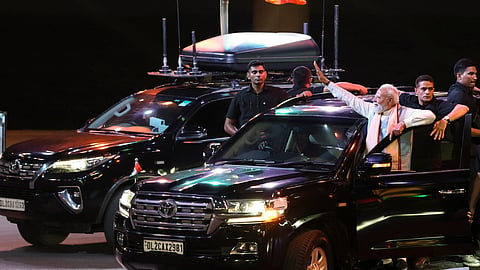
PM Modi set to become India’s longest-serving elected Prime Minister

Prime Minister Narendra Modi is set to create a political milestone on June 10, when he becomes the longest-serving elected Prime Minister in India’s history, surpassing the record held by the country’s first Prime Minister, Jawaharlal Nehru.
Modi, who first assumed office on May 26, 2014, after leading the Bharatiya Janata Party (BJP) to a decisive victory in the Lok Sabha elections, will complete 4,399 consecutive days as Prime Minister on June 10. This will take him past Nehru’s tenure of 4,398 days as an elected Prime Minister, which stretched from May 13, 1952, to May 27, 1964.
The achievement comes amid a period of remarkable political continuity in India. Modi has secured three consecutive mandates at the national level, a feat accomplished by only a handful of leaders in independent India. His tenure has coincided with significant shifts in governance, infrastructure development, welfare delivery and digital transformation.
Political observers note that the milestone is particularly significant given the scale and complexity of governing a country of more than 1.4 billion people, marked by vast linguistic, cultural and regional diversity. At a time when several democracies across the world have witnessed frequent changes in government and political instability, India has experienced sustained leadership under Modi.
The Prime Minister’s supporters point to a range of achievements during his tenure, including the expansion of digital public infrastructure, major investments in roads, railways and logistics, and targeted welfare schemes aimed at improving service delivery. India has also emerged as the world’s fastest-growing major economy in recent years and has expanded its diplomatic and economic engagement globally.
Modi’s political journey has also drawn attention because of his rise from a modest background to the country’s highest elected office without the backing of a political dynasty. The narrative has often been cited by the BJP as an example of the opportunities available within India’s democratic framework.
Over the past decade, India has sought to position itself as a leading voice on issues ranging from climate action and technology to the concerns of developing nations and the Global South. The government has also highlighted improvements in poverty reduction, financial inclusion and digital governance as key achievements of the period.
As Modi crosses the historic mark, the milestone is expected to trigger renewed debate over his political legacy, governance record and long-term impact on India’s democratic and economic trajectory. Regardless of political affiliations, the achievement places him in a unique position in the annals of Indian politics as the longest-serving elected Prime Minister since Independence.

