.png)
PM Modi says energy security investments helped India withstand Iran-Gulf war disruptions
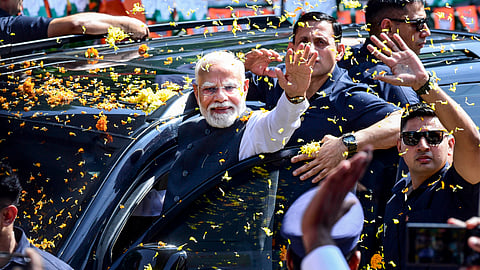
Prime Minister Narendra Modi on Friday said India's investments in energy security over the past decade had helped the country withstand disruptions arising from the conflict involving Iran and Gulf countries. He made the remarks while inaugurating and dedicating infrastructure projects worth more than ₹15,600 crore in Karnataka, spanning metro connectivity, railways, renewable energy, petroleum infrastructure and waste management.
Addressing a gathering at the Indian Institute of Management Bangalore (IIMB), Modi said India had strengthened its domestic fuel production, expanded crude oil storage facilities and diversified its energy sources through greater generation of solar, hydroelectric and wind power.
"War around Iran and Gulf countries shows how important energy security is. Steps taken for energy security in the last decade helped the country face the crisis with resilience," he said.
The Prime Minister added that investments in infrastructure and energy security were essential to India's economic growth and its ambitions of becoming a developed nation.
Bengaluru Metro crosses 100-km milestone
Earlier, Modi inaugurated a 7.5-km stretch of Bengaluru Metro's Pink Line, taking the city's operational metro network beyond 100 km. Bengaluru has become the third urban region in India, after Delhi-NCR and the Mumbai Metropolitan Region, to cross the milestone.
The newly inaugurated corridor connects Kalena Agrahara with Tavarekere and is expected to improve connectivity to IIM Bangalore, educational institutions and major commercial and technology hubs.
At the inauguration, Modi called Karnataka Chief Minister DK Shivakumar, who was standing some distance away, to join him. He took Shivakumar by the hand and brought him alongside before the two leaders flagged off the metro service.
Modi subsequently handed over the green flag to the Governor. He then purchased a ticket at the station counter and boarded a metro train for IIM Bangalore station, accompanied by Shivakumar, state minister Krishna Byre Gowda and Surya.
During the journey, the Prime Minister interacted with Gowda and was also seen sharing a light-hearted moment with the Chief Minister.
The Prime Minister said Bengaluru's metro network had expanded from just 17 km in 2014 to more than 100 km, reflecting the government's emphasis on improving urban mobility and making travel more convenient and affordable.
Energy infrastructure and renewable power expansion
At IIM Bangalore, Modi inaugurated several projects and laid foundation stones for infrastructure initiatives worth more than ₹15,600 crore. The projects include important energy assets intended to strengthen Karnataka's power transmission capacity, petroleum infrastructure and renewable energy network.
An underground LPG storage facility in Mangaluru will add 80,000 metric tonnes to India's storage capacity. The Devangonthi marketing terminal is expected to improve the distribution of petrol, diesel and aviation fuel.
A compressed biogas (CBG) plant in Bengaluru will produce approximately 13 tonnes of biogas every day. Apart from improving waste management, the facility is expected to help reduce India's dependence on imported natural gas.
The projects also include power transmission infrastructure at Koppal-II and Gadag-II, along with the Bidar transmission project and new transmission facilities for renewable energy zones in Davanagere, Chitradurga and Ballari.
Modi said India's renewable energy capacity had crossed 300 gigawatts, highlighting the country's growing reliance on cleaner energy sources.
He also referred to the PM Surya Ghar Muft Bijli Yojana, under which more than six million households across the country have installed rooftop solar systems. These include over 40,000 households in Karnataka, with each beneficiary household receiving around ₹80,000 in government assistance.
Under the PM-KUSUM scheme, more than 800,000 solar pumps are supporting agricultural irrigation in Karnataka.
"This means that Karnataka's food providers are now also becoming energy providers. These schemes are reducing electricity costs and creating new income and employment opportunities," Modi said.
Middle class emerging as a major growth engine
The Prime Minister also highlighted the expanding middle class and the emergence of a new aspirational section of society, describing them as significant drivers of India's economic growth.
He said rising demand for consumer goods, better education, healthcare, nutrition and travel was creating opportunities across several industries.
"From automobiles to electronics, from tourism to the service sector, new industries, factories and employment opportunities are emerging. In other words, this neo-middle class is becoming a major engine of growth for India's economy," he said.
Modi added that the government's efforts were aimed at increasing household savings, strengthening purchasing power and putting more disposable income in the hands of middle-class families.
He also referred to measures such as income-tax relief for individuals earning up to ₹12 lakh annually, changes to tax deduction at source (TDS) provisions and GST reforms intended to reduce the cost of everyday goods and services.
Space technology finding applications in everyday life
Later, addressing a gathering at the COSMOS Planetarium in Mysuru, which he inaugurated on Friday, Modi spoke about India's progress in astronomy, astrophysics and space exploration, emphasising how advances in space technology were increasingly benefiting ordinary citizens.
COSMOS-Mysuru is India's first LED-dome planetarium and has been developed by the Indian Institute of Astrophysics in collaboration with the University of Mysore. The facility is designed to promote astronomy education and scientific research through an immersive viewing experience.
Modi said rapid technological advancements were transforming the world and that India could not afford to slow down its progress in scientific research.
"In the past decade, India has progressed at an unprecedented pace in astronomy, astrophysics and the space sector," he said.
He credited the government's decision to open up the space sector to private participation with creating opportunities for companies, startups and young entrepreneurs.
"Our government opened up the space sector. This has created new opportunities for the private sector. Indian startups have also had the opportunity to showcase their capabilities. Today, our youth are launching their own rockets, putting satellites into orbit, and accomplishing many things in the space sector that have never been done before in India," he said.
The Prime Minister also highlighted the practical applications of satellite technology, including sending advance storm warnings to fishing boats and tracking their safe return to shore.
Satellite-based systems are also being used to monitor train movements and provide real-time information about their locations.
In agriculture, satellite imagery and other data are being used under the Pradhan Mantri Fasal Bima Yojana to estimate crop yields and determine insurance claims for farmers.
"This means that today our satellites are reaching the heights of space, and at the same time, they are being used to improve the lives of people on Earth," Modi said.
He added that India's expanding space capabilities and scientific research ecosystem were creating opportunities for young people while helping address practical challenges on the ground.


