.png)
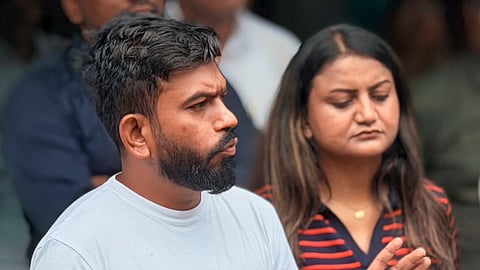
‘PM Modi is scared of youth’: CJP's Abhijeet Dipke heads to Delhi amid massive security clampdown
Cockroach Janta Party (CJP) founder Abhijeet Dipke on Saturday headed to Delhi from Mumbai to lead a planned demonstration at Jantar Mantar, accusing Prime Minister Narendra Modi of being afraid of the country's youth and describing him as a “dictator”.
Dipke questioned the extensive security arrangements and restrictions on public transport imposed ahead of the protest against Chief Election Commissioner Gyanesh Kumar over alleged irregularities in electoral rolls.
“Narendra Modi is a dictator. He is scared, which is why he has closed the Delhi Metro, roads, everything. If he is this scared of the youth of the nation, why is he sitting in the PM's post?” Dipke told reporters before leaving for the national capital.
In a subsequent conversation with news agency ANI, he questioned the deployment of police and security forces and the restrictions on movement in central Delhi.
“Do Narendra Modi and Amit Shah want to wage war against the people of their own country? Is Gyanesh Kumar so dear to them that they would unleash their police and army forces upon their own citizens?” he asked.
Dipke alleged that the measures reflected the Prime Minister's fear of losing public support. “PM Modi is afraid as he fears that the people of this country will not vote for him after this,” he said.
Defending the planned demonstration, the CJP founder invoked Article 19 of the Constitution, which guarantees several fundamental freedoms, including the right to assemble peacefully and without arms.
“Protesting is our fundamental right. Article 19 grants us the fundamental right to protest in a democratic and peaceful manner, and that is exactly what we intend to do,” he said.
The protest is aimed at demanding Gyanesh Kumar's resignation over allegations of irregularities in the revision of electoral rolls. The Delhi Police denied permission for the demonstration, citing concerns over law and order and the timing of the application. The organisers, however, maintained that they intended to proceed with the protest.
Security blanket across the national capital
Delhi was placed under an extensive security arrangement ahead of the expected gathering, with more than 40,000 Delhi Police and Central Armed Police Forces (CAPFs) personnel reported to be involved in the deployment.
Jantar Mantar, the intended venue, was sealed off, including to media personnel. Roads leading to the protest site were barricaded and manned by security personnel. Loudspeakers at three key entry and exit points broadcast warnings in Hindi and English against gatherings, processions, road blockades and other prohibited activities under Section 163 of the Bharatiya Nagarik Suraksha Sanhita (BNSS).
Delhi Police said more than 15,000 of its personnel had been deployed to manage the anticipated protest, while around 26,000 central force personnel were expected to be present in the city.
One of the heaviest deployments was at the Tolstoy Marg-Sansad Marg intersection, a key approach to Jantar Mantar, and outside the Parliament Street police station. At least two layers of barricades restricted pedestrian and vehicular movement towards the protest site.
The carriageway leading to the Ashoka Road roundabout was blocked at Connaught Place's Outer Circle, with traffic diverted to the opposite carriageway. Barricades, police vehicles and security personnel were also deployed along other important routes across central Delhi.
A senior police officer said the New Delhi district had been divided into 20 zones, each headed by an officer of deputy commissioner of police rank. Barricades were installed at 37 identified points from where protesters could potentially enter the area.
Officials familiar with the deployment arrangements said central forces had also been asked to send women personnel, including physically trained recruits, to manage and detain women protesters. Around 5,000 personnel from Haryana and Uttar Pradesh could also be deployed, an officer said.
The security arrangements were intended to prevent protesters from converging on Jantar Mantar despite the organisers' insistence that the demonstration would go ahead.
Metro restrictions and mobile internet suspension
The security measures extended to public transport and telecommunications, affecting commuters travelling through central Delhi.
The Delhi Metro Rail Corporation (DMRC) initially announced that entry and exit at 57 stations would be suspended from 9pm on Friday, October 9, through Saturday. It subsequently revised the list to 45 stations. Under the revised arrangement, entry and exit restrictions were scheduled to remain in force until 6pm on Saturday, while interchange facilities continued at affected stations except New Delhi Metro station.
In a separate order dated October 9, Delhi Police directed the suspension of mobile internet services within a four-kilometre radius of the Janpath-Kartavya Path crossing. The restriction was scheduled to run from 10pm on Friday until 10pm on Saturday.
Issued under the Telecommunications Act, 2023, and the Telecommunications (Temporary Suspension of Services) Rules, 2024, the order directed Airtel, Vodafone Idea, Jio and MTNL to implement the suspension.
The restrictions were imposed as authorities prepared for the anticipated gathering and sought to prevent disruptions around the protest site.
Traffic diversions and railway cancellations
A late-night Delhi Traffic Police advisory warned of disruptions across central Delhi, with diversions at 30 locations from 6am on Saturday, depending on the situation.
The affected stretches included the Dhaula Kuan flyover, Jhandewalan, Mandi House, Minto Road, Deen Dayal Upadhyay Marg, Lodhi Road flyover, Patel Chowk, Rail Bhawan and Windsor Place, as well as junctions around Connaught Place.
Jantar Mantar Road, Ashoka Road, Sansad Marg, Janpath and Barakhamba Road were also identified as routes that could face restrictions.
Commuters were advised to avoid non-essential travel and plan their journeys to railway stations, inter-state bus terminals and the airport in advance.
Railway services were also disrupted. The Railways cancelled mail and express trains scheduled to arrive at New Delhi and Hazrat Nizamuddin stations between 4am and 2pm on Saturday, citing the likelihood of severe road congestion.
The cancellations applied to trains scheduled to depart their originating stations after 2pm on Friday and arrive at either of the two stations during the specified period.
The restrictions on rail and metro services added to the difficulties faced by people travelling into and around the national capital during the security operation.
Hotels, hostels and temporary accommodation under scrutiny
Delhi Police also intensified checks at hotels, guest houses, hostels, paying guest facilities and other temporary accommodation across the Capital.
Officials said police personnel had been visiting these establishments to question occupants considered suspicious as part of the security arrangements ahead of the demonstration.
Officers were instructed to scrutinise stays between October 8 and 11, with particular attention to large groups, especially people in their 20s and early 30s, and the reasons visitors gave for travelling to Delhi.
The checks formed part of the broader effort to identify potential protesters and prevent unauthorised gatherings in the run-up to Saturday's demonstration.
Supreme Court weighs in on transport curbs
The extensive restrictions also drew judicial scrutiny. The Supreme Court, while hearing pleas challenging the measures imposed ahead of the protest, questioned the blanket curbs on public transport and asked the Centre and Delhi Police to lift them.
The court observed that authorities should adopt proportionate measures rather than impose sweeping restrictions that could affect ordinary commuters, workers and students.
Despite the restrictions and the denial of police permission, Dipke maintained that the CJP intended to pursue its demand for Gyanesh Kumar's resignation and proceed with its planned demonstration.
The confrontation has brought the party's allegations concerning electoral rolls, the government's security response and the constitutional right to peaceful protest into sharp focus.


