.png)
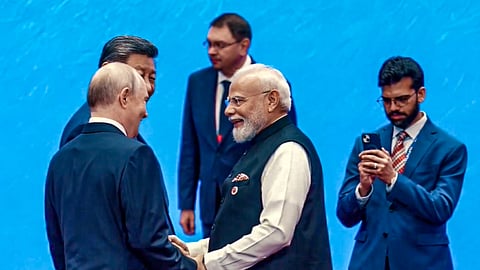
PM Modi calls for united SCO action against terror, warns against ‘double standards’
Prime Minister Narendra Modi on Tuesday called on the Shanghai Cooperation Organisation (SCO) to act decisively against countries using terrorism as an instrument of state policy, warning that there could be no place for “double standards” in combating the menace. Addressing the SCO Summit in the presence of Pakistan Prime Minister Shehbaz Sharif, Chinese President Xi Jinping and other leaders, Modi said the grouping must move beyond an “action-reaction approach” and dismantle the entire ecosystem supporting terrorism, including financing networks, recruitment, radicalisation and safe havens.
“We must speak with one voice and make it clear that there can be no place for double standards on this serious issue,” Modi said. “We must send a strong message to countries that use terrorism as an instrument of policy and provide safe haven and support to terrorists that terrorism can never be a strategic asset for anyone.” The remarks were widely seen as directed at Pakistan, though Modi did not name the country.
SCO echoes stand on terrorism
The Bishkek Declaration adopted at the summit strongly condemned terrorism in all its forms and emphasised the “inadmissibility of attempts to exploit terrorist, separatist and extremist groups for selfish purposes”. It also declared that double standards in combating terrorism were unacceptable and called for international cooperation against the cross-border movement of terrorists.
Turning to the crisis in West Asia, Modi said conflicts could no longer be viewed as geographically contained because their consequences spread rapidly across the interconnected global economy.
“The crisis in West Asia has demonstrated that a conflict in one region does not remain confined to that region,” he said, pointing to its impact on energy security, maritime trade and supply chains. He said countries of the Global South bore a disproportionate share of such disruptions and reiterated India's position that conflicts should be resolved through dialogue and diplomacy rather than on the battlefield.
The Bishkek Declaration expressed deep concern over developments in the Middle East, condemned military strikes against Iran and offered condolences over the death of Iranian Supreme Leader Seyyed Ali Khamenei. SCO members backed Iran's sovereignty and territorial integrity and called for the conflict to be resolved “solely through political and diplomatic means”. The declaration also said a comprehensive and just settlement of the Palestinian issue was essential for lasting peace and stability in the Middle East.
Sovereignty key to connectivity
In an apparent reference to China's Belt and Road Initiative, Modi said connectivity projects must respect the sovereignty and territorial integrity of all countries. India has consistently opposed the BRI because the China-Pakistan Economic Corridor passes through Pakistan-occupied Kashmir.
Modi said India supported initiatives connecting markets, facilitating trade and opening new development opportunities, but stressed that respect for sovereignty was fundamental to the SCO Charter. He also called for simpler customs procedures, greater use of digital documentation and more efficient logistics networks alongside improved road, rail and air connectivity.
On Afghanistan, Modi said peace and stability there were closely linked to the SCO's aspiration for a secure Eurasia. India, he said, would continue supporting Afghanistan through development initiatives and humanitarian assistance.
Roadmap for next 25 years
Modi framed India's approach to the SCO around three pillars — security, connectivity and opportunity — and called for translating them into concrete outcomes as the organisation marked its 25th anniversary.
He also stressed greater people-to-people engagement, saying the success of SCO cooperation should ultimately be measured by opportunities created for young people, new markets opened for entrepreneurs, technological benefits reaching farmers and improvements in citizens' lives.
Besides the Bishkek Declaration, SCO leaders adopted four memorandums of understanding and more than 20 decisions and statements covering areas including climate action, nuclear safety, energy conservation, biodiversity, scientific cooperation and combating drug trafficking.
The summit also approved initiatives to combat synthetic drugs until 2030, create an SCO Green Technology Corridor, develop ports and logistics centres during 2026-30 and establish regional data centres and computing capacity to support the development of artificial intelligence.


