.png)
Pakistan minister’s Delhi visit takes an off-itinerary turn, with Qutub Minar and Red Fort
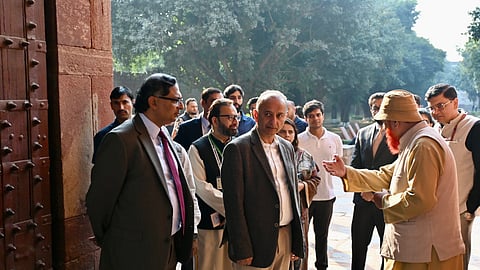
Pakistan’s first ministerial visit to India since Operation Sindoor saw an unexpected change of plans, with Federal Minister Musadik Masood Malik and his wife visiting Delhi monuments that were not included in the itinerary approved by the Indian government.
Malik, Pakistan’s Minister for Climate Change and Environmental Coordination, led the country’s delegation to the Shanghai Cooperation Organisation (SCO) Civilisational Dialogue Forum, held at Purana Qila from November 20 to 22. His visit marked the first by a Pakistani federal minister to India since former foreign minister Bilawal Bhutto Zardari attended an SCO meeting in Goa in May 2023.
Qutub Minar and Red Fort added to the sightseeing itinerary
The Pakistan High Commission had sought advance clearance for Malik and his delegation to visit five sites. Four were approved by the Indian government: the Taj Mahal in Agra, Humayun’s Tomb, Dilli Haat and Qila Rai Pithora. A request to visit Nizamuddin Dargah was declined on security grounds.
However, Malik did not follow the approved itinerary in full. A senior culture ministry official said the minister and his wife visited Humayun’s Tomb from the list of four approved sites, while skipping the Taj Mahal, Dilli Haat and Qila Rai Pithora because of his packed schedule.
Instead, the couple chose to visit Qutub Minar and the Red Fort, neither of which had been included in the sites originally sought by the Pakistan High Commission.
Culture Secretary Vivek Aggarwal said a liaison officer had been assigned to the visiting minister and his wife, who were “going to various monuments and various sites”. Malik’s office also shared details of his visits to Humayun’s Tomb and the Red Fort.
Pakistani official says she wanted to explore more of Delhi
Pakistan’s deputy national coordinator for the SCO, Farhat Ayesha, said she had hoped to see more of the capital but could not do so because of the demanding schedule of the conference.
“The city has cultural similarities with Lahore,” she said, adding that she had not even been able to see Purana Qila properly.
“I wanted to explore Delhi and see more of the city,” Ayesha said.
The SCO forum brought together representatives from member countries to discuss civilisational heritage, cultural exchange and shared histories. The event was hosted by India’s ministries of culture and external affairs, with the Indira Gandhi National Centre for the Arts serving as the knowledge partner.
India and Pakistan became permanent members of the SCO in 2017.
Lahore to host SCO cultural and tourism events in 2026-27
Ayesha also invited people to visit Lahore, which has been designated the SCO Tourism and Cultural Capital for 2026-27. The announcement was made at the 26th SCO Council of Heads of State summit in Bishkek on September 1, attended by Pakistan Prime Minister Shehbaz Sharif.
The rotating designation is intended to promote tourism and people-to-people exchanges among SCO member states. Previous cities to hold the title include Varanasi in India for 2022-23, Almaty in Kazakhstan for 2023-24, Qingdao in China for 2024-25 and Cholpon-Ata in Kyrgyzstan for 2025-26.
Pakistan, which holds the SCO presidency this year, has adopted the theme “Turning Vision into Action: Connectivity, Innovation and Shared Prosperity”. The country is scheduled to host several meetings next year, including a gathering of culture ministers and the SCO summit, Ayesha said.
Lahore and Delhi share a layered cultural history
Lahore, widely regarded as Pakistan’s cultural hub, is home to several historic monuments built during the period of undivided India. These include Lahore Fort, Badshahi Mosque and Shalimar Gardens, as well as centuries-old havelis in the city’s Walled City.
The city’s architectural and cultural heritage bears similarities to Old Delhi, reflecting centuries of shared history, artistic traditions and cultural influences across the region.
The SCO’s Tourism and Cultural Capital initiative seeks to highlight such heritage and encourage greater cultural engagement among member states, making Lahore’s designation an opportunity to strengthen tourism and people-to-people links across the region.
