.png)
Over 4,500 Indian seafarers in Gulf under watch amid maritime threats
More than 4,500 Indian seafarers aboard commercial vessels operating in and around the Persian Gulf are being closely monitored amid heightened maritime security risks, the Ministry of External Affairs said on Tuesday, days after attacks on merchant vessels left an Indian sailor dead and another missing.
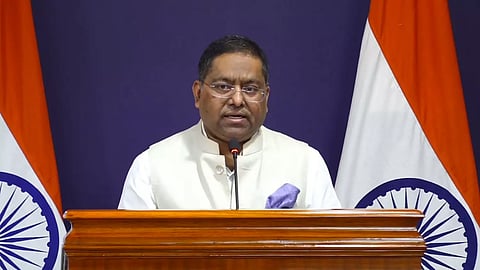
MEA spokesperson Randhir Jaiswal said the Ministry of Ports, Shipping and Waterways was monitoring the movement of vessels and the welfare of Indian crew members, with Indian missions and other stakeholders prepared to provide assistance when required.
163 aboard 12 vessels
Jaiswal said 163 Indian seafarers were currently aboard 12 commercial vessels in the Persian Gulf, west of the Strait of Hormuz. Six of these are India-flagged commercial vessels, while another six are foreign-flagged ships carrying cargo to India.
Apart from these vessels, more than 4,500 Indian seafarers are serving aboard various commercial ships operating in the wider region. The government is keeping track of their movement and welfare as security concerns persist along crucial maritime routes.
Government monitoring crews
“The Ministry of Shipping continues to monitor the movement of these ships and is looking at the well-being of all these seafarers,” Jaiswal said. He added that Indian embassies and other stakeholders would provide assistance whenever required.
The MEA said India remained committed to the safety and welfare of its seafaring community abroad. New Delhi has repeatedly condemned attacks on civilian shipping and disruptions to free and safe navigation through international waterways since the escalation of the West Asia conflict.
Indian sailor killed
The heightened monitoring follows a series of attacks on commercial vessels. External Affairs Minister S Jaishankar said last week that an Antigua and Barbuda-flagged bulk carrier, MV Cape Dao, had been attacked in the Gulf of Oman, killing an Indian sailor.
Around 10 days earlier, the Panama-flagged oil tanker EL Gaia was struck while transiting the Strait of Hormuz, with an Indian crew member reported missing after the incident.
Jaishankar said such attacks could no longer be treated as exceptional incidents, pointing to repeated threats to commercial shipping and mariners across the Gulf, Red Sea and surrounding waters.
Attacks beyond Gulf
India has also raised concerns over attacks on merchant vessels in the Black Sea. According to Jaishankar, MV Omorfi was hit in Russian territorial waters on July 18, killing its chief officer, an Indian national.
A day later, MV Golden Leo was struck after leaving Odesa, resulting in the deaths of four Indian seafarers. India has cited these incidents while calling for greater international cooperation to protect civilian shipping and crews operating through conflict-affected waters.
Global initiative
India and Liberia recently launched the Group of Friends on Safety and Security of Shipping and Seafarers, bringing together countries to focus attention on threats faced by commercial shipping and maritime workers.
India is among the world's largest suppliers of seafarers, while Liberia operates one of the world's biggest shipping registries. New Delhi has argued that protecting mariners is essential not only for their personal safety but also for maintaining global trade and supply chains.
Emergency support network
India has also proposed the creation of a Seafarers Emergency Support Network to connect maritime authorities and embassies of participating countries. The proposed mechanism is intended to facilitate distress alerts, medical assistance, communication with families and evacuation support during emergencies.
With more than 80 per cent of global trade by volume moving by sea and nearly two million seafarers serving the world's merchant fleet, India has sought stronger international mechanisms to protect civilian crews from conflicts spilling into commercial shipping lanes.


