.png)
NDA MPs asked to put travel plans on hold as Parliament session likely before December 15
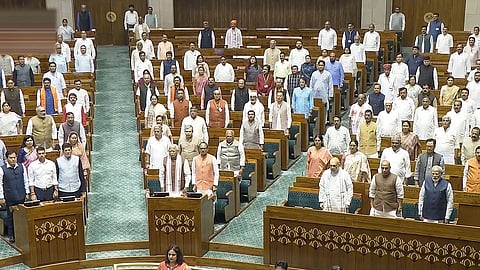
Ministers and MPs belonging to the ruling National Democratic Alliance (NDA) have been asked to remain available and are putting travel plans on hold as the government prepares to convene Parliament, possibly before December 15, amid uncertainty over the timing and format of the next session.
Prime Minister Narendra Modi is learnt to have indicated at Wednesday’s Union Cabinet meeting that Parliament could meet before mid-December. Ministers have reportedly been advised against overseas travel and engagements in the run-up to the sitting.
A lawmaker said there had been no formal instruction to MPs, but an understanding that Parliament could be convened at short notice. “There are indications that the session may be convened in the first week of December,” the lawmaker said.
Monsoon session remains unprorogued
The Monsoon Session, which was adjourned sine die on August 13, has not yet been formally prorogued. The delay has fuelled speculation that the government may reconvene the existing session for a brief sitting rather than summon Parliament afresh.
The opposition has questioned the government’s decision to keep the session pending, with no official explanation offered so far. Union Parliamentary Affairs Minister Kiren Rijiju has maintained that there is nothing unconstitutional about the delay.
The arrangement could allow the government to call Parliament with just a few days’ notice. Under parliamentary procedure, a fresh session requires the President to summon both Houses, while an unprorogued session can be resumed without a new summons. Lawmakers are generally given at least a couple of weeks’ notice for a regular session.
Delimitation and women’s reservation on legislative agenda
The uncertainty comes as the government seeks to secure passage of the delimitation and Constitution amendment bills linked to the implementation of 33 per cent reservation for women in the Lok Sabha and state assemblies by 2029.
The Centre has reached out to opposition parties, urging them to set aside political differences and support the legislation. The proposed constitutional amendment seeks to increase the Lok Sabha’s strength from its present 543 seats to a maximum of 850 through delimitation, while maintaining proportional representation for states.
The bills are considered necessary for rolling out the women’s quota. The government has said the proposed expansion would ensure that states retain proportional representation, even as the number of parliamentary constituencies increases.
Opposition seeks assurances in the bills
Opposition parties have insisted that the government’s assurances on state representation be incorporated into the legislation itself. Some parties have also argued that the women’s reservation should be implemented using the existing strength of the Lok Sabha, rather than being linked to an increase in seats through delimitation.
The proposed constitutional amendment will require a special majority in Parliament. The government’s earlier attempt to pass the legislation was defeated in the Lok Sabha in April after it failed to secure the required numbers, making opposition support a key factor in its renewed effort.
Recent reports suggest the government is weighing a sitting before December 15, although the final dates and whether Parliament will meet as a special or winter session remain uncertain.


