.png)
Navy chief urges Agniveers to pursue full careers under revamped Agnipath scheme
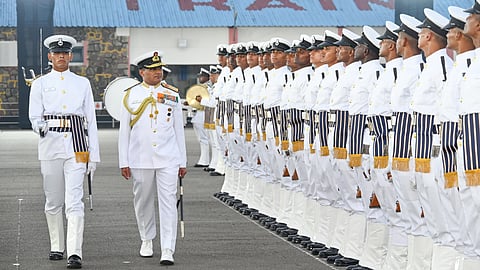
Navy Chief Admiral Krishna Swaminathan on Friday encouraged the Indian Navy's latest batch of Agniveers to aspire to permanent service, highlighting the additional opportunity created by the Centre's revamped Agnipath scheme. Addressing more than 3,300 recruits at the INS Chilka training establishment in Odisha, he urged them to work towards building long and rewarding careers in the Navy.
The passing-out parade included 2,756 Agniveers, making it the first batch to complete training and join service under the revised Agnipath framework. The recruits also included naval medical assistants and regular Naviks of the Indian Coast Guard.
Swaminathan was the chief guest and reviewing officer at the ceremony. Addressing the newly inducted sailors, he said the changes to the recruitment scheme had created an additional opportunity for those seeking a long-term career in the armed forces.
"I need to mention that during your training here at Chilka, there has been an important addition to the Agnipath scheme. You now have an additional opportunity to become a regular sailor and build a long and rewarding career in the Indian Navy," he said.
The Navy chief encouraged the recruits to aim for permanent positions, but emphasised that their performance and conduct would determine their prospects.
"I would encourage each one of you to pursue a full career in the service. The Navy can offer you the opportunity, but you must earn it through your performance, conduct, behaviour, commitment and competitiveness. So, work hard from day one, make the most of every facility and opportunity you get, and strive to be among the best," he said.
He also urged the recruits to master their respective professions, continue learning throughout their careers and uphold a strong value system.
Navy chief highlights changing nature of warfare
Swaminathan told the recruits that they were joining the Navy at a significant time, with technological advancements rapidly transforming maritime warfare.
He pointed out that satellites, drones, artificial intelligence, quantum technologies and autonomous systems were changing the nature of naval operations and the way battles were fought at sea.
Of the lakhs of candidates who had applied for recruitment, only around 1.5% had successfully cleared the selection process, he said, adding that the recruits had earned their positions through intense competition.
The Navy chief also spoke about the professional and personal opportunities offered by a career in the armed forces, describing naval service as an experience unlike any other.
"It offers adventure and challenge. It also offers opportunities for professional growth and personal development that few other careers can match. There will be tough days, but there will also be many moments of achievement, happiness, satisfaction and quiet pride. Above all, you will have the honour and privilege of serving your country and making a difference," he said.
What changes under the revamped Agnipath scheme?
The Union Cabinet approved significant changes to the Agnipath recruitment scheme on November 4, with Chief of Defence Staff General NS Raja Subramani announcing the revised framework.
Under the original arrangement, Agniveers were recruited for four years, after which 25% of each batch could be selected on merit and organisational requirements for permanent service in the armed forces. The remaining 75% were required to leave after completing their contractual tenure.
The revised framework provides the latter category with an additional two-year engagement period, giving them another opportunity to qualify for regular service. Following completion of the extended tenure, they will be considered for enrolment as regular personnel, subject to their willingness and fulfilment of prescribed selection criteria.
The second engagement period will also come with higher remuneration, an enhanced Seva Nidhi package and seniority benefits, according to the Ministry of Defence.
The revised provisions apply exclusively to the approximately 3 lakh Agniveers currently serving in the three armed forces. The government is expected to make further changes to the framework for recruits inducted after December 31.
The overhaul was announced weeks before the first batch of Agniveers was due to complete its four-year tenure. Under the earlier arrangement, only 25% of the recruits were to be retained for another 15 years, while the remaining personnel would have been discharged.
Around 18,300 Agniveers out of the 24,400 recruited into the Army, Navy and Air Force in the first recruitment cycle were scheduled to leave service between mid-November and December 31.
The revised framework creates an additional pathway for these personnel to continue serving, with the possibility of eventually joining the regular armed forces.
Army and Air Force Agniveers to pass out in December
The INS Chilka ceremony marks the first passing-out parade of Agniveers following the announcement of the revised framework. The Navy's latest batch completed its 16-week initial training at the Odisha-based establishment.
The next batches of Army and Indian Air Force Agniveers are scheduled to complete their training and pass out of their respective establishments in December.
The changes to the Agnipath scheme followed an assessment of the programme's performance over its first four years. The Defence Ministry said feedback from the armed forces highlighted improvements in physical fitness, morale, motivation, discipline, technological adaptability and the skills of Agniveers.
The government has maintained that the revised arrangement seeks to balance the career aspirations of young recruits with the operational requirements of the armed forces.


