.png)
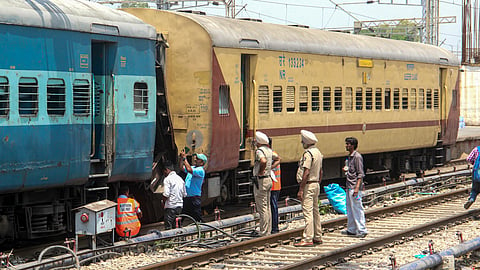
Ludhiana coach uncoupling | Experts flag poor maintenance, negligence amid safety drive

A section of railway experts has flagged "poor maintenance" of passenger coaches as a key factor behind coach uncoupling during train operations, following a similar incident at the Ludhiana railway station on June 6. A major tragedy was averted when the coupling connecting two coaches of the Katra-bound Malwa Express broke unexpectedly in Ludhiana, causing significant damage to one of the coaches. A day after the incident, the Railway Ministry launched a safety drive, directing all zonal railways to identify passenger coaches with rusted or corroded critical components. "Photos of the incident show that the coach's underbody and the section where it connects to other coaches were severely damaged," a railway expert said. He added, "When a coupling breaks on a moving train, the powerful pulling forces place extreme stress on the coach's main structural frame. If the metal has been weakened by corrosion or age, it can tear apart like this," he explained.
In the recent years, the uncoupling of coaches has raised serious concerns about the operational safety of passenger train services. The issue was also discussed at the Principal Chief Mechanical Engineers' Conference held in Puri in August 2025. The prevention of jerks and train parting in LHB coaches through improved coupler design and maintenance was identified as a key area requiring attention. In 2024, two major incidents involving the uncoupling of coaches on the Kisan Express and Magadh Express drew the railways' attention to issues of poor maintenance and corrosion of critical components.
Shedding light on the causes, the railways had said that the unusual occurrence of train uncoupling during operations could be attributed to a combination of factors, including improper coupling, material properties, corrosion due to adverse weather conditions, and wear and tear during train operations. Responding to questions raised in Parliament, Railway Minister Ashwini Vaishnaw earlier said, "The particular incidents involving the said trains occurred due to corrosion in a component of the coupler. After a detailed investigation, a material specification with increased corrosion resistance was introduced to address such cases." "Further, advanced semi-automatic couplers have also been developed for use in Amrit Bharat and Vande Bharat trains, enabling automatic coupling between coaches," he added.
Explaining other causes, experts said that metal fatigue, often manifested as hairline cracks, can develop due to constant movement and jerks. If these defects are not detected during ultrasonic flaw detection (USFD), the coupling may fail under excessive strain. Besides, they added that locking mechanism failure, as well as the lack of effective buffer gear and shock absorption, are other factors that can lead to the sudden uncoupling of coaches. "If the coach was equipped with a centre buffer coupler (CBC), the interlocking mechanism or knuckle may have been damaged or may not have locked properly, causing it to open or break unexpectedly," another railway expert said.
He added, "Buffers between coaches are designed to absorb shock forces. If the buffer springs or pads have lost their elasticity, the entire shock is transmitted directly to the coupling, increasing the risk of it snapping." The experts noted that while ICF and LHB coaches are equipped with several safety systems to prevent major tragedies in the event of uncoupling, regular non-destructive testing of draft gear, knuckles, and coupling pins during primary and secondary maintenance remains essential.

