.png)
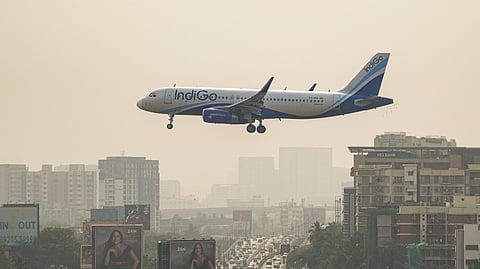
IndiGo limping back to stability; over 1,800 flights being operated on Monday

IndiGo, which has spent the past week grappling with massive operational chaos, is slowly restoring stability across its network. The airline expects to run over 1,800 flights on Monday out of its schedule of more than 2,300, signalling a gradual return to normalcy. Its on-time performance — which had plunged to unprecedented lows during the disruption — climbed back to 91 per cent on Monday. Although more than 500 flights were still cancelled, the number marked a noticeable improvement when compared to the previous four days of widespread cancellations.
The airline said its board has been holding frequent meetings through the crisis, and a crisis management group (CMG) appointed by the board has been reviewing the situation daily. IndiGo stated that operations across the network have shown “consistent and significant improvement,” adding that customers are being informed of cancellations in advance. Refunds amounting to ₹827 crore have already been processed for affected passengers, with the remainder being cleared for flights cancelled until December 15.
IndiGo’s recovery trajectory has been uneven. The airline managed just over 1,650 flights on Sunday, an improvement from 1,500 on Saturday and more than double Friday’s approximately 700 flights — the worst day of the disruption, when cancellations crossed 1,000. The airline had then undertaken a full-scale “network reboot,” resetting rosters and schedules to curb cascading delays. On-time performance mirrored this volatility: from a historic low of 3.7 per cent on Friday to 20.7 per cent on Saturday, before rising sharply to 78.2 per cent on Sunday.
The root of the turmoil lies in severe crew shortages triggered by the second phase of India’s revised Flight Duty Time Limit (FDTL) norms. According to the Directorate General of Civil Aviation (DGCA), IndiGo under-estimated the number of crew members needed to comply with the new requirements, leading to what the airline itself admitted were planning gaps and misjudgements.
The nationwide fallout was immediate. As India’s dominant airline with over 60 per cent domestic market share, IndiGo’s disruptions sent ripples through airports across the country. In response, the DGCA granted IndiGo temporary exemptions from certain night-duty restrictions under the FDTL norms for its A320 pilots. These relaxations — valid until February 10 — are intended to give the airline breathing room to rebuild rosters and stabilise schedules.
Even so, scrutiny from the government and regulator has intensified. A DGCA inquiry panel is investigating the disruption, and show-cause notices have been issued to CEO Pieter Elbers and COO Isidre Porqueras. Civil Aviation Minister K. Rammohan Naidu has publicly stated that the lapses were avoidable, promising strict action once the inquiry concludes.
IndiGo’s board, under pressure for its handling of the crisis, has been meeting regularly alongside the CMG — formed on December 4 — to monitor recovery efforts. The CMG comprises chairman Vikram Singh Mehta, directors Gregg Saretsky, Mike Whitaker, and Amitabh Kant, along with CEO Elbers.
Although all airlines are subject to the new FDTL rules, industry observers note that IndiGo was particularly exposed due to its vast fleet, dense schedule, heavy reliance on night operations, and high crew utilisation with minimal buffers. With over 400 aircraft and more than 2,300 daily services, the airline operates at a scale unmatched in India — Air India, the next largest group, flies less than half as many daily departures.
Despite the turbulence, IndiGo maintains that it continues to comply fully with all safety and FDTL regulations. The airline said Monday that it is working closely with authorities to restore normal operations as quickly as possible.

