.png)
India-US trade deal in final stretch, remaining concerns largely on American side: Jaishankar
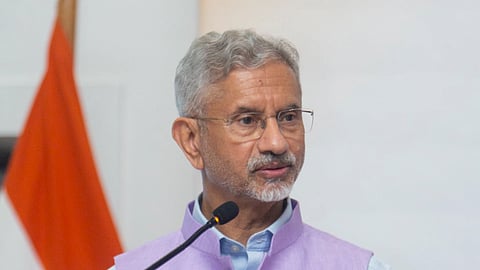
External Affairs Minister S Jaishankar on Friday said India and the United States were in the final stages of negotiations for a bilateral trade agreement, expressing hope that the deal would be concluded soon. He said most of the issues had been resolved and that several of the remaining concerns were more on the American side than on New Delhi's.
Speaking at the Hindustan Times Leadership Summit 2026, Jaishankar stressed that India was seeking a balanced agreement that would be mutually beneficial to both countries.
“It is certainly our hope and, I would say, in many ways, our expectation that we are in the final stretch. That is no secret. If Mr Piyush Goyal were sitting here, he would be able to give you a more detailed answer. But my understanding, since we consult very closely on this matter, is that we have sorted out the bulk of the issues. There are a few remaining issues to be addressed,” he said.
Explaining that the outstanding concerns were not necessarily on India's side, the minister added that the changes required during the negotiations had largely been on the American end.
“In many cases, these concerns are not so much on our side, because the changes have been more on the American side than ours. So, the hope is that we should be able to conclude the deal soon,” he said.
India-US negotiations in final stages
Jaishankar's remarks come as New Delhi and Washington continue efforts to finalise a bilateral trade agreement after more than a year of negotiations. The two countries are seeking to expand market access and address differences over tariffs, agricultural products, industrial goods and regulatory barriers.
The immediate focus is on concluding the first tranche of the agreement. Negotiations have continued despite changes in the US tariff framework, which have complicated the process. An Indian official said on November 10 that discussions between the two sides were still underway to finalise the first tranche, with recent talks also covering customs and trade facilitation.
Commerce and Industry Minister Piyush Goyal has been closely involved in the negotiations. Jaishankar said he regularly consults Goyal on the matter and indicated that the commerce minister would be better placed to provide details about the remaining issues.
India's objective, he emphasised, is to secure an agreement that delivers balanced benefits rather than simply concluding negotiations quickly.
Jaishankar recalls nuclear negotiations
Addressing questions about the time required to complete the agreement, Jaishankar said impatience was common during the closing stages of major negotiations. However, he cautioned against expecting negotiators to disclose specific details while discussions were still underway.
“In the final stages of any negotiation, everybody becomes impatient. People want to know what the specific issues are and how long it will take. Negotiators don't usually disclose such details during a negotiation,” he said.
Drawing on his experience in diplomacy, the minister recalled being involved in nuclear negotiations several years ago, when similar questions were raised about the timeline and obstacles to reaching an agreement.
“Many years ago, I was involved in a nuclear negotiation, and we went through a very similar experience. People would ask: How long will it take? When will you conclude it? What is holding it up?” he said.
His comments came amid continued diplomatic engagement between New Delhi and Washington to resolve the outstanding differences and bring the trade pact to completion.
Changing world order and global conflicts
Beyond trade, Jaishankar also discussed the geopolitical shifts shaping international relations, including the conflicts in West Asia and Ukraine and the crises affecting parts of Africa.
He said the world was undergoing a readjustment of its existing order, driven in part by the emergence of new powers and changing global influence. The rivalry between the United States and China was one of the factors contributing to current international tensions, he said, but it was not the only reason behind the growing friction.
The minister emphasised that the changing geopolitical environment required countries to respond to multiple sources of uncertainty rather than view global tensions through the prism of a single rivalry.
He also underlined the importance of strong and steady leadership in navigating the current period of international uncertainty.
Separately, discussions on India's economic competitiveness have remained an important part of the broader trade agenda. The government has been seeking to strengthen domestic manufacturing through production-linked incentive schemes, improve infrastructure and logistics, support small and medium enterprises, and build capabilities in sectors such as semiconductors, life sciences and artificial intelligence.
These efforts are aimed at strengthening India's position in global supply chains and ensuring that the country can compete more effectively as the international economic and political order evolves.


