.png)
India rebukes UN rapporteur over Dawood Ibrahim report, reaffirms his links to Pakistan
India has strongly criticised United Nations Special Rapporteur Ben Saul over a counter-terrorism report that described underworld don Dawood Ibrahim as the leader of the “India-based” D-Company criminal gang with terrorist links. New Delhi accused the rapporteur of factual inaccuracies and called for greater impartiality and accountability in the preparation of UN reports.
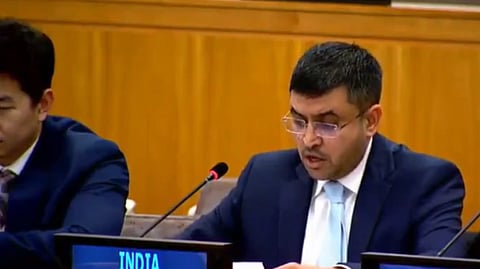
Raghoo Puri, First Secretary at India's Permanent Mission to the United Nations, expressed “serious concern” over the release of reports containing factual errors for which, he said, special rapporteurs were not held accountable.
“This presents Member States with a fait accompli, which is unfortunate for this organisation that is facing challenges of legitimacy,” Puri told the UN General Assembly.
India argued that the report's description of Dawood and D-Company did not adequately reflect the history of the criminal network's alleged involvement in terrorist attacks against India or the circumstances surrounding Dawood's designation under the UN sanctions regime.
India says report omits Dawood's role in 1993 terror attacks
Puri said Dawood was a wanted criminal in India over terrorist attacks dating back to 1993, well before the United Nations Security Council listed him in 2003 for links to Al-Qaeda.
He acknowledged that the report referred to the Security Council's listing of D-Company's leader over his association with the terrorist organisation, but argued that the wording gave an incomplete account of the case.
“This line paints a very different picture from the actual reality,” Puri said.
He pointed to the narrative summary of reasons for Dawood's designation under the UN's 1267 sanctions regime, which, he said, clearly recorded that D-Company and its listed leader had been wanted in India in connection with terror attacks since 1993.
“Not mentioning this fact is regrettable, and such incompetence on the part of special mandate holders does this organisation tremendous harm,” the Indian diplomat said.
Puri stressed that Dawood had been wanted in India long before his 2003 listing, which was linked to his association with Al-Qaeda and its founder, Osama bin Laden, while he was operating outside India.
He also reiterated India's position that Dawood resides in Pakistan. Referring to the UN listing entry, Puri said the underworld figure remained a wanted criminal in India and lived in the same country where bin Laden was found and killed by United States forces in 2011.
India has long accused Pakistan of harbouring Dawood, who is wanted in connection with major terrorist attacks and other criminal activities. Pakistan has denied allegations of supporting or sheltering terrorists.
India says human rights cannot be used to justify terrorism
India also challenged what it described as bias in the report, arguing that human rights principles should not be used to protect individuals or groups responsible for terrorism, radicalisation and extremism.
“It seems to have become fashionable for sponsors of terror to use human rights and the framework of counterterrorism to justify their misdeeds,” Puri told the assembly.
“The human rights framework cannot be the refuge of the perpetrators of terror and those who propagate radicalisation and extremism. Terrorism can never be justified,” he added.
New Delhi maintained that counter-terrorism assessments must accurately reflect the available facts and should not overlook the history of terrorist activity attributed to individuals or organisations under scrutiny.
India rejects Pakistan's remarks on Jammu and Kashmir
Puri also responded to statements made by Pakistan's delegation at the UN, dismissing its allegations against India as politically motivated propaganda.
He said the remarks concerning India, including those relating to the Union Territories of Jammu and Kashmir and Ladakh, were intended to serve narrow political interests.
“Regarding the statement just made by the delegate of Pakistan, everyone in this room knows that what has been mentioned against my country, including about the Union Territories of Jammu and Kashmir and Ladakh, is pure propaganda made for very narrow political gains. And these have been on account of the actual rulers of Pakistan, which is its military,” he said.
Reiterating India's position on the two Union Territories, Puri added: “I would like to reiterate for the record that Jammu and Kashmir and Ladakh are inalienable parts of India, have been so, and will always remain so.”
India pushes back against UN criticism over handling of protests
The latest exchange came a day after India criticised what it described as the selective use of human rights concerns to exert political pressure on countries. The response followed concerns raised by more than 20 UN human rights experts in Geneva over what they called a “repeatedly heavy-handed police response” to youth-led protests in Delhi.
Barkha Tamrakar, deputy secretary in the Ministry of External Affairs, delivered India's statement before the UN General Assembly's Third Committee on Tuesday. She said India engaged with international human rights mechanisms but expected the process to be guided by dialogue, consultation, cooperation, non-selectivity and transparency.
“India engages with international human rights mechanisms, but such engagement must be based on dialogue, consultation, cooperation, with non-selectivity and transparency as guiding principles,” Tamrakar said.
She added that India was prepared to address specific allegations supported by proper documentation through established channels. However, she objected to what she described as attempts to portray the country negatively on the basis of unverified claims and incomplete data.
Tamrakar said India opposed any “attempt to convert unverified allegations, incomplete statistics or a report that contains no India country observation into a negative characterisation of the world's largest democracy”.
The statement followed criticism by UN experts of police handling of youth-led demonstrations in Delhi and other areas over the preceding three months. The experts urged Indian authorities to protect peaceful protests and ensure justice for alleged human rights violations during the demonstrations and earlier incidents.
New Delhi calls earlier UN report 'hearsay'
India's latest criticism also follows its rejection last week of a report by a UN human rights expert concerning a satirical political movement formed by young people in India.
The report referred to alleged retaliation against members of the movement. New Delhi dismissed the claims as “hearsay” and urged the expert to verify the allegations before making statements that, in India's view, risked vilifying the country on the basis of unverified information.
Across the recent exchanges, India has maintained that UN human rights and counter-terrorism mechanisms must operate impartially, rely on verified information and avoid selective criticism. Its latest intervention over the Dawood Ibrahim report reflects that position, with New Delhi arguing that factual omissions in assessments of terrorism can undermine the credibility of the United Nations and its reporting mechanisms.


