.png)
India hits back at US over ‘offensive’ remarks on Indian workers, flags green card curbs
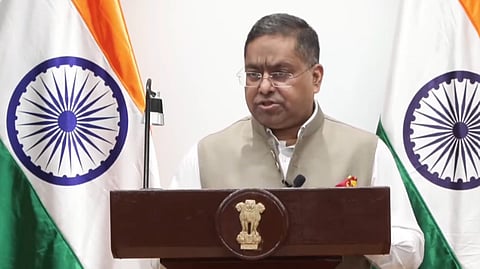
India has criticised the United States over its suspension of applications under the Permanent Labour Certification (PERM) programme for certain companies, warning that the move does not advance the shared ambitions of the two countries. The Ministry of External Affairs (MEA) also objected to remarks by the US Vice-President about foreign workers, describing the characterisation of Indian professionals as unwarranted and deeply offensive.
MEA spokesperson Randhir Jaiswal said on Friday that the suspension would not, by itself, affect the validity of existing H-1B visas or the status of their dependants. However, he acknowledged that the decision could affect the green card process for eligible employees of the companies concerned.
“The suspension of PERM applications does not, by itself, affect the validity of H-1B visas or the status of H-1B visa holders and their dependents,” Jaiswal said.
He added that the measure could have implications for the permanent residency process of eligible employees whose employers had been affected by the suspension.
The US administration announced the move against eight technology companies, including Indian IT majors Tata Consultancy Services, Infosys, Wipro and HCL, as well as Microsoft, Adobe, Capgemini and Cognizant. The action has raised concerns among Indian professionals who rely on employer-sponsored green cards to secure permanent residency in the US.
India stresses mutual benefits of skilled talent mobility
Jaiswal emphasised that the movement of skilled professionals benefits both countries by supporting innovation, research, productivity and economic growth.
“It should also be clear that talent mobility adds value to both economies, that of India and that of the United States,” he said.
“While it creates opportunities for Indians, it equally benefits U.S. companies by providing access to cutting-edge talent, innovation, research, productivity, competitiveness, and job creation.”
The MEA spokesperson said skilled Indian professionals also contributed to shareholder wealth in the US, describing talent mobility as an area of “tremendous mutual benefit” for both countries.
He said India expected all stakeholders involved in the process to recognise the economic value of cross-border talent movement.
“Our expectation is that all stakeholders in this process will appreciate this fact. The steps announced by the U.S. do not advance the shared ambitions of both countries. We continue to follow developments on this particular issue,” Jaiswal said.
The remarks came amid heightened scrutiny of US immigration policies and their impact on technology companies that employ skilled workers from overseas. The PERM programme is a key step in the employment-based green card process. It requires employers to establish that there are not sufficient available, qualified and willing US workers for the position being offered to a foreign employee.
MEA calls US Vice-President’s remarks on Indian professionals offensive
Jaiswal also responded to comments made by US Vice-President JD Vance, who had described foreign workers brought to the US on H-1B visas as “foreign indentured servants” while criticising companies over their use of the visa programme.
The MEA spokesperson said the description was unwarranted and failed to acknowledge the contribution of Indian professionals to the American economy and its innovation ecosystem.
“Regarding the comments made by the US Vice President, let me say that we believe such descriptions are unwarranted and ignore the fact that Indian professionals in the United States are highly educated and skilled contributors to its economy and innovation ecosystem,” Jaiswal said.
He pointed to the role played by successive generations of immigrants in shaping the United States, saying their labour, enterprise and innovation had contributed to the country’s economic growth and prosperity.
“Resorting to terminology that carries painful historical and colonial legacy connotations is deeply offensive,” he added.
India’s response highlighted the contrast between the contributions of skilled foreign workers to the US economy and the language used to describe them amid the administration’s tightening of immigration rules.
PERM suspension does not automatically invalidate H-1B visas
The MEA’s clarification drew a distinction between the PERM process and the H-1B visa system. The suspension does not automatically invalidate existing H-1B visas or change the status of visa holders’ dependants, but it could delay or disrupt the route to permanent residency for eligible employees of affected companies.
For Indian professionals who have spent years working in the US while pursuing employer-sponsored green cards, the distinction is important. A disruption to PERM applications can create uncertainty over long-term residency plans even when their current work visas remain valid.
The latest move forms part of a wider US effort to scrutinise employment-based immigration and the use of foreign workers by technology companies. India said it would continue to monitor developments while reiterating that skilled talent mobility supports the economic interests of both countries.


