.png)
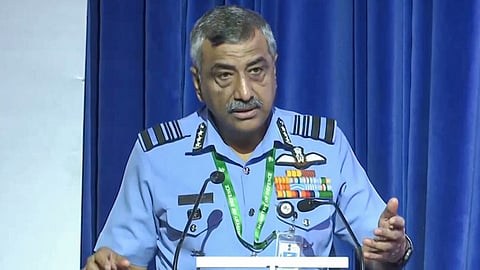
IAF chief says India 'couldn't respond' after 26/11, highlights 'new normal' in terror response
Air Chief Marshal Ashutosh Dixit on Thursday said India had moved towards a new approach to responding to terror attacks, contrasting the country's inability to retaliate after the 2008 Mumbai attacks with its subsequent military responses.
Speaking at an event to commemorate the 18th anniversary of the 26/11 attacks, the Indian Air Force (IAF) chief cited Operation Sindoor as the strongest example of India's changed counter-terrorism posture.
"It happened in 2008, and we could not give a response. But after that, whatever events like this have happened, we have been able to give a befitting response. The best response you have seen was in Operation Sindoor, which is still ongoing," Dixit said.
He described the approach as a deterrent against those responsible for terror attacks and said India hoped the strengthened deterrence would prevent such incidents in the future.
'Terror and talks cannot go together'
Dixit said the country's new approach reflected Prime Minister Narendra Modi's stated position that terrorism and dialogue could not proceed simultaneously.
"After this, we have created this new normal, as our Prime Minister has stated that terror and talks will not go together, water and blood will not flow together, and the differentiation between a terrorist and his supporter will no longer be there," he said.
The Air Chief Marshal added that the armed forces were prepared to act under this approach.
"It's a very great thing, and we are all prepared to do this. So, hopefully, given the amount of deterrence which we have now created, such events should not happen at all," he said.
Operation Sindoor followed Pahalgam attack
Operation Sindoor was launched on May 7, 2025, in response to the Pahalgam terror attack of April 22, in which 26 people, including tourists, were killed.
India carried out airstrikes against terror infrastructure in Pakistan and Pakistan-occupied Kashmir (PoK). Pakistani forces subsequently launched attacks on Indian military and civilian installations, prompting New Delhi to intensify its military response.
Indian missiles struck deep inside Pakistan and targeted military bases. The hostilities continued for several days before Pakistan's Director General of Military Operations (DGMO) contacted his Indian counterpart on May 10 and requested a halt to military action.
The two sides agreed to stop firing and military operations on land, air and sea. Indian officials have described the operation as halted rather than concluded, while Dixit referred to it as ongoing.
26/11 remains a reminder of the need to protect the nation
Dixit paid tribute to the 166 people killed in the Mumbai terror attacks and remembered the police personnel, National Security Guard (NSG) commandos, security forces and civilians who confronted the attackers.
"Today is 26 November. It is a day no Indian can forget. Eighteen years ago today, terrorists attacked the city. A total of 166 innocent people lost their lives," he said.
He praised those who fought the attackers, noting that several made the supreme sacrifice while protecting Mumbai and the country.
"I pay homage to every life we lost, and to every braveheart who laid down his life protecting Mumbai and the nation. I also remember their families, who have carried that loss with great dignity for 18 years," he added.
The Air Chief Marshal also invoked the Constitution, noting that November 26 is observed as Constitution Day. He said the Constitution defines the nation and places a duty on every citizen to defend the country and render national service when called upon.
"The events of 2008 (26/11 attacks) remind us that this nation must be protected by every one of us," he said.
IAF chief calls for self-reliance and a developed India
Dixit also spoke about India's ambitions to become a developed nation and strengthen its role in global affairs.
"We want to be a developed country, we want to be Atmanirbhar, we want to have a great say in global affairs, and we want to make every person in India feel very proud that they are part of Bharat. That is the vision of Viksit Bharat," he said.
Addressing young people, he highlighted India's demographic advantage, noting that nearly 65 per cent of the population is below the age of 35 and the median age is around 29.
He said the country's youth would play a crucial role in nation-building and urged them to develop skills, contribute to innovation and support India's journey towards self-reliance.
Dixit also cautioned against misinformation, including fake news, doctored images and deepfakes, urging young people to verify information before sharing it.
He said national security was a collective responsibility involving not only the armed forces but also scientists, engineers, entrepreneurs, doctors and teachers.
The Air Chief Marshal concluded that the best tribute to those who lost their lives in the 26/11 attacks would be to build a strong, self-reliant and united India.


