.png)
‘Did you raise salaries or create jobs?’ PM Modi questions companies after tax cuts
Prime Minister Narendra Modi on Thursday, November 19, questioned Indian companies over whether they had increased employee salaries or expanded their workforce after the government reduced corporate taxes and provided income tax relief to individuals. Addressing industry leaders at the centenary convention of the Federation of Indian Chambers of Commerce and Industry (FICCI) in New Delhi, he urged businesses to ensure that the benefits of government reforms reached employees and the wider economy.
“I have waived income tax on the Rs 12 lakh bracket, but did you increase salaries or the number of employees? ‘Modi ji aap karo hum dekh lenge’, is this how things will function?” Modi asked, drawing laughter from the audience.
The Prime Minister said the government had taken significant decisions to reduce the tax burden despite knowing that the measures might not fully satisfy industry leaders. He pointed out that the basic corporate tax rate, which stood at 30% in 2014, had been reduced to 22%. He also referred to the income tax relief under which individuals earning up to Rs 12 lakh annually pay no income tax under the new tax regime, subject to applicable conditions.
Modi said the relief had substantially increased people's purchasing power and called on businesses to recognise the government's efforts by creating more jobs and improving employee compensation.
“Friends, we had the courage to provide such a massive relief in income tax. This has significantly increased the purchasing power of our people,” he said.
PM Modi highlights faster tax refunds and simpler filing
The Prime Minister also pointed to changes in income tax administration, saying the government had simplified return filing and refund procedures to prevent taxpayers from having their money unnecessarily held up.
Recalling the delays under the earlier system, he said taxpayers once had to wait several months for official communication. “Earlier, you must remember, it used to take eight months for a letter to arrive. Today, does a return get processed within a week or not?” he asked.
The changes, he said, were part of the government's broader effort to improve ease of doing business and make the tax system more taxpayer-friendly.
‘India First’ should guide long-term investments
Moving beyond taxation, Modi urged Indian businesses to look beyond the domestic market and strengthen their presence in international markets. He said India's large consumer base should give companies the confidence to compete globally rather than become a comfort zone that discourages innovation and expansion.
“In every long-term investment decision of yours for the next 20 years, make India First your foundation,” he told industry leaders.
The Prime Minister said businesses must prepare for future national and global demand by developing capabilities in areas where India has the resources and potential to manufacture goods. He also called on companies to make use of opportunities created by India's trade agreements and invest in understanding the requirements of customers in different international markets.
Modi cautioned businesses against assuming that India's domestic market would automatically absorb whatever they produced. He said companies should focus on improving product quality and ensure that Indian consumers receive the same standards of goods as customers abroad.
He criticised the practice of marketing products to Indian consumers as “export quality”, asking why people in the country should have to be told that a product meets international standards before considering it good.
“The domestic market must not become our comfort zone. It should provide us with the confidence to compete in global markets,” he said.
PM flags India's dependence on imported pharmaceutical ingredients
Modi called for reducing India's dependence on imports and building domestic manufacturing capabilities in sectors where the country already has a strong industrial base.
Citing the pharmaceutical industry, he said India had earned a global reputation as the “pharmacy of the world” through its production of finished medicines. However, it continued to import billions of dollars' worth of active pharmaceutical ingredients (APIs), bulk drugs and drug intermediates.
“In finished medicines, we have strength. Now we will have to build our capabilities in ingredients as well,” he said.
He urged pharmaceutical companies to identify ingredients that could be manufactured domestically and invest in the technology needed to produce them.
The Prime Minister also questioned India's approach to agricultural trade, saying the country exported raw wheat but imported processed products such as bread. He argued that businesses should invest in value addition and food processing rather than depend heavily on imports.
Modi pointed out that India's share of global agricultural exports remained only around 2-2.5%, despite its size and agricultural potential. He said corporate investment in agriculture and allied sectors was still inadequate and called on industry to treat food processing as a major business opportunity.
He also noted that the share of processed food in India's agri-food exports had increased from 13% to more than 20% over the past 12 years.
Manufacturing, engineering exports and global opportunities
Modi urged Indian companies to explore opportunities in sectors such as hand tools, power tools, machinery manufacturing, packaging equipment, irrigation systems and factory-related machinery.
He said India's share in global exports of hand tools and power tools remained relatively small, leaving considerable room for expansion. Large companies, he suggested, could help smaller manufacturers develop the quality and production capacity needed to compete internationally.
He also called for greater investment in machinery that could meet the requirements of developing countries, particularly those in the Global South.
The Prime Minister said the current international environment, in which access to resources and supply chains had become increasingly important, made domestic manufacturing capabilities essential for safeguarding India's economic future.
He urged businesses to identify imported products that could be manufactured in India and build the necessary technology and production capacity.
Modi cites poverty reduction, exports and growth projections
Highlighting India's economic performance, Modi said the country had moved from being counted among the world's “Fragile Five” economies to becoming the fastest-growing major economy.
Citing a recent World Bank report, he said around 50 crore Indians had moved out of poverty over the past 12-13 years.
He also pointed to India's merchandise exports, which reached nearly $50 billion in October, describing the figure as the country's highest monthly goods export performance.
The Prime Minister said international institutions, including Moody's Ratings, S&P Global Ratings, Fitch Ratings, the World Bank and the Asian Development Bank, had revised their growth projections for India upwards. He said the economy was expected to grow at around 7%.
“Developed India is not a slogan; it is a commitment,” Modi said, calling on businesses to play a greater role in the country's long-term development.
FICCI marks 100 years
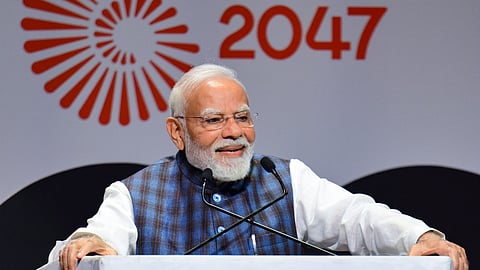
Modi was addressing FICCI's Annual General Meeting and Annual Convention at Bharat Mandapam in New Delhi. The event, themed ‘Bharat 2047’, brought together more than 2,500 delegates, including industry leaders, chief executives, ambassadors, diplomats and policymakers.
Founded in 1927, FICCI is completing 100 years of its establishment in 2027. The Prime Minister said the organisation's ability to evolve with changing times and contribute to India's economic journey over a century was a significant achievement.
He also invited industry leaders to share suggestions for further reforms without hesitation, saying the government was willing to work with businesses to improve the country's investment and business environment.
Modi said India's growth story was creating new opportunities and that Indian industry needed to be prepared to seize them. He urged companies to make national interests central to their investment decisions while expanding manufacturing, creating employment and competing in global markets.


