.png)
"How dare you?" | Rahul Gandhi slams universities for issuing 'no protest' advisory to students

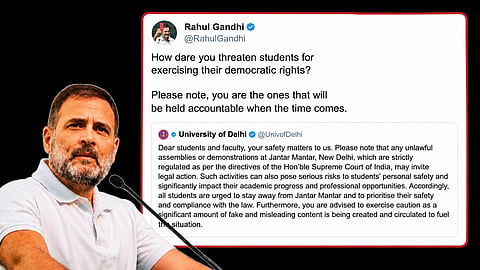
Leader of Opposition Rahul Gandhi on Friday criticised Delhi University's advisory asking students to stay away from the ongoing protests at Jantar Mantar, accusing the institution of intimidating students for exercising their democratic rights.
In a post on X, Gandhi questioned the university's decision to caution students against joining demonstrations demanding the resignation of Union Education Minister Dharmendra Pradhan over alleged examination paper leaks and reforms in the education system. "How dare you threaten students for exercising their democratic rights?" Gandhi wrote, adding that those responsible for issuing such warnings "will be held accountable when the time comes."
The remarks came a day after Delhi University issued a public advisory urging students to avoid what it described as "unlawful assemblies" at Jantar Mantar. The university cited Supreme Court directions regulating protests in the area and warned that participation could expose students to legal consequences, compromise their personal safety and adversely affect their academic and professional prospects. The advisory also cautioned students against misinformation circulating on social media, asking them to remain vigilant against misleading content related to the protests.
Delhi University is not the only higher education institution to issue such a warning. Jawaharlal Nehru University (JNU) on Friday released a similar advisory, asking members of its academic community to refrain from participating in demonstrations around Jantar Mantar and to prioritise their personal safety. The university also reminded students to exercise restraint on social media, warning that violations could attract disciplinary action under institutional rules as well as legal consequences under applicable laws. The advisories have triggered criticism from political leaders, academics and public figures, who argue that universities should protect students' constitutional freedoms rather than discourage peaceful participation in democratic movements.
Actor and filmmaker Pooja Bhatt criticised the Delhi University advisory, saying students' safety is better protected by safeguarding their right to express themselves rather than suppressing dissent. She argued that silencing student voices would do little to secure their future. Congress MP and Delhi University alumnus Deepender Hooda also questioned the legal basis of the advisory. He challenged the university's characterisation of demonstrations at Jantar Mantar as "unlawful," asking which Supreme Court ruling had declared all assemblies at the designated protest site to be illegal.
The controversy follows similar developments at other premier educational institutions. Earlier this week, IIT Roorkee circulated an advisory reminding students, faculty and staff not to participate in political movements or issue public political statements without prior permission from the institute. After criticism, the institute clarified that the communication was part of its routine annual code of conduct circulated at the beginning of every academic session and was not linked specifically to the ongoing protests.
Separately, a student at IIT Madras claimed that the institute's administration had asked students to remove social media posts expressing solidarity with the protest movement. According to a message circulated among students, the instruction was conveyed through faculty after the dean allegedly intervened. The institute has not officially commented on the claim.
The advisories come amid continuing demonstrations led by the Cockroach Janata Party (CJP), which has been spearheading protests over alleged examination paper leaks and broader reforms in the recruitment and examination system. While activist Sonam Wangchuk has ended his hunger strike following assurances from the Centre, protest organisers have said the movement will continue until their principal demands, including the resignation of the education minister, are addressed.
The growing number of advisories from universities has added a new dimension to the debate, raising questions over where institutions should draw the line between ensuring student safety and respecting their constitutional rights to free expression and peaceful assembly.

