.png)
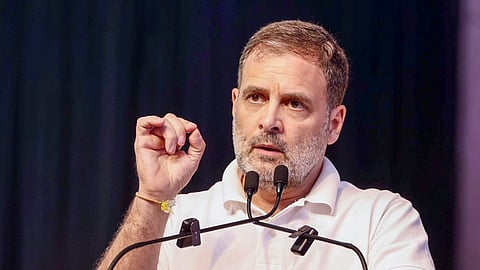
Govt hiding reality of foreign surveillance via CCTVs, apps; people's security at risk: Rahul

Congress leader Rahul Gandhi on Saturday alleged that the Modi government is putting the security of every Indian at risk by attempting to "cover up its own failures" and concealing the reality of foreign surveillance through Chinese cameras installed at vital locations.
"This is a deliberate conspiracy to keep India in the dark," he said in a post in Hindi on Facebook.
Gandhi said the government recently banned the public use of Chinese CCTV cameras.
"Yet, Chinese cameras remain installed inside government buildings. Banned Chinese apps are resurfacing under changed names. Foreign AI platforms are processing sensitive data. And the government has absolutely nothing to say about this," he said.
The leader of opposition in Lok Sabha said he asked these questions in Parliament to the Ministry of Electronics and IT.
"The response offered plenty of verbiage, but provided no answers to the specific questions asked," he claimed.
"From which countries did our cameras originate? How many of them are certified from a security point of view? Which foreign AI platforms are processing government data? Which banned apps continue to operate under altered names?
"The ministry's response contained no figures, no answers -- not even the name of a single platform," Gandhi said.
The Congress leader said five years after acknowledging that the ten lakh Chinese cameras used by the government posed risks regarding data transfer, the government has still failed to disclose whether the cameras monitoring us today are secure or not.
"By attempting to cover up its own failures and conceal the reality of foreign surveillance, the Modi government is putting the security of every single citizen at risk," Gandhi said.
Gandhi had asked an unstarred question in the Lok Sabha on March 25 and the Minister of State for Electronics and Information Technology Jitin Prasada responded that the Government of India is conscious of the cybersecurity risks posed by digital technologies.
"In last 12 years, numerous efforts have been made to strengthen India's digital ecosystem, outlined below," Prasada said.
He had listed several steps taken by the government on the "use of technology for espionage" in response to Gandhi's question, which included protecting India's telecom networks, strengthening the legal framework on network security and data protection and strengthening the security of CCTV systems.
The minister said telecom networks are the most critical part of digital infrastructure. "In 2021, the government undertook a decisive step to implement the National Security Directive on Trusted Sources. It ensures that telecommunication equipment only from the trusted sources is deployed in the telecom networks in the country."
"The government has strengthened the legal framework pertaining to network security and data protection. The government has notified the Telecommunication Act, 2023, containing extensive provisions for security of telecommunication networks in the country and the Digital Personal Data Protection Act, 2022, containing legal framework to ensure protection of personal data," he said.
On the strengthening security of CCTV systems, the minister said, "The government has undertaken major reforms for strengthening the security of CCTV systems and notified the mandatory Essential Requirements required for CCTVs in the Indian market."

