.png)
ECI sets fresh timeline for ASDD voters to rejoin electoral rolls across seven states
The Election Commission of India (ECI) has issued a revised schedule for providing another opportunity to electors marked absent, shifted, dead or duplicate (ASDD) during the ongoing Special Intensive Revision (SIR) of electoral rolls to seek inclusion in the final voters' list.
Under the fresh instructions issued on Tuesday, November 17, enumeration forms for ASDD electors must be generated and printed by November 18. Their distribution and collection will take place between November 18 and 30, while the forms must be disposed of by December 10.
The directions have been sent to the Chief Electoral Officers (CEOs) of Delhi, Maharashtra, Telangana, Andhra Pradesh, Nagaland, Haryana and Jharkhand. The revised schedule follows delays in implementing the mechanism announced on November 6, which had remained largely inactive for around 10 days, with ground-level work initially beginning only in Delhi and Jharkhand.
The ECI has also revised the SIR timeline for six of the seven states and Union Territories, keeping Delhi's schedule unchanged. The notice phase and disposal of claims and objections will conclude on December 15, while the final electoral rolls are scheduled to be published on December 22.
The Commission has directed officials to publicise the revised schedule through all available media and ensure that the decision is communicated to everyone concerned.
Fresh opportunity for electors excluded from draft rolls
The November 6 decision had given electors marked ASDD, whose enumeration forms were not received during the initial exercise and whose names were consequently excluded from the draft rolls, another opportunity to seek inclusion in the final electoral list.
The arrangement allows them to submit fresh enumeration forms instead of having to apply through Form 6, the statutory application generally used for first-time voter registration. Those whose applications are accepted will retain the same Elector Photo Identity Card (EPIC) number they held before the SIR, treating them as existing electors rather than new applicants.
The four ASDD categories together account for approximately 130 million of the 134 million electors removed from rolls across the country during the SIR exercise.
In its latest communication, the ECI has directed officials to display fresh booth-wise lists of electors marked absent, shifted, dead or duplicate at the notice boards of their respective polling stations. These lists will cover those whose enumeration forms were not returned and whose names were therefore left out of the draft electoral rolls.
Electors will also be able to download and fill in their enumeration forms through the ECI website or the ECINET application by entering the EPIC number they held before their names were deleted.
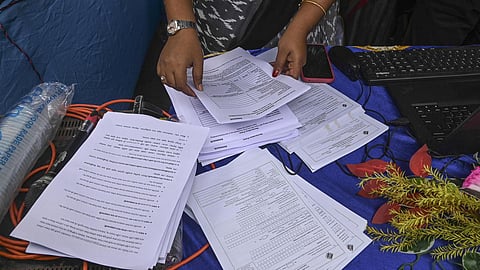
Partially filled forms will be generated afresh on the Electoral Registration Officer's (ERO) dashboard on ECINET. Booth-level officers (BLOs) have been instructed to contact the affected electors through house-to-house visits, coordinating with booth-level agents of political parties.
Different procedures for voters who have not moved and those who have shifted
The Commission has laid down separate procedures depending on whether an elector has changed their place of residence.
Electors who continue to live at the same address must submit the signed enumeration form along with a statement explaining why they could not return it during the earlier round.
Those who have shifted residence within the same state must submit the enumeration form with a separate statement mentioning their new address, along with address proof, to the ERO of their new constituency. They will not be required to submit Form 8 for the change of address.
For homeless electors, a field verification report prepared by the concerned BLO will be accepted as proof of residence.
The ECI has also clarified that electors who have already submitted Form 6 during the SIR exercise do not need to submit fresh enumeration forms. Their applications will be processed under the Commission's earlier clarification.
The CEOs have been asked to issue instructions to all district election officers, EROs and BLOs for immediate compliance, establish monitoring mechanisms and submit action-taken reports to the Commission at the earliest.
Process yet to begin in several states
The fresh instructions came after implementation of the November 6 mechanism remained uneven across the seven states and Union Territory.
As of Tuesday, the process was yet to begin in at least four regions: Maharashtra, Andhra Pradesh, Telangana and Haryana. The status in Nagaland was unclear.
In Haryana, around 3.38 million electors were removed under the ASDD categories. Additional CEO Raj Kumar said the process would begin only towards the end of the week, as officials were awaiting the printing of enumeration forms. He said printing could take another five to six days.
Telangana recorded around 7.3 million deletions under the ASDD categories. However, the CEO's office said that only the Form 6 route was being used and that no fresh enumeration forms had been printed. A spokesperson told HT that voters were continuing to use Form 6 to get their names restored to the rolls.
In Delhi, around 4.7 million electors were excluded from the draft roll. Nearly 9.5 million fresh enumeration forms were being printed, with one copy to be retained by the BLO and another, carrying an acknowledgement of receipt, to remain with the elector.
The Delhi Chief Electoral Officer's office has since announced a fresh opportunity for approximately 43.32 lakh excluded electors to submit enumeration forms. The special exercise is intended to facilitate their inclusion in the final electoral roll, with BLOs also tasked with reaching out to affected voters.
Meanwhile, petitioners Anjali Bhardwaj and Amrita Johri wrote to the ECI on Monday, alleging "flagrant non-compliance" with its November 6 directions. Responding to the concerns, an EC official said the process had begun and that electors could use enumeration forms along with the prescribed declaration to seek restoration of their names.
Jharkhand, where approximately 4.36 million electors were removed under the ASDD categories, had already started the process. Additional CEO Subodh Kumar said enumeration forms were available to voters left out of the draft roll and that a special drive would be conducted on Wednesday to help them complete the process.
Form 6 controversy and Supreme Court intervention
The fresh mechanism follows weeks of scrutiny in the Supreme Court over the treatment of voters excluded from Delhi's draft electoral roll.
Form 6 is the statutory application under the Registration of Electors Rules, 1960, used by eligible citizens seeking first-time inclusion in the electoral roll. Its declaration requires applicants to state that they are enrolling for the first time and that their names do not appear in any other constituency.
Making a false declaration is punishable under Section 31 of the Representation of the People Act, 1950, with imprisonment of up to one year, a fine, or both.
The form became controversial during the SIR exercise because electors who had been registered for years but were excluded from the draft rolls were being asked to apply afresh as new voters. The ECI subsequently clarified that such applicants would not face punishment for submitting Form 6 to seek inclusion.
The November 6 decision came after the Supreme Court raised concerns over the process. The draft electoral roll published in Delhi on August 31 had removed around 4.7 million names from approximately 14.5 million electors.
During a hearing on October 28, the bench questioned why people who had already been registered as voters should have to use Form 6 to regain their place on the rolls. It suggested that they be allowed to restore their names through Form 8, which is used for changes of address, or through the enumeration process.
The court also asked the ECI to devise a mechanism to reach voters whose names had been omitted, observing that the right to vote should not be forfeited merely because an elector was absent during the enumeration exercise.
On November 3, the ECI clarified that electors deleted from the draft rolls could still submit Form 6 to seek fresh registration, even if they had previously been enrolled. Citing an October 14 Delhi High Court judgment, the Commission said concerns about applicants making false declarations were misplaced.
The issue also came under scrutiny before the Bombay High Court at Goa on November 9. A division bench comprising Justices Valmiki Menezes and Amit Jamsandekar said existing voters who had only changed their addresses could not be compelled to submit Form 6, which is meant for first-time registration. The court held that they must be allowed to use Form 8 even while the SIR exercise is underway.
The latest ECI directions seek to provide a separate route for ASDD electors to submit their details again and have their names considered for inclusion in the final electoral rolls.


