.png)
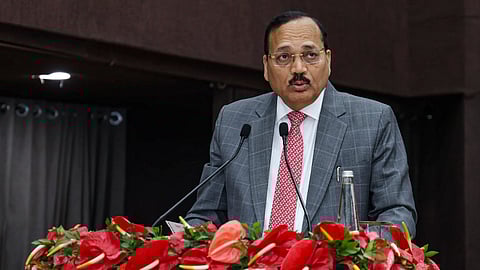
CJI pitches for energy justice as 'moral architecture' for India's growth

CJI Justice Surya Kant on Saturday emphasised that the only defensible development is one that is environmentally responsible and stressed that India's growth must be aligned with ecological sustainability and the principles of energy justice.
He said that the country must be prepared and equipped to undertake a delicate balancing exercise between "our pursuit of development and our fidelity to a greener future".
Addressing the International Conference on Sustainable Energy: An agenda for India @2047, he stressed that India's vision for 2047 must be grounded in justice. "The way I see it, must synchronise economic growth with ecological sensibility. This is because, as a nation, we are still very much on our development journey, and therefore we cannot afford to treat environmental protection and economic progress as a binary choice."
Stressing that energy justice is not an "alien concept" imported from the developed world, the Chief Justice of India said, "It is the moral architecture that allows a rising nation such as ours to grow without compromising what belongs to every citizen: clean air, clean water, and a livable future."
Highlighting the constitutional basis for this balance, the CJI said both development and environmental protection are embedded within Article 21, and "the genius of our constitutional framework lies in its insistence that development and environmental protection must proceed together."
He said that he has been emphasising with increasing conviction that the only defensible development is one that is environmentally responsible. Courts cannot afford to look through a narrow keyhole that treats every project as suspect, but nor can they adopt a complacent approach that treats environmental safeguards as negotiable.
"Our task is to move from a purely reactive model to one that integrates environmental protection into the very design of development -- not as an afterthought, but as a foundation," Justice Kant said.
Underlining the evolving role of the judiciary, he said, "We no longer simply say, if you pollute, you will pay. The question we now ask is far more demanding: Have you done everything reasonably possible to avoid polluting in the first place?
The CJI pointed to the doctrine of continuing mandamus as a key procedural innovation enabling courts to monitor environmental compliance over time, citing the MC Mehta cases as examples of sustained judicial intervention in issues ranging from air pollution and river cleaning to forest and wildlife protection.
Referring to a recent decision, he said the court allowed construction of a road to a paramilitary hospital despite the need to fell 700 trees, but ordered compensatory afforestation over 185 acres and planting of 1.75 lakh trees, describing it as a "balanced and restorative approach."
"Our judicial approach now strives to reconcile competing interests through calibrated, context-sensitive solutions ensuring that development imperatives are pursued within the framework of accountability, restoration and long-term ecological stewardship," the CJI said.
Justice Kant also outlined four pillars of energy justice--affordability, accessibility, equity and inclusiveness-- emphasising that clean energy must not become "a privilege for the few" and that communities must be active participants in policy-making.
On the regulatory front, he said the Electricity Act, 2003, has played a crucial role in shaping India's energy sector through market reforms and the creation of regulatory commissions, but noted that several mechanisms such as renewable purchase obligations and green tariffs remain underutilised.
"It is imperative that legislative decision-making addresses these gaps to ensure a more robust, capable and future-ready regulatory ecosystem - one that not only facilitates growth but aligns it with broader sustainable development objectives," he added.

