.png)
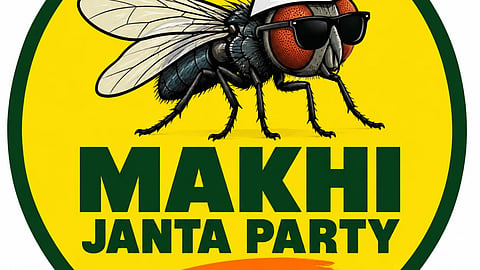
After CJP, ‘Makhi Janta Party’ emerges following CJI’s ‘hammer to kill a fly’ remark
A new satirical outfit, the Makhi Janta Party (MJP), has surfaced on social media following Chief Justice of India Surya Kant’s “hammer to kill a fly” remark, echoing the rise of the Cockroach Janta Party (CJP), which began as a satirical response to an earlier comment by the Chief Justice and subsequently evolved into a protest movement.
The MJP claimed on Tuesday that it had garnered more than 40 lakh views and over 330,000 followers on Instagram within 72 hours. Its social media account identifies a student named Aaryan as its founder, while a story posted on the page said the outfit was looking for spokespersons.
According to the account information, the Instagram page was created in June 2021 and had changed its username eight times before adopting its current handle, makhijantaparty.ig.
How CJI’s ‘hammer to kill a fly’ remark inspired MJP
The MJP said its name was inspired by the Chief Justice’s recent observation while questioning the rationale behind a proposed blanket shutdown of public transport in Delhi ahead of the CJP protest on October 10.
During a hearing on October 9, a Supreme Court bench led by CJI Surya Kant, along with Justices Joymalya Bagchi and V Mohana, stressed that regulating public transport and stopping it altogether were two different things.
“One can regulate but it is completely different to put a halt on everything…you cannot stop everything,” the bench observed, cautioning authorities against excessive restrictions. The court expressed concern over the proposed closure of 57 Delhi Metro stations and the cancellation of trains ahead of the protest, emphasising that security measures should remain proportionate to the anticipated threat.
The MJP used the remark to frame its satirical identity. In a post, it wrote: “Jab CJI ne hi kaha, ‘Can't use hammer to kill a fly!’ ab to makkhi bhi bolegi hum bhi kisi se kum nahi”, which translates to: “When the CJI himself said, ‘Can't use a hammer to kill a fly’, now even the fly will say it is no less than anyone else.”
The comment has provided the basis for the outfit’s name, with “Makhi” meaning fly in Hindi. Its emergence follows the trajectory of the CJP, which gained traction after the controversy surrounding the use of the word “cockroaches” for a section of young people.
MJP expresses solidarity with CJP and Neha Bora
The MJP has also expressed solidarity with the CJP and Neha Bora, president of the All India Students’ Association (AISA), who has been protesting against Chief Election Commissioner Gyanesh Kumar.
In a statement on Instagram, the outfit praised Bora’s “courage and determination”, arguing that raising questions and demanding accountability were essential to democracy. It also acknowledged that the recent protest had been held without the required permission from the authorities, urging citizens to exercise their right to protest responsibly and in accordance with the law.
The MJP further said it was trying to contact the CJP to explore the possibility of adopting a common position or coordinating action, subject to mutual agreement between the two outfits.
The outreach signals a possible attempt to connect the newer satirical group with the movement that inspired its emergence, although no agreement between the organisations has been confirmed.
Outfit questions detention of CJP leaders at Jantar Mantar
In another statement issued on Tuesday, Aaryan, identified as the MJP’s founding president and a student, questioned the detention of CJP leaders Ashutosh Ranka and Saurav Das after they breached security restrictions at Jantar Mantar and hoisted the Indian flag.
Pointing out that Jantar Mantar is a designated protest site, the statement questioned the purpose of restricting demonstrations to locations far removed from public attention.
“So what's the point of a protest site if people can't make their voices heard where it matters?” it asked.
“Democracy needs dialogue, not distance,” the statement added, reiterating the outfit’s support for peaceful protests, democratic rights and public participation.
The remarks reflect the MJP’s position that the right to protest must be accompanied by opportunities for citizens to make their concerns heard in public spaces. At the same time, the group’s statement acknowledged the importance of conducting demonstrations within the law.
From online satire to a wider protest movement
The MJP’s emergence draws parallels with the CJP, which developed from an online satirical response to the controversy over the term “cockroaches” into a wider movement associated with protests and demands for political accountability.
The CJP gained prominence following the controversy over alleged examination irregularities and demonstrations at Jantar Mantar in July, which the supplied account links to the resignation of Education Minister Dharmendra Pradhan.
The latest development comes amid protests against Chief Election Commissioner Gyanesh Kumar over allegations concerning electoral processes and voter-list revisions. The Election Commission has faced criticism from protesters, while the authorities have maintained that security and legal requirements must be considered when permitting demonstrations.
With its name drawn from the Chief Justice’s latest metaphor, the MJP appears to be following a similar path of using satire to draw attention to political and public issues. Whether it develops beyond its social media following into a broader protest movement, or coordinates with the CJP, remains to be seen.


