.png)
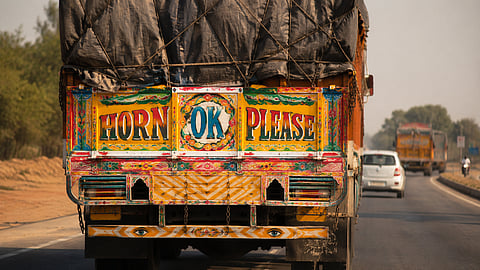
Seen ‘Horn OK Please’ on trucks? Here’s how the phrase reportedly originated
If you have spent any time on Indian roads, chances are you have seen the words ‘Horn OK Please’ painted across the back of a truck. The colourful phrase has become a familiar part of road culture, but its supposed origins are linked to a much more serious warning from the past.
How ‘Horn OK Please’ reportedly began
An influencer couple, Rajat and Isha, who are known as ‘chartered couple’ on Instagram, recently shared a video explaining the story behind the phrase.
According to their account, the wording dates back to World War II, when fuel shortages led to kerosene being used in Indian trucks. The fuel was considered more volatile than diesel, making accidents potentially dangerous.
“You will find this single line written on every Indian truck: ‘Horn OK Please.’ You have likely seen it thousands of times, but have you ever wondered what the ‘OK’ in the middle stands for? After all, it could have simply been ‘Horn Please’ or ‘Please Horn’. So, why ‘OK’? The answer lies in World War II,” the influencer wondered.
He said, “In the 1940s, the British were shipping India's diesel supply to Europe for their army, leading to a diesel shortage in India.”
He added, “Consequently, kerosene was used as an alternative fuel to operate Indian trucks. Kerosene is far more volatile than diesel; even a minor collision could cause the truck to explode like a bomb.”
From ‘On Kerosene’ to ‘OK’
The explanation says trucks carried the warning "Horn Please On Kerosene" to alert vehicles approaching from behind about the fuel being used.
“Over time, people stopped writing 'On Kerosene,' leaving only the two letters ‘OK’. Indians began placing this between ‘Horn’ and ‘Please,’ resulting in the phrase ‘Horn OK Please’,” he added.
A 2010 release by Mahindra Truck and Bus was cited as confirming the theory.
Why Maharashtra banned the phrase
The sign has also faced restrictions. The Maharashtra government banned ‘Horn OK Please’ in 2015, according to reports.
The state's transport department believed the wording could encourage drivers to honk whenever they approached a truck or tempo, potentially promoting unnecessary use of horns.


