.png)
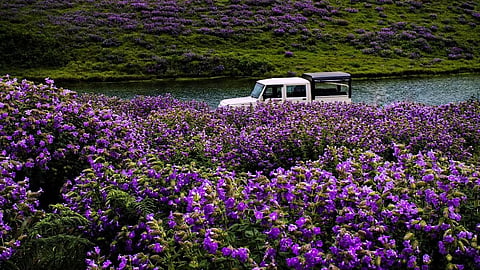
Munnar witnesses rare Neelakurinji bloom, a natural spectacle seen once in 12 years

The hills of Munnar in Kerala have turned shades of purple and blue as the rare Neelakurinji flowers come into bloom, drawing attention from nature lovers and travellers. Images and videos of the flowering have also been widely shared on social media.
Known scientifically as 'Strobilanthes kunthiana', Neelakurinji is found in parts of the Western Ghats, particularly across the hills of Kerala, Karnataka and Tamil Nadu. Its distinctive blue-purple flowers and unusual blooming pattern make it one of the region's most remarkable natural sights.
Why Neelakurinji blooms are so rare
Neelakurinji is known for flowering in large numbers only once every 12 years. During the bloom, entire stretches of hills can appear to be covered in a purple-blue carpet.
Reports this time have said that the flowers in Munnar have appeared four years earlier than their expected cycle.
The unusual timing is linked to the plant's life cycle. Neelakurinji follows a monocarpic, or plietesial, cycle, meaning the plant spends more than a decade growing and reaching maturity before flowering on a large scale.
After flowering, the plant produces seeds and dies. The mass flowering also helps the species survive. With so many seeds produced at the same time, predators and pollinators cannot consume all of them, allowing enough seeds to remain for the next generation.
Admire the flowers, but don't pluck them
The spectacular sight comes with an important restriction. Neelakurinji is a protected plant under the Wildlife (Protection) Act, and plucking or damaging the flowers is prohibited.
The rule came into focus after two young boys reportedly plucked the flowers and shared photographs of them on social media. The Forest department registered a case after the photographs came to its attention, following directions from the Munnar Divisional Forest Officer.
According to the Forest department, violating the law by plucking or destroying the flowers can attract imprisonment of up to three years, a fine of up to Rs 25,000, or both.
For visitors, the rare bloom is therefore a sight to be observed and photographed without disturbing the plants.

