.png)
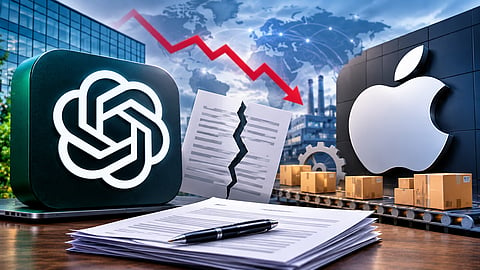
OpenAI countersues Apple, accuses iPhone maker of stealing trade secrets and pressuring suppliers
OpenAI has escalated its legal battle with Apple, accusing the iPhone maker of using its influence over suppliers to obstruct the development of the artificial intelligence company's planned hardware products and imposing restrictive employment agreements to discourage engineers from joining competitors.
In counterclaims filed on Friday in a federal court in San Jose, California, OpenAI also accused Apple of misappropriating its trade secrets. The filing turns a lawsuit initiated by Apple into a broader legal dispute, with both companies now accusing each other of taking confidential information and attempting to restrict access to talent and resources.
The counterclaims were filed in the case Apple v. Liu, 5:26-cv-07078, before the US District Court for the Northern District of California. The defendants' filing reportedly contains 12 counterclaims, involving OpenAI, its hardware unit io Products and two former Apple employees.
OpenAI alleges Apple pressured suppliers
OpenAI alleged that Apple has been using its influence over shared industry suppliers to make it harder for the AI company to develop and manufacture its own devices. According to the filing, Apple has pressured vendors to disclose details of their OpenAI projects, including the names, locations and assignments of employees who have previously worked with the iPhone maker.
OpenAI claimed that Apple subsequently seeks to prevent workers with experience at the AI company from being assigned to further projects for the iPhone maker. It alleged that this discourages suppliers from committing employees, production resources and managerial attention to OpenAI's work.
The filing cited the example of a supplier offering specialist finishing services that shifted manufacturing work for OpenAI products to the night shift to avoid overlapping with production for Apple. The move allegedly increased OpenAI's costs and was made following pressure from the iPhone maker.
OpenAI also claimed that suppliers had expressed concern about losing Apple's business. Some had reportedly moved or rescheduled meetings with the AI company to avoid being seen working with it, while others had warned OpenAI staff to be cautious about allocating resources to its projects.
The company argued that Apple's market power over suppliers and engineers should not be used to exclude competing businesses from the market.
Dispute over Apple's employment agreements
OpenAI's counterclaims also challenge Apple's employment agreements, alleging that certain provisions make it difficult for engineers to leave the company and join competitors.
One provision under scrutiny prevents former Apple employees from soliciting or recruiting the company's workers for a year after leaving. OpenAI argued that the restriction limits its ability to hire experienced engineers from the iPhone maker.
The AI company has also challenged Apple's intellectual property agreements, or IPAs, which employees are required to sign. It alleged that these agreements define confidential information so broadly that they cover virtually all non-public information employees learn during their time at Apple, even when it does not qualify as a trade secret.
According to OpenAI, the provisions could restrict former employees from using professional skills and experience acquired during their careers and expose them to the risk of legal action. It argued that the threat of expensive and intrusive litigation could discourage employees from moving to rival companies.
OpenAI has also alleged that Apple encourages employees to use personal devices and accounts for work-related communications, while retaining access to those accounts after they leave. The company claims that such practices can be used to monitor and intimidate employees moving to competitors. OpenAI said around 400 Apple employees had joined it.
OpenAI accuses former employee of sharing confidential files
The counterclaims further accuse Apple of obtaining confidential information about OpenAI's unreleased hardware through a former employee who had previously moved from Apple to the AI company before returning to the iPhone maker.
OpenAI alleged that the former employee sent more than 100 highly confidential files relating to at least one unreleased device to personal accounts. The material reportedly included images of unreleased hardware, engineering and manufacturing data, as well as information about suppliers.
Apple said it has policies to prevent employees from using confidential information belonging to former employers and that it had found no evidence to substantiate OpenAI's allegations.
Apple's original lawsuit against OpenAI
The counterclaims come months after Apple sued OpenAI and its chief hardware officer, Tang Tan, in July, accusing the ChatGPT maker of orchestrating a campaign to obtain its trade secrets through job candidates and former employees.
Apple alleged that OpenAI employees used a stolen Apple-issued laptop to access confidential information. It also claimed that they exploited a rare, previously unknown authentication flaw to gain access to the company's shared network.
The iPhone maker further alleged that OpenAI had asked candidates who were still employed by Apple to bring actual Apple hardware components to job interviews.
The lawsuit also names former Apple engineer Chang Liu, who joined OpenAI in January. Apple claimed that Liu accessed confidential hardware-related files over several weeks while working on devices for the AI company, after discovering an authentication bug that allowed him to access Apple's information.
Apple has argued that its case is backed by extensive evidence of employees deliberately accessing and using confidential information about unreleased technologies, products and processes.
OpenAI has denied wrongdoing and asked the court to dismiss Apple's lawsuit. In October, it voluntarily agreed not to use the trade secrets Apple alleges were taken, after a judge indicated that he was likely to issue an order restricting their use.
Apple, meanwhile, described OpenAI's counterclaims as a transparent attempt to distract from the substance of its lawsuit. The company said the dispute concerns the deliberate theft, access and use of its secret and confidential information, rather than the inadvertent retention of material belonging to it.
Jony Ive's hardware plans add to rivalry
The dispute has emerged as OpenAI prepares to enter the consumer hardware market, potentially placing it in direct competition with Apple. The AI company is working with former Apple design chief Jony Ive on a family of devices, with an expected doughnut-shaped smart speaker among the products reportedly being developed.
The two companies had previously worked together to integrate ChatGPT into Apple's iPhone, iPad and Mac software. However, their relationship has cooled as OpenAI has pursued plans to develop its own hardware products.
The latest counterclaims widen the dispute beyond the alleged misuse of trade secrets, bringing supplier relationships, employee mobility and access to specialist manufacturing resources into focus. Both companies have accused the other of attempting to gain an unfair advantage as competition in the technology and AI hardware markets intensifies.
The allegations made by both sides remain claims in an ongoing legal dispute and have not been established by a court.


