.png)
Your favourite Delhi restaurant could soon get an 'A' or a 'D'—here's why
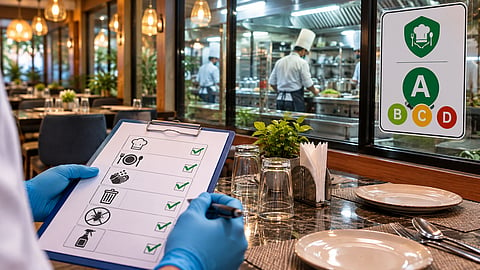
Delhi's restaurants are set to be rated on hygiene standards under a new inspection framework introduced by the Municipal Corporation of Delhi (MCD). Inspired by the public grading system used in New York, the initiative will assign eateries grades ranging from 'A' to 'D', allowing customers to check a restaurant's hygiene record before deciding to dine there.
Under the revised rules, every restaurant will be required to display its Hygiene Rating Certificate prominently at the entrance. Failure to do so will be treated as a violation of licence conditions.
New inspection system replaces decades-old process
The updated framework replaces inspection practices that had largely remained unchanged since 1964.
Each establishment will begin with a score of 100 during inspections. Points will be deducted for violations, with one point for every minor lapse, four points for each major violation and 10 points for every critical violation. Restaurants scoring between 90 and 100 will receive Grade 'A', 75 to 89 will be awarded Grade 'B', 60 to 74 will get Grade 'C', while any score below 60 will result in Grade 'D'. Any establishment found with two or more critical violations will automatically receive Grade 'D'.
Explaining the objective, an MCD official told PTI, "The grading system is intended to increase transparency. Customers will be able to see how an establishment performed during inspections, while businesses that maintain higher standards will also benefit."
Focus shifts to food safety and staff hygiene
The inspection process will now cover a wider range of hygiene and food safety checks instead of primarily reviewing documents.
Officials will assess food preparation and storage, kitchen sanitation, cleanliness of utensils and equipment, hand hygiene of food handlers, pest control, waste segregation, ventilation, first-aid facilities and the overall health of kitchen staff.
Food handlers will also be required to wear clean uniforms and head coverings, maintain proper hand hygiene, avoid jewellery while preparing food and stay away from kitchen duties if suffering from fever, diarrhoea or skin infections. Restaurants must also maintain written standard operating procedures for food preparation, cleaning and waste disposal.
High-risk outlets to face more frequent checks
The MCD has also introduced a risk-based inspection model, classifying food businesses as high, medium or low risk based on seating capacity, nature of operations, compliance history, complaints and previous enforcement action.
Large banquet halls, food courts and establishments with a history of serious violations will be inspected more frequently, while low-risk outlets with a good compliance record are expected to undergo inspections once a year or whenever complaints are received.
Describing the changes, an official told PTI, "Earlier, inspections followed a fairly uniform format and could often be completed within minutes. Under the revised system, inspections will be carried out using a standardised checklist and may take up to an hour depending on the type of establishment. The focus is on identifying actual public health risks rather than simply reviewing documents."
The revised guidelines came into effect last month and also include operational standards for cloud kitchens, takeaway outlets, food courts, dhabas, catering units and terrace dining facilities.


