.png)
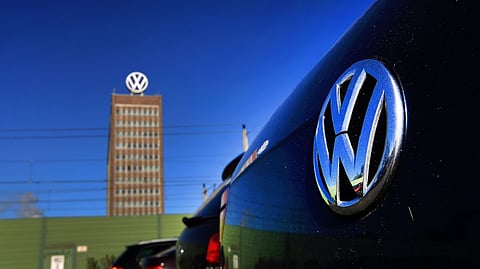
Volkswagen's $3.5B gamble | Can it win back share in the competitive Chinese market

Volkswagen is making a high-stakes bet on China — the world’s largest and one of its most fiercely competitive auto markets. Whether the gamble will pay off remains an open question.
The German carmaker, which once commanded more than 50% market share in China, has invested €3 billion ($3.5 billion) in a sprawling research and development centre in Hefei, a central Chinese city of around 10 million people. The facility is Volkswagen’s largest R&D hub outside Germany and marks a sharp departure from how foreign automakers have traditionally operated in China.
For decades, global carmakers sold vehicles designed overseas, sharing technology with local joint-venture partners. That model has been overtaken by fast-rising Chinese automakers that have aggressively cut prices, accelerated innovation and eroded the dominance of foreign brands.
“This business model is now gone,” said Thomas Ulbrich, Volkswagen Group’s chief technology officer in China.
‘The Chinese consumer is king’
In what Ulbrich describes as a paradigm shift, Volkswagen began overhauling its China strategy in 2022. The company is now developing vehicles specifically for Chinese customers — models that are unlikely to be sold in Europe, though they could later reach markets in the Middle East and Southeast Asia.
As these new models roll out, Volkswagen will find out whether its investment can help it catch up with domestic leaders such as BYD and Geely, and stabilise its shrinking market share.
The strategy is essential for maintaining competitiveness in China, said Rella Suskin, an equity analyst at Morningstar covering European automakers. However, she cautioned that while it may help Volkswagen hold its current position, it is unlikely to restore the market share lost in recent years.
The larger question, analysts say, is profitability. China’s hypercompetitive auto market has driven prices to levels that have pushed some players into bankruptcy.
Racing to catch up
Audi, part of the Volkswagen Group, has already taken a bold step by launching a new China-focused brand called “AUDI”, spelled entirely in capital letters. Volkswagen itself is preparing to launch new 2026 models developed “in China, for China,” as the company puts it.
“It’s a million-dollar question whether this strategy will pay off,” said Claire Yuan, director of corporate ratings for China autos at S&P Global Ratings. “We need to monitor execution, but they are on the right path to catching up.”
Foreign automakers have struggled largely because China’s market has transformed at extraordinary speed over the past five years. Electric vehicles now account for roughly half of new car sales, and buyers expect advanced digital features — from large touchscreen displays to driver-assistance systems that can autonomously park a car.
Volkswagen’s traditional models increasingly failed to match those expectations in a market that represents about one-third of its global sales, four decades after it first entered China through a joint venture with state-owned SAIC.
For years, the Santana and Jetta sedans were ubiquitous — staples of taxi fleets and first-time car buyers. Today, survival depends on revamping line-ups at what the industry calls “China speed.”
In China, said Bill Russo, CEO of Shanghai-based consultancy Automobility, new electric vehicles can go from concept to showroom in 12 to 18 months, compared with three to five years for global automakers.
“The pace is not a choice — it’s a necessity,” Russo said. “That pressure fuels global competitiveness.”
From manufacturing hub to innovation centre
Volkswagen’s transformation mirrors China’s broader evolution. In the mid-1990s, Ulbrich worked in northeastern China, where Volkswagen manufactured cars with FAW (First Auto Works), importing most components because local suppliers lacked capacity.
Thirty years later, nearly everything is made in China — and increasingly, designed there.
To accelerate development, Volkswagen’s headquarters has devolved decision-making authority to its China operations. Other foreign automakers have taken different paths: some have downsized or exited entirely, while others are following a similar localisation strategy.
Japan’s Toyota, for instance, has granted its China teams “unprecedented autonomy in product planning and development,” according to S&P’s Yuan.
Volkswagen is also seeking to absorb expertise from China’s EV startups. It has partnered with Xpeng to speed up model launches and co-develop its own electronic architecture — the software backbone that controls a vehicle’s functions.
The shift reflects a growing recognition that innovation now flows both ways.
“Knowledge flows are a two-way street between China and Germany,” said Martin Hofmann, a Volkswagen executive who chairs the German Chamber of Commerce in North China.
In a recent chamber survey, about half of the more than 600 responding companies said they expect Chinese competitors to become innovation leaders within five years — while 9% said that has already happened.
For Volkswagen, the Hefei bet represents not just a bid to survive China’s auto wars, but an acknowledgement that the future of the global car industry is increasingly being shaped inside China itself.

