.png)
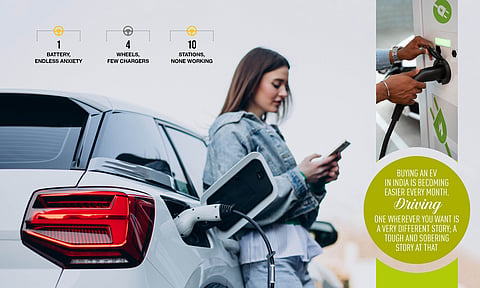
India’s EV boom has a roadblock | Charging chaos on the highways
India’s car-buyer has always been an optimist. Every generation has willingly embraced change, be it the transition from carburettors to fuel injection, manual gearboxes to automatics or BS-IV to BS-VI emission norms. Today, that optimism is powering yet another revolution: Electric Mobility.
Walk into any showroom and you realize that an electric vehicle has never been easier. Auto firms have expanded their portfolios, battery ranges have improved, government incentives have nudged buyers in the right direction and charging cables now come neatly packed in bottomless boots. For wannabe buyers, especially amid continuing concerns over the compatibility of E20 fuel with internal combustion engines, an EV appears to be the logical and safe step.
Then comes the first long drive. Suddenly, the conversation is no longer about torque, touchscreen displays or driving range. It is about charger availability, charging speed, connector compatibility, payment apps and whether the next charging station would actually be working. Buying the car, it dawns on you, is the easy part. Living with it is far more adventurous.
Missing Ecosystem
To be fair, India’s EV journey deserves applause. Vehicle technology has advanced at a remarkable pace. Modern electric cars are quieter, quicker and more refined than many sceptics imagined even a few years ago. Battery chemistry continues to improve, driving ranges are increasing and almost all manufacturers now consider electrification central to their future.
The problem lies elsewhere. In an India that has built an EV market faster than it has built an EV ecosystem. A conventional fuel station inspires confidence because motorists never ask whether it will be operational. They pull in, refuel in a few minutes, pay and accelerate away.
Charging an electric vehicle, on the other hand, resembles a treasure hunt. Drivers consult multiple mobile applications, compare user reviews, call charging operators, calculate battery percentages and hope that the station shown on a digital map is functional when they finally arrive. But hope is not infrastructure.
Range vs Reality
The phrase ‘range anxiety’ has become synonymous with electric vehicles. Ironically, it no longer accurately describes the problem. Most modern EVs offer respectable driving ranges for everyday use. The real anxiety stems not from how far the car can travel, but from uncertainty about everything that follows.
Will the charging station be occupied? Will it deliver the promised fast-charging speeds or trickle electricity into the battery while daylight quietly gives way to darkness? Will the payment gateway cooperate? Is the connector compatible? Is the location well-lit and secure enough for a family travelling after sunset?
Far too many EV owners recount stories of arriving at charging stations only to discover equipment that is out of service, painfully slow or plain inaccessible. Some describe spending hours inside parked vehicles late into the night, waiting for enough charge to continue their journey, because nearby alternatives either do not exist or cannot be relied upon.
The irony is difficult to miss. We have built vehicles capable of whisper-quiet acceleration, connected them to satellites and smartphones and equipped them with AI. Yet, a weekend drive can still hinge on whether a charging unit beside a dhaba decides to cooperate. Technology has galloped ahead. Infrastructure is trying to trot in its wake.
Beyond the Plug
Charging stations cannot be viewed merely as electrical installations. They are becoming the roadside service stations of tomorrow. A petrol or diesel vehicle spends barely five minutes at a fuel pump. An EV may remain at a charger for 30 minutes, or much longer. That changes everything. Drivers need restrooms, safe parking, seating areas, cafés, convenience stores, adequate lighting and security. Families travelling with children or elderly passengers require comfort and reassurance, not uncertainty and inconvenience.
Equally important is information. Despite India’s achievements in digital infrastructure, there remains no single authenticated, universally accepted repository of charging stations that provides real-time information on availability, operational status, charging speeds, connector types and payment options across operators. Instead, EV owners navigate a maze of proprietary apps, crowdsourced reviews and social media recommendations before venturing onto unfamiliar highways.
Planning a road trip should involve choosing destinations, not conducting forensic investigations into charging infrastructure.
Way Beyond Cars
None of this should be interpreted as an argument against electric mobility. Quite the contrary. Electric vehicles are a critical part of India’s automotive future. They promise cleaner cities, lower dependence on imported fossil fuels and exciting opportunities for domestic manufacturing. Their momentum is unlikely to (and should not) be reversed.
But revolutions are not measured merely by the number of units sold. They are judged by the confidence they inspire. The true benchmark for India’s EV transition will not be monthly sales figures or the number of models launched. It will be the day when a family can set out from Delhi to Jaipur, Bengaluru to Mysuru, Mumbai to Goa or Chennai to Coimbatore without checking half a dozen charging apps, calculating contingency plans or silently praying that the next charging station is operational.
The automobile industry has built cars that are ready for tomorrow. The challenge now belongs to everyone else. Governments must accelerate the creation of reliable charging networks. Charging operators must be held to standards of uptime, maintenance and transparency. Urban planners must integrate charging into future infrastructure rather than treat it as an afterthought. Technology platforms should work towards interoperable payment systems and a unified, authenticated national database of charging stations.
Electric mobility ultimately runs on batteries. But public confidence runs on certainty. Until charging an EV becomes as predictable and effortless as refuelling a conventional vehicle, India’s electric revolution will remain a journey of immense promise, but one frequently interrupted by a blinking battery icon and an uncomfortable wait on the side of the highway.


