.png)
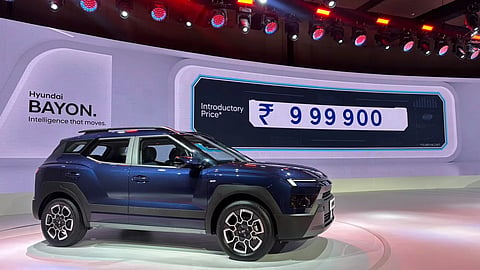
Hyundai Bayon launched at Rs 10 lakh in India; CNG version scheduled for January
Hyundai Motor India on Monday launched the new Bayon SUV at a starting price of Rs 9.99 lakh (ex-showroom), expanding its presence in India's competitive midsize SUV market. Positioned below the popular Creta, the Bayon will be available in seven trims, with prices extending up to Rs 18 lakh for the top-end variant.
The new model is Hyundai's second offering in the midsize SUV segment and is aimed at buyers seeking a combination of modern technology, safety equipment and everyday practicality at a relatively accessible price.
Bookings are open for Rs 11,000 through Hyundai's dealerships and official website, while deliveries have commenced. The Bayon is being manufactured at the company's Chennai facility in both right-hand-drive and left-hand-drive configurations, with exports planned for more than 50 international markets.
Prices and variants
The Hyundai Bayon is available in seven trims, comprising HX2, HX3, HX3+, HX5, HX6, HX8 and HX10, with a total of 11 manual and automatic variants.
The entry-level HX2 manual is priced at Rs 10 lakh, while the HX3 and HX3+ cost Rs 10.90 lakh and Rs 11.80 lakh, respectively. The HX5 manual is priced at Rs 12.45 lakh, while its automatic version costs Rs 13.85 lakh.
The HX6 is priced at Rs 13.57 lakh for the manual and Rs 14.97 lakh for the automatic. The HX8 costs Rs 15.10 lakh and Rs 16.54 lakh, respectively, while the top-end HX10 is priced at Rs 16.65 lakh for the manual and Rs 18 lakh for the automatic.
The Bayon's starting price is approximately Rs 91,000 lower than that of the Creta, allowing Hyundai to target buyers at the lower end of the midsize SUV segment.
Engine and performance
The Bayon is powered by a 1.5-litre, four-cylinder, naturally aspirated petrol engine that produces 115hp and 144Nm of torque. The same engine is also available in the Hyundai Creta.
Buyers can choose between a six-speed manual gearbox and a continuously variable transmission (CVT), which Hyundai markets as its Intelligent Variable Transmission.
The automatic version comes with Eco, Normal and Sport driving modes, along with paddle shifters and a Dash Boost function designed to improve acceleration response during overtaking.
Hyundai claims a fuel efficiency of 18.6 kilometres per litre for the CVT version, based on ARAI certification.
The company has also confirmed that a CNG-powered version of the Bayon will be introduced in January 2027. However, diesel and turbo-petrol engine options are not available.
Exterior design and dimensions
The Bayon follows Hyundai's latest Art of Steel design philosophy, featuring a sculpted bonnet, prominent wheel arches, sharp body lines and extensive black cladding.
The front fascia incorporates LED projector headlamps and L-shaped daytime running lights that also function as turn indicators. Unlike several recent Hyundai models, the Bayon does not feature a full-width LED light bar.
The SUV gets 17-inch alloy wheels, conventional door handles and a distinctive rear design with slim LED tail-lamps connected by a black panel. A roof spoiler and dual-tone rear bumper complete the exterior styling.
The Bayon measures 4,245mm in length, 1,810mm in width and 1,605mm in height, with a wheelbase of 2,600mm.
It offers 205mm of ground clearance and a 505-litre boot, providing considerable luggage capacity for family use.
Hyundai is offering the model in 10 exterior colour options, including six monotone shades, two dual-tone combinations and two matte finishes.
Technology and comfort features
Inside, the Bayon features a dual-tone black-and-grey cabin with two 12.3-inch displays integrated into a curved panoramic dashboard arrangement.
The displays serve as the digital instrument cluster and infotainment touchscreen, while a separate panel houses the air-conditioning controls.
Hyundai has retained physical buttons and rotary controls for several frequently used functions, including steering-mounted controls and infotainment shortcuts.
The Bayon also introduces Hyundai's generative AI voice assistant, developed using technology from Perplexity and SoundHound AI. According to the company, the system supports conversational voice commands rather than relying exclusively on predefined instructions.
Other equipment includes ventilated front seats, powered driver's seat adjustment, a Bose sound system, wireless smartphone charging, ambient lighting, rear air-conditioning vents, reclining rear seats and a panoramic sunroof.
The SUV also offers Hyundai Bluelink connected-car technology and over-the-air software updates.
Safety and driver assistance
The Bayon is built on Hyundai's Global K Enhanced Platform, which the company says has been engineered to meet five-star Indian crash-test safety standards.
However, the vehicle's Bharat NCAP crash-test rating has not yet been announced, with results expected later this year.
Safety equipment includes six airbags, electronic stability control, hill-start assistance, a tyre-pressure monitoring system, all-wheel disc brakes and an electronic parking brake with auto-hold functionality.
Higher variants also offer a 360-degree camera and Hyundai SmartSense Level 2 Pro advanced driver assistance technology, comprising 23 functions.
These include forward collision warning, automatic emergency braking, lane-keeping assistance, blind-spot collision avoidance and highway driving assistance.
Competition in midsize SUV segment
The introduction of the Bayon gives Hyundai a second model in the midsize SUV category, allowing it to compete across a wider price range without relying exclusively on the Creta.
The new SUV will compete with the Maruti Suzuki Victoris and Grand Vitara, Kia Seltos, Tata Sierra, Honda Elevate, Skoda Kushaq, Volkswagen Taigun and MG Astor.
With its lower starting price, petrol engine, extensive equipment list and upcoming CNG option, the Bayon is expected to strengthen Hyundai's position in one of India's most competitive passenger vehicle segments.


