.png)
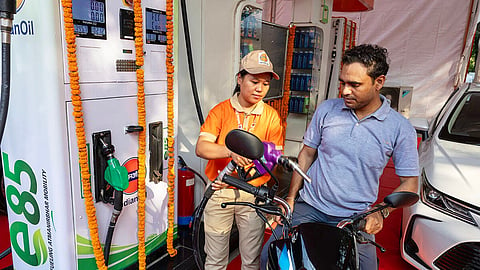
E85 fuel launched. Is your current vehicle useless now? | No plan to phase out regular petrol yet

The launch of E85 fuel by the Centre has triggered confusion among vehicle owners, with social media platforms flooded with claims that conventional petrol and diesel may soon be phased out. Several posts suggested that motorists would be compelled to switch to E85 fuel, raising concerns about the future of existing vehicles.
The government, however, has moved to dispel these fears. Union Petroleum and Natural Gas Minister Hardeep Singh Puri clarified that E85 is intended only for a specific category of automobiles and does not signal the end of petrol-powered vehicles currently on the road.
Introduced on World Environment Day, E85 contains a significantly higher proportion of ethanol than the E20 fuel currently available across the country. While E20 consists of up to 20 per cent ethanol blended with petrol, E85 contains between 80 and 85 per cent ethanol, with the remainder being conventional petrol. The fuel has been positioned as part of India's broader push towards cleaner energy and reduced dependence on imported crude oil.
Experts note that E85 cannot be used in ordinary petrol vehicles. The fuel is designed exclusively for flex-fuel vehicles (FFVs), which are equipped with engines capable of operating on varying ethanol-petrol blends. Using E85 in vehicles not designed for it could potentially damage engine components and affect performance.
To encourage adoption of flex-fuel technology, the government has priced E85 lower than regular petrol. In Delhi, the fuel is being sold at ₹82.12 per litre, making it nearly ₹20 cheaper than conventional petrol. Officials also claim that widespread use of E85 could substantially reduce greenhouse gas emissions compared with traditional fossil fuels.
Addressing concerns over the future of existing vehicles, Puri said E20-compatible vehicles would continue to operate normally and there are no plans to discontinue petrol supplies. He emphasised that E20 and E85 serve different vehicle categories and that fuel stations dispensing E85 would prominently indicate that it is meant only for compatible flex-fuel vehicles.
The minister also highlighted the experience of countries such as Brazil, where high-ethanol fuels have been used successfully for decades. According to him, expanding the use of ethanol-based fuels would support farmers through increased demand for feedstock, strengthen India's energy security, and contribute to the country's environmental goals.
Government officials maintain that the introduction of E85 is an additional fuel option rather than a replacement for existing fuels, and that motorists driving conventional petrol vehicles have no reason to worry about immediate changes to fuel availability.

