.png)
Supreme Court to hear plea on Delhi-NCR air pollution crisis on December 17 — Here's all we know

A Supreme Court bench comprising Chief Justice of India Surya Kant and Justices Vipul M. Pamcholi and Joymalya Bagchi has listed a hearing on the worsening air pollution situation in Delhi-NCR for December 17, news agency PTI reported on Monday.
“This is coming up before a three-judge Supreme Court bench on Wednesday (December 17). It will come up,” the Chief Justice said.
Delhi air pollution: What is the hearing about?
The bench took note of submissions made by senior advocate Aparajita Singh, who is assisting the court as amicus curiae. She told the court that while several preventive measures have been put in place to address air pollution, weak implementation by authorities remains a major concern. She added that compliance with existing protocols often lags until the court issues specific directions.
Another lawyer drew the court’s attention to an application highlighting the health impact of pollution on children. The counsel submitted that despite earlier Supreme Court orders, several schools were continuing to conduct outdoor sports activities.
“Despite the order of this court, schools have found ways and means to hold sporting activities. It is taking place. The Commission for Air Quality Management (CAQM) is again citing the order of this court,” the amicus said.
What has the Supreme Court said?
Responding to the submissions, Chief Justice Surya Kant observed that the court was fully aware of the gravity of the problem and stressed the need for issuing directions that are capable of being implemented on the ground.
“We know the problem, and let us pass orders which can be complied with. There are some directions which can be forcibly imposed. In these urban metropolitan cities, people have their own lifestyle. But the poor…,” the Chief Justice said, trailing off.
At this point, the amicus curiae intervened to underline that poor labourers and daily-wage workers are among the worst affected by the air pollution crisis.
In an earlier observation, the Supreme Court had clarified that pleas related to air pollution cannot be treated as “customary” matters to be taken up only during the peak winter months. The bench had said it would hear such matters twice every month to explore both short-term and long-term solutions to the problem.
Delhi AQI slips deeper into ‘severe’ zone
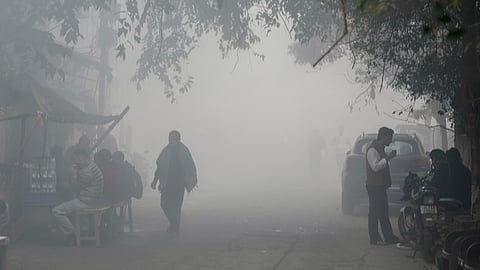
Meanwhile, Delhi continued to choke under a dense layer of smog on Monday, with the Air Quality Index (AQI) settling at 498 — placing it at the higher end of the ‘severe’ category.
Out of the 40 air quality monitoring stations in the city, 38 recorded ‘severe’ air quality, while two stations reported ‘very poor’ levels. Jahangirpuri emerged as the most polluted area, recording an AQI of 498.
According to the Central Pollution Control Board (CPCB), an AQI of 0–50 is considered ‘good’, 51–100 ‘satisfactory’, 101–200 ‘moderate’, 201–300 ‘poor’, 301–400 ‘very poor’, and 401–500 ‘severe’.
The AQI in the national capital had already climbed to 461 on Sunday, marking Delhi’s most polluted day so far this winter and the second-worst December air quality reading on record. Officials attributed the spike to weak winds and low temperatures, which trapped pollutants close to the surface.

