.png)
Supreme Court seeks replies from Rahul Gandhi, Kharge over October 12 march to court
The Supreme Court on Tuesday sought responses from Leader of the Opposition in the Lok Sabha Rahul Gandhi and Congress president Mallikarjun Kharge over a petition questioning their alleged role in an October 12 march to the court premises that resulted in a large gathering and allegedly left a pregnant woman journalist injured.
A bench headed by Chief Justice of India Surya Kant directed the Centre and the private respondents named in the petition, including Gandhi and Kharge, to file their replies. The court posted the matter for November 23.
The petition was filed by a group of lawyers led by Digant Mishra, seeking guidelines to regulate processions, protests, demonstrations and assemblies in the vicinity of the Supreme Court and other constitutional courts.
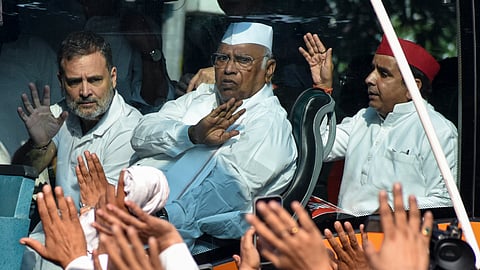
Appearing for the petitioners, senior advocate Gaurav Bhatia alleged that Opposition leaders, led by Gandhi, took out a march on October 12 that proceeded inside the Supreme Court premises. He said the procession resulted in a large gathering of lawyers and their supporters within the court complex, triggering serious security concerns.
Bhatia further alleged that a woman journalist, who was three months pregnant at the time, was pushed by Gandhi during the gathering and sustained injuries, following which she had to be hospitalised. He also moved an application seeking registration of an FIR against the Congress leader.
Gandhi and Kharge to file responses
Senior advocate Abhishek Manu Singhvi, appearing for Gandhi and Kharge, told the bench that he would submit their responses to the petition.
“I only request that irresponsible statements should not be made before the court takes up the matter. We will be filing our response,” Singhvi said.
The petition has also named Samajwadi Party leader Akhilesh Yadav, the Commissioner of Police, the Centre, the Supreme Court Registry and the Indian National Congress as respondents.
Solicitor General Tushar Mehta, appearing for the Centre, assured the court that the government's response would be filed before the next hearing. He also urged the bench to hear the matter alongside a separate petition filed by the Network of Women in Media, which has highlighted instances of alleged sexual harassment faced by women journalists while covering protests in the national Capital.
Petition seeks ban on political protests inside court complexes
Bhatia told the court that the petition seeks the creation of a neutral framework to regulate processions, demonstrations and assemblies in and around the judicial complexes of constitutional courts.
Among the key demands is an absolute prohibition on political protests inside judicial premises. The petition also seeks guidelines specifying the standards of decorum to be maintained by political parties and their leaders within court campuses.
The plea argues that unregulated political gatherings in judicial complexes could compromise security, disrupt court functioning and undermine the dignity and independence of judicial institutions.
The Supreme Court's directions came amid concerns over the conduct of protests near judicial premises and the safety of journalists covering political demonstrations in Delhi.


