.png)
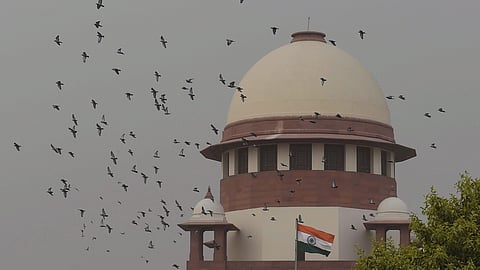
Supreme Court seeks nationwide report on illegal river sand mining, warns rivers cannot be restored
The Supreme Court on Tuesday directed the Central Empowered Committee (CEC) to submit a report on illegal sand mining across the country, observing that rivers, once destroyed, cannot be compensated.
The direction widened the scope of the apex court's ongoing proceedings on illegal sand mining, which began with reports of rampant extraction in the Chambal river inside the National Gharial Sanctuary.
A bench of Justices Vikram Nath and Sandeep Mehta said the issue required a pan-India approach and directed the expert environmental body assisting the court to examine river sand mining across the country.
“There is a measure of control the states must exercise while enforcing orders on sand mining in rivers. Nature takes care of itself but when you put obstacles, it becomes a problem. Ultimately, rivers will be destroyed, and once destroyed, they cannot be compensated,” the bench said.
The court also pulled up Rajasthan and Madhya Pradesh over their failure to identify the organised gangs allegedly behind large-scale illegal extraction.
Court warns Rajasthan of possible blanket ban
The Supreme Court told Rajasthan that despite earlier directions to identify and act against the alleged kingpins of the illegal sand-mining mafia operating across state borders, not a single such gang had been identified.
The court also noted that seized vehicles had been released after payment of fines.
“We want to inform you that a blanket ban on sand mining will be imposed in Rajasthan. We will not allow the rivers of the state to be destroyed in this manner,” the bench told the state.
The matter has been posted for November 4. The bench gave Rajasthan two weeks to instruct its officials and warned that if the situation remained unchanged, it could order a total ban on sand mining across all rivers in the state.
The court was hearing a suo motu proceeding initiated after news reports highlighted continuing illegal sand mining in the Chambal river despite several earlier judicial orders.
Goel informed the court that forest ranger Pratap Singh Chundawat was crushed to death last month by a dumper allegedly carrying illegally mined sand while he was on duty.
The bench also recalled that Rajasthan had previously imposed a total ban on sand mining between 2018 and 2021. During that period, consumers faced difficulties because sand is in high demand for construction.
“We will not tolerate such a lacklustre response by the states. There has to be proactive action on your part. Our orders were very clear. Yet, we are told by the amicus that they have hardly been respected or followed,” the bench said.
Ken River petition raises fresh concerns
The court also considered a separate petition alleging rampant illegal sand mining in the Ken River and sought a response from Madhya Pradesh.
The petition questioned how huge excavators and sand-pulling pumps had been installed in the river when there was no government contract for sand mining.
The wider proceedings are being assisted by senior advocate Nikhil Goel and advocate Rupali Fransesca Samuel as amicus curiae. They submitted a note detailing compliance with the Supreme Court's directions concerning the Chambal sanctuary issued in May and July this year.
The court had taken suo motu cognisance of illegal sand mining in the Chambal Gharial Sanctuary earlier this year and issued a series of directions to Rajasthan, Madhya Pradesh and Uttar Pradesh, which share the sanctuary's boundaries.
The states were directed to strengthen surveillance, identify and track illegal mining routes and protect frontline forest personnel. In its July 22 order, the court also directed the states to consider preventive detention against the alleged kingpins of organised gangs involved in illegal sand mining.
CEC flags surveillance and enforcement gaps
The CEC has previously highlighted several weaknesses in the enforcement mechanism and recommended a series of measures to address illegal mining in the National Chambal Gharial Sanctuary.
Its recommendations have included stronger surveillance through CCTV, PTZ cameras and AI-enabled thermal cameras, regular reviews of surveillance infrastructure and checkposts, additional frontline personnel, and an integrated digital database of habitual offenders.
The committee has also recommended district-level enforcement and monitoring committees, AI-enabled surveillance by the National Highways Authority of India, greater protection for forest personnel and stronger accountability among district authorities.
The CEC also flagged the lack of adequate legal protection for forest officials who confront organised sand-mining groups, which it said may possess sophisticated weapons.
It pointed to Section 218(3) of the Bharatiya Nagarik Suraksha Sanhita, which requires prior sanction before a public servant can be prosecuted for an offence committed in the discharge of official duty. The CEC recommended similar protection for forest guards, citing experience in Odisha and Assam where such safeguards have produced positive results.
Other recommendations included filling vacancies among forest guards, providing adequate financial support for surveillance infrastructure, regularly upgrading technology, conducting periodic ecological monitoring, enforcing strict district-level accountability and ensuring continuous coordination between states.
The CEC has also suggested that the Supreme Court consider developing a uniform national framework for protecting riverine protected areas from illegal sand mining and related activities. The Court had earlier deferred consideration of this recommendation because of its wider ramifications.
Chambal habitat faces continuing degradation
The Supreme Court's proceedings began after reports highlighted extensive illegal sand mining in the National Chambal Gharial Sanctuary. The Court took suo motu cognisance in March 2026 after reports described severe degradation of habitats of protected aquatic species, including the endangered gharial.
A May 25 report by HT showed that mining had continued near the Chambal river despite court orders. The riverbank inside the sanctuary, once an important nesting site for critically endangered gharials and accounting for nearly 80 to 90% of the global wild gharial population, had been degraded, with deep pits scattered across the floodplain.
The CEC has also raised concerns about maintaining adequate environmental flows in the Chambal and its tributaries. It has recommended a basin-level scientific assessment involving the Wildlife Institute of India, the Ministry of Jal Shakti, the Central Water Commission and the concerned states to determine the minimum environmental flows required to maintain the river's ecological integrity.
In its July order, the Supreme Court recorded recommendations covering surveillance, enforcement, ecological monitoring, alternative livelihoods, M-sand manufacturing units, licensed sand storage depots and stronger protection for forest officials.
Sanctuary spans three states
The area along the Chambal river was designated a wildlife sanctuary in 1978 and spans Rajasthan, Madhya Pradesh and Uttar Pradesh.
The Chambal is home to the largest population of gharials. Within the demarcated boundary of the National Gharial Sanctuary are 173 villages in Madhya Pradesh, 260 in Rajasthan and 130 in Uttar Pradesh.
The Supreme Court's latest direction comes as it expands its scrutiny from the continuing crisis in the Chambal to illegal river sand mining as a nationwide environmental concern.


